
By VFuturMedia Staff | December 6, 2025
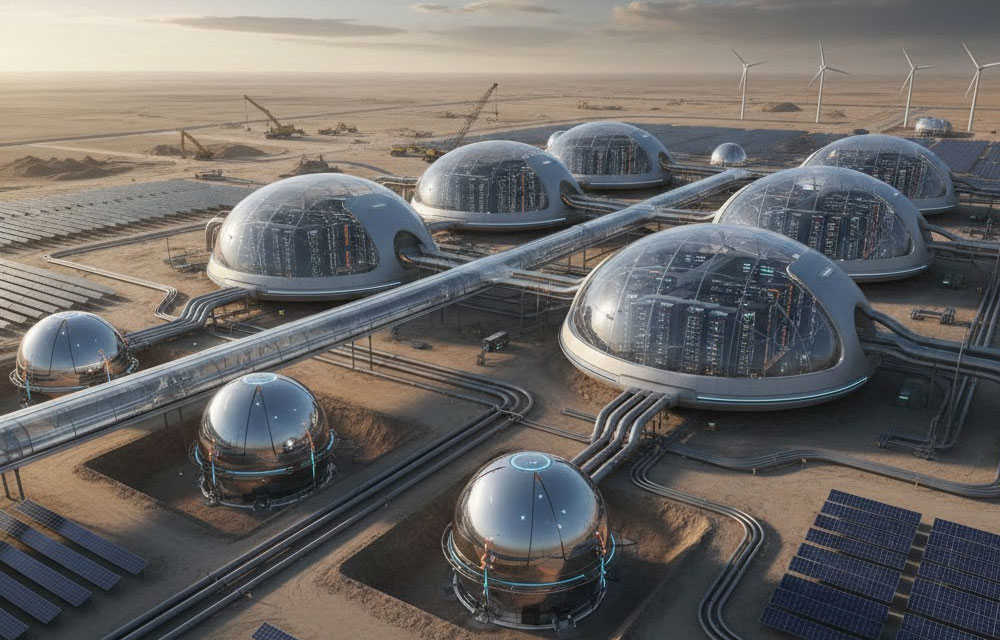
The unstoppable rise of artificial intelligence is triggering a full-blown energy crisis. By 2026, global data centers powering AI could demand up to 1,050 terawatt-hours of electricity, nearly quadruple today’s consumption and equal to the entire power usage of Japan. The International Energy Agency’s latest forecast warns of 945 TWh by 2030, with AI workloads driving most of the surge. Without radical solutions, sustainable AI 2026 will remain an oxymoron, threatening climate goals, water supplies, and grid stability worldwide.
The Numbers Behind the Crisis
- Global data center electricity demand expected to hit 945–1,050 TWh by 2030, doubling from 2024 levels in just six years
- AI queries already use 10 times more energy than traditional search; a single ChatGPT-style conversation consumes as much power as an LED bulb left on for 20 minutes
- U.S. data centers alone could account for 6–8% of national electricity by 2030, with AI responsible for 35–50% of that total
- Ireland’s grid warns data centers could consume 35% of the country’s power by 2026
- Training one large language model can emit as much CO₂ as five cars over their entire lifetimes
Earth’s Hidden Toll
Carbon emissions from AI data centers could reach 24–44 million metric tons per year by 2030, equivalent to adding 5–10 million cars to American roads. Water cooling for these facilities is projected to drain 4.2–6.6 billion cubic meters annually by 2027, half of the United Kingdom’s total yearly water use. In drought-hit regions like Texas and Arizona, that volume rivals the daily needs of cities with 50,000 residents.
Land use is exploding too: sprawling hyperscale campuses cover hundreds of acres of impermeable concrete, fragment wildlife habitats, and generate mountains of toxic e-waste as servers are replaced every three to five years.
Efficiency Targets Every Company Must Hit in 2026
Power Usage Effectiveness (PUE): drop from today’s average of 1.58 to under 1.2 Water Usage Effectiveness (WUE): reduce from 1.8 liters per kWh to below 0.5 liters Carbon Usage Effectiveness (CUE): slash grid-dependent emissions to under 0.2 kg CO₂ per kWh Server utilization: raise from 30–40% to above 80% through virtualization and AI-optimized scheduling
Meeting these benchmarks with liquid cooling, immersion systems, and smarter workloads could cut energy demand by 15–20% and water use by up to 85%.
Mini-Nuclear Reactors: The Green Power Lifeline
Tech giants are turning to small modular reactors (SMRs) to escape fossil-dependent grids. Rolls-Royce is leading the charge with factory-built 470 MW mini-reactors that can be deployed in three to four years at a fraction of traditional nuclear plant costs. Amazon, Google, Microsoft, and data center operators have already committed billions to SMR projects, aiming for 22 GW of new nuclear capacity dedicated to AI by 2030.
These always-on, zero-carbon plants are designed to sit right next to data centers, eliminating transmission losses and blackout risks while delivering the reliable baseload power that wind and solar alone cannot guarantee.
Carbon Footprint Calculators Every AI Team Needs
Leading tools now make it simple to measure and slash emissions:
Deloitte AI Carbon Calculator: instantly scores any model training run and suggests lower-impact alternatives Persefoni Pro: free enterprise-grade tracker covering Scope 1, 2, and 3 emissions Climatiq: open emission-factor database used by developers to audit workloads in real time Terrascope: AI-powered platform that forecasts up to 40% emissions cuts through hardware and algorithm optimization
Companies using these calculators routinely achieve 70%+ reductions by choosing efficient models, scheduling jobs during renewable-heavy hours, and consolidating inference workloads.
The Path to Truly Sustainable AI 2026
The choice is stark: continue on the current path and watch AI become one of the fastest-growing sources of emissions and resource strain, or combine aggressive efficiency gains, transparent carbon accounting, and new nuclear capacity to make AI a net positive for the planet.
2026 will decide which future wins.
VFuturMedia delivers the sharpest coverage of sustainable AI 2026 trends and AI energy breakthroughs. Subscribe now and stay ahead of the power revolution reshaping technology and the planet.
You made it to the end, which means you actually care about this stuff. So do we. Check out our AI and EV sections for more stories worth your time.


Leave a Comment