
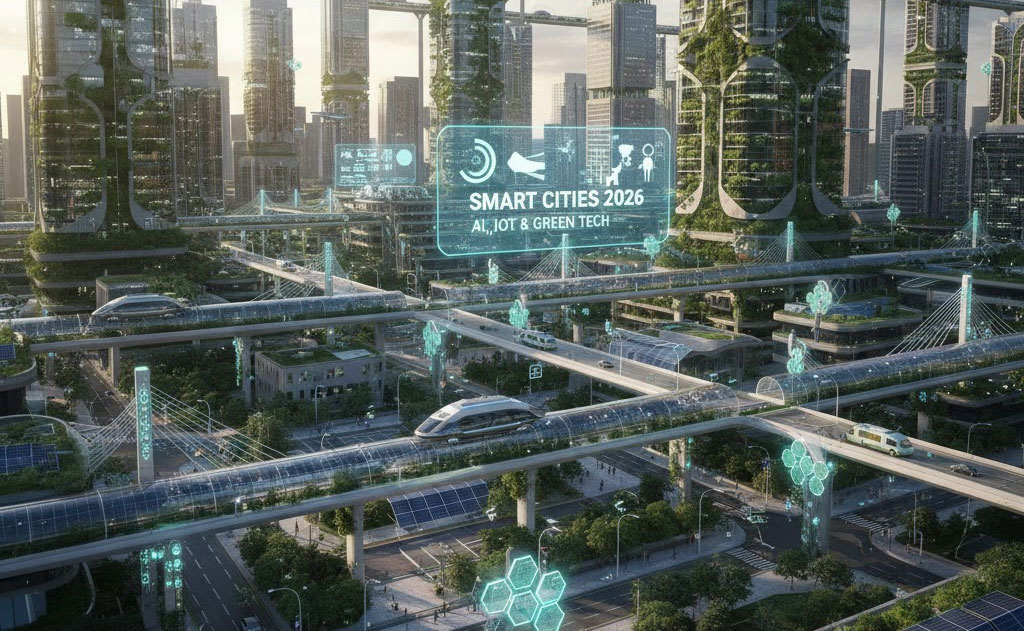
Imagine waking up in 2026 to a city that knows you better than you know yourself. Your alarm doesn’t just buzz—it gently syncs with traffic data to suggest the perfect departure time. Streetlights dim automatically as dawn breaks, saving energy without a single human command. Your building’s rooftop garden quietly absorbs CO2 while producing fresh greens for the neighborhood. This isn’t science fiction. This is the dawn of smart cities 2026, where artificial intelligence, the Internet of Things, and cutting-edge green technology converge to create urban environments that are smarter, cleaner, and more livable than ever before.
The numbers tell a compelling story: by 2030, the global smart cities market is projected to surpass $900 billion, with investments pouring in from governments, corporations, and visionary startups. As urban populations swell—68% of humanity will live in cities by 2050, according to the United Nations—the pressure to build sustainable, efficient metropolises has never been greater. AI, IoT, and green tech aren’t just tools; they’re the foundation of the cities of tomorrow.
At VFutureMedia, we’re obsessed with the innovations and ventures shaping our future. Join us as we dive into how these technologies will transform urban life in 2026—and why this revolution is the biggest opportunity of the decade.
The Three Pillars Driving the Smart City Revolution
1. Artificial Intelligence: The Thinking Brain of the City
In 2026, AI won’t just react—it will predict. Advanced machine learning models will analyze petabytes of data in real time to forecast everything from energy demand peaks to flood risks. Urban digital twins—virtual replicas of entire cities—will let planners simulate traffic changes, new building impacts, or climate scenarios before breaking ground.
Picture this: AI detects a spike in air pollution from rush-hour traffic and instantly reroutes delivery drones, adjusts ventilation in subway stations, and nudges citizens toward public transit with personalized incentives. The result? Cleaner air, less congestion, and millions saved in healthcare and infrastructure costs.
2. Internet of Things: The City’s Nervous System
By 2026, billions of IoT sensors will be embedded in roads, buildings, streetlights, and waste bins, creating a seamless web of real-time information. This AIoT (Artificial Intelligence of Things) fusion turns raw data into instant action.
Smart streetlights will dim when no one’s around, cutting energy use by up to 70%. Water pipes will self-report leaks before they become floods. Even parking spots will signal availability, eliminating the endless circling that wastes fuel and patience. The beauty lies in the autonomy: the city manages itself, quietly and efficiently, while citizens enjoy smoother daily lives.
3. Green Technology: The Sustainable Heartbeat
Sustainability isn’t an add-on—it’s baked into the design. Smart grids powered by AI will balance renewable sources like solar and wind with pinpoint precision, storing excess energy in building batteries or electric vehicle fleets. Vertical farms and biosolar roofs will turn skyscrapers into food and energy producers, slashing urban heat islands and food transportation emissions.
Circular waste systems—already proven in places like Songdo—will use pneumatic tubes and AI sorting to achieve near-zero landfill rates. Every resource will be tracked, optimized, and reused, pushing cities toward true carbon neutrality.
Five Game-Changing Trends You’ll See in Smart Cities 2026
Intelligent Mobility Takes Over
Traffic jams become relics of the past. AI-coordinated traffic lights, connected autonomous shuttles, and Mobility-as-a-Service platforms will cut commute times by 30% while slashing emissions. Vehicle-to-everything (V2X) communication ensures cars, bikes, and pedestrians move in perfect harmony.
Energy Systems That Think Ahead
Smart grids will predict household and neighborhood demand hours in advance, shifting usage to off-peak renewable surges. Buildings will become mini power plants, trading energy peer-to-peer on blockchain-enabled microgrids.
Real-Time Environmental Guardians
Networks of IoT sensors will monitor air, water, noise, and biodiversity continuously. When pollution rises, the city responds instantly—deploying misting systems, altering traffic flows, or alerting vulnerable residents.
Waste Management Reimagined
Smart bins will signal when full, optimizing collection routes to reduce truck miles by half. AI-powered sorting facilities will recover 90%+ of recyclables, feeding a thriving urban circular economy.
Citizen Empowerment Through Data
Personalized city apps will deliver hyper-local insights: the cleanest walking route, nearest EV charger, or upcoming community solar buy-in. Citizens won’t just live in smart cities—they’ll co-create them.
Real-World Pioneers Leading the Charge into 2026
NEOM’s The Line (Saudi Arabia) A 170-km linear city with no cars, no roads, and 100% renewable energy. AI and IoT will orchestrate everything from vertical farming layers to hyper-efficient transport pods.
Songdo (South Korea) Built from the ground up as a smart city lab, Songdo’s pneumatic waste system, ubiquitous sensors, and green spaces prove the model works at scale—and it’s only getting smarter.
Singapore’s Digital Masterplan Already a global leader, Singapore’s AI-driven urban planning and sensor networks will deepen in 2026, setting benchmarks for data privacy and citizen engagement.
Barcelona & Emerging Leaders From smart waste bins that slashed fuel use to open data platforms, cities worldwide are scaling proven solutions, with new hotspots emerging in India, China, and North America.
Challenges on the Horizon—And Why They’re Solvable
Privacy, cybersecurity, and digital divides remain real concerns. But 2026 will see stronger ethical AI frameworks, decentralized data ownership, and inclusive design principles gaining traction. The ventures solving these problems—secure edge computing, privacy-preserving analytics—represent some of the hottest investment opportunities today.
The Big Picture: A Livable, Thriving Urban Future
Smart cities 2026 won’t just be efficient—they’ll be joyful. Greener streets, shorter commutes, cleaner air, and technology that serves people rather than overwhelming them. This convergence of AI, IoT, and green tech isn’t just building infrastructure; it’s reimagining what urban life can be.
For entrepreneurs and investors, the message is clear: the smart city revolution is underway, and the biggest winners will be those who build the platforms, sensors, and solutions powering it.
At VFutureMedia, we’re tracking every breakthrough, every funding round, and every visionary founder turning urban dreams into reality.
Which smart city trend excites you most for 2026—autonomous mobility, carbon-neutral grids, or citizen-powered governance? Share your vision in the comments below.
Ethan Brooks covers the tech that’s reshaping how we move, work, and think — for VFuture Media. He was at CES 2026 in Las Vegas when the world got its first real look at humanoid robots, AI-powered vehicles, and Samsung’s tri-fold phone. He writes about AI, EVs, gadgets, and green tech every week. No hype. No filler. X · Facebook
Stay ahead of the future—follow VFutureMedia for the latest on smart cities, emerging tech, and the ventures shaping tomorrow.




Leave a Comment