
Ancient Stardust from Bennu and Bold Plans for Mars Human Missions in 2026
Space exploration in 2026 promises groundbreaking advancements, building on recent discoveries from asteroid Bennu and new scientific strategies for human missions to Mars. As NASA and international partners push the boundaries of deep space, these milestones highlight humanity’s quest to understand our solar system’s origins and prepare for crewed exploration of the Red Planet.
Bennu’s Presolar Grains: A Window into the Early Universe
Recent analyses of samples returned by NASA’s OSIRIS-REx mission from asteroid Bennu have revealed extraordinary insights into the building blocks of our solar system. In late 2025, scientists announced the detection of an unexpectedly high abundance of presolar grains — tiny dust particles from stellar explosions that predate the Sun itself.
These presolar grains, including supernova-derived stardust, are six times more abundant in Bennu samples than in any previously studied astromaterial. Alongside bio-essential sugars (such as ribose, crucial for RNA) and organic compounds, these findings suggest asteroids like Bennu delivered the ingredients for life to early Earth. Pockets of unaltered material in the samples preserved fragile presolar silicates and organics, offering clues to the solar system’s formation over 4.5 billion years ago.
Bennu’s composition points to its origin in the outer solar system, enriched with material from dying stars. This “stardust” reinforces theories that primordial dust seeded planets and potentially sparked life’s chemistry.
New Science Strategy for Human Mars Missions
As excitement builds for 2026 missions, a December 2025 National Academies report outlines a science-driven roadmap for initial human explorations of Mars. Commissioned by NASA, the strategy prioritizes searching for evidence of past or present life as the top objective for the first crewed landings.
Key priorities include:
- Characterizing water and CO2 cycles
- Mapping Martian geology
- Assessing crew health in the deep space environment
- Studying dust storms and in-situ resource utilization
- Evaluating biological effects on humans, plants, and animals
The report proposes mission campaigns to maximize discoveries during the first three human landings, emphasizing sample returns and surface laboratories. This framework evolves NASA’s Moon to Mars objectives, synergizing lunar missions with Red Planet science to prepare for sustained human presence.
Looking Ahead: Key Space Exploration Events in 2026
2026 will feature pivotal missions advancing human and robotic exploration:
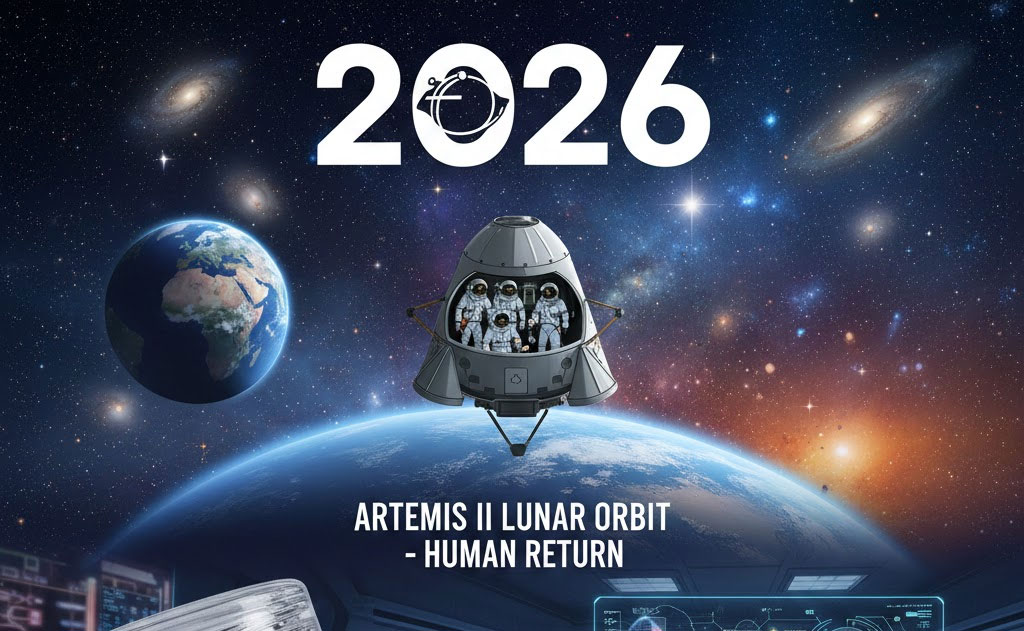
- Artemis II: NASA’s first crewed Artemis mission, launching no earlier than early 2026, will send four astronauts on a lunar flyby to test the Orion spacecraft and SLS rocket.
- Chang’e 7: China’s lunar south pole explorer, including an orbiter, lander, rover, and mini-flying probe.
- Martian Moons eXploration (MMX): JAXA’s mission to sample Phobos and return material to Earth.
- Other highlights: Potential Starship tests toward Mars and commercial lunar landers.
These developments bridge ancient cosmic origins — revealed through Bennu’s presolar grains — with future human footsteps on Mars. Space exploration in 2026 continues to inspire, uncovering the universe’s secrets while paving the way for multi-planetary humanity.
Ethan Brooks covers the tech that’s reshaping how we move, work, and think — for VFuture Media. He was at CES 2026 in Las Vegas when the world got its first real look at humanoid robots, AI-powered vehicles, and Samsung’s tri-fold phone. He writes about AI, EVs, gadgets, and green tech every week. No hype. No filler. X · Facebook
Stay tuned to VFutureMedia.com for the latest in space exploration 2026 updates, Bennu presolar grains research, and Mars human mission science advancements.



Leave a Comment