
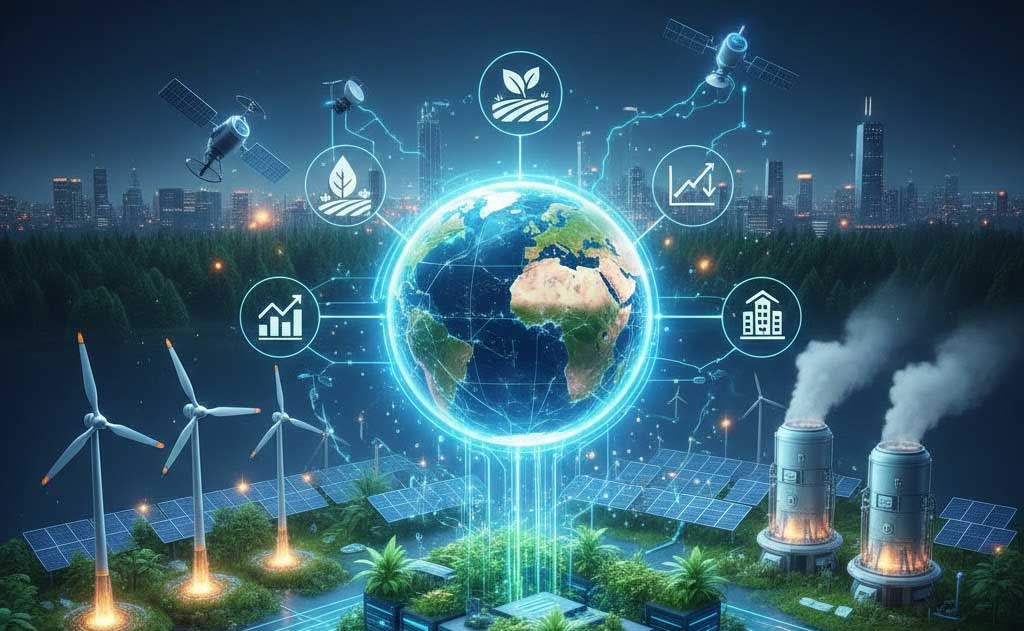
December 22, 2025 – As artificial intelligence continues to reshape industries, its intersection with climate technology is accelerating rapidly. Major tech giants like Google and Microsoft are forging strategic partnerships and investments to address AI’s massive energy consumption while deploying AI tools to combat climate change. Through the third quarter of 2025, climate-focused AI startups raised over $6 billion in funding, according to PwC’s latest State of Climate Tech report—marking a record pace that underscores the growing recognition of AI as a powerful ally in decarbonization efforts.
This convergence comes at a critical juncture: AI data centers are projected to drive significant electricity demand growth, potentially adding hundreds of gigawatts globally by 2030. Simultaneously, AI’s predictive and optimization capabilities are unlocking efficiencies across energy systems, buildings, agriculture, and disaster response.
Big Tech Leads with Clean Energy Offtake Deals
Google has emerged as a frontrunner in aligning its AI infrastructure needs with sustainable power sources.
In a landmark move, Google signed a long-term power purchase agreement (PPA) with Fervo Energy for 115 MW of next-generation geothermal energy from a Nevada project. This deal, coupled with Google’s participation in Fervo’s recent $462 million Series E, directly supports the tech giant’s ambitious goal of operating on 24/7 carbon-free energy by 2030.
Geothermal—enhanced by AI for drilling precision and reservoir management—provides firm, baseload power that complements intermittent renewables like solar and wind. As Google’s data centers ramp up for advanced AI training and inference, such always-on clean sources are essential to avoid reliance on fossil fuels.
Microsoft is pursuing similar strategies, with expanded commitments to nuclear, geothermal, and advanced renewables. The company has invested in fusion startups and signed PPAs for small modular reactors (SMRs), while integrating AI to optimize its global energy portfolio.
These offtake agreements not only secure low-carbon electricity but also de-risk innovative clean energy projects, accelerating deployment at scale.
Record Funding Flows into AI-Climate Startups
PwC’s Q3 2025 data reveals more than $6 billion invested in AI-enabled climate tech startups year-to-date—a sharp increase from previous years. Key categories include:
- Grid optimization and energy management: AI algorithms forecasting demand, balancing loads, and integrating renewables more efficiently.
- Wildfire and extreme weather prediction: Machine learning models analyzing satellite imagery, weather data, and terrain to enable early detection and response.
- Emissions tracking and carbon accounting: Automated platforms using AI to monitor supply chains, industrial processes, and corporate footprints with unprecedented accuracy.
Venture capital firms, corporate funds (e.g., Google’s Climate Innovation Fund, Microsoft’s Climate Innovation Fund), and impact investors are driving this wave, betting on dual-impact solutions that deliver both environmental and financial returns.
Leading Innovators: Real-World Emissions Reductions
Several startups are already demonstrating tangible results:
- BrainBox AI: This Montreal-based company specializes in autonomous building management. Its AI platform optimizes HVAC systems in commercial real estate, achieving average energy savings of 20-25% and corresponding emissions reductions. Deployed across millions of square feet globally, BrainBox uses deep learning to predict occupancy, weather impacts, and equipment performance—adjusting settings in real-time without human intervention.
- Clarity AI: Focused on sustainability analytics, Clarity leverages machine learning to provide institutional investors and corporations with precise environmental risk assessments. Its tools track Scope 1-3 emissions, regulatory compliance, and climate scenario impacts, enabling data-driven decisions that have influenced trillions in assets under management.
Other notables include:
- Startups using AI for precision agriculture to minimize fertilizer use and methane emissions.
- Platforms predicting and mitigating flood risks through advanced modeling.
- AI-driven carbon credit verification systems enhancing market integrity.
These applications prove AI’s value extends far beyond efficiency—directly contributing to net-zero pathways.
Challenges and the Path Forward
Despite momentum, hurdles remain:
- Energy intensity: Training large models consumes enormous power, raising concerns about short-term emissions spikes.
- Data quality: Climate AI relies on accurate, comprehensive datasets—gaps in global monitoring can limit effectiveness.
- Equity: Ensuring benefits reach developing nations and vulnerable communities.
Experts advocate for responsible development: Transparent energy reporting, open-source models for public good, and collaborative standards.
As Sarah Porter, PwC’s Global Climate Tech Leader, noted in the report: “AI is not just a tool for climate action—it’s becoming the backbone of resilient, low-carbon systems.”
Outlook: A Symbiotic Future for AI and Climate
The deepening ties between Big Tech and climate innovators signal a virtuous cycle: Clean energy powers AI growth, while AI accelerates the clean energy transition.
With COP30 approaching in 2026 and corporate net-zero deadlines looming, expect continued acceleration—more corporate PPAs, larger funding rounds, and widespread deployment of AI-climate solutions.
This integration offers hope: Technology once viewed warily for its environmental footprint is emerging as one of our strongest weapons against climate change.
For the latest developments in AI, clean energy partnerships, climate tech funding, and sustainable innovation, visit vfuturemedia
Ethan Brooks covers the tech that’s reshaping how we move, work, and think — for VFuture Media. He was at CES 2026 in Las Vegas when the world got its first real look at humanoid robots, AI-powered vehicles, and Samsung’s tri-fold phone. He writes about AI, EVs, gadgets, and green tech every week. No hype. No filler. X · Facebook
We started VFuture Media because we wanted tech news written by people who actually follow this industry — not content farms chasing keywords. If that resonates, we’d love to have you as a regular reader. Pull up a chair.


Leave a Comment