
The silent rear-end threat exposed: Tesla vs BYD, XPeng, Li Auto, NIO in 2025 automatic emergency braking battles and the race to unbreakable autonomy
The Highway Heart-Stopper: A Tesla Owner’s Close Call in Late 2025
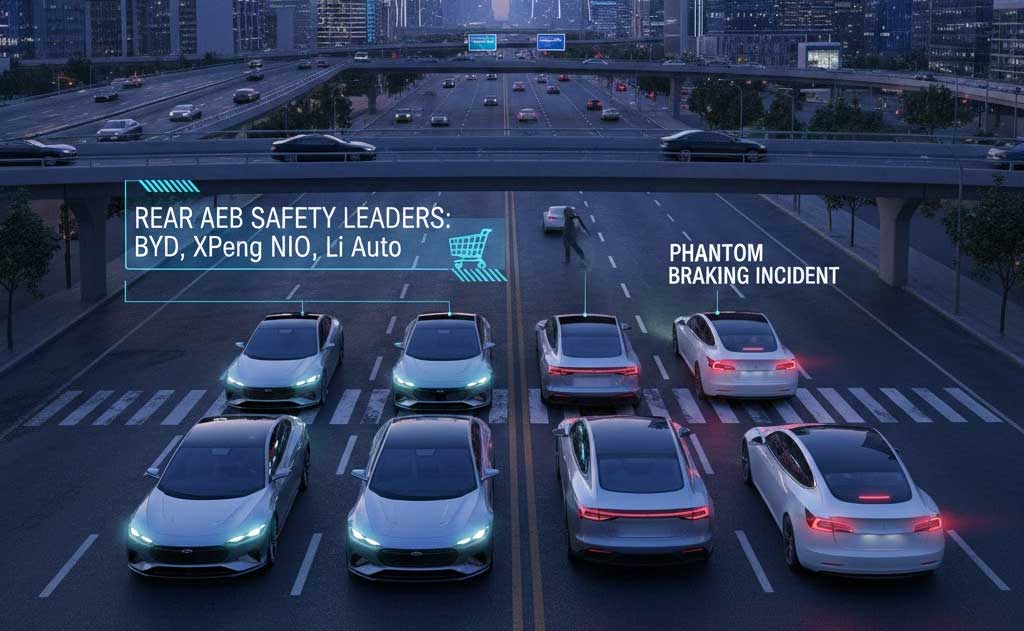
Picture this: It’s a busy freeway in California, just weeks before Christmas 2025. You’re cruising at 70 mph in your Tesla Model Y, Autopilot engaged, when—bam—the car slams on the brakes for no apparent reason. Tires screech, ABS kicks in, and the truck behind you swerves wildly to avoid rear-ending you. Your heart races as you stomp the accelerator to override. This isn’t a rare horror story; it’s a daily reality for thousands of Tesla owners grappling with “phantom braking.”
Here’s what most people get wrong: They think Tesla’s Automatic Emergency Braking (AEB) is flawless because of its vision-only system and billions of miles of data. But in 2025, persistent phantom events—sudden, unwarranted braking—have fueled NHTSA complaints, class-action lawsuits, and a growing perception that Tesla’s forward AEB, while innovative, carries risks that could invite rear-end collisions.
Now flip to China: A driver in a XPeng P7+ navigates chaotic Shanghai traffic. The car’s rear cross-traffic AEB gently but firmly stops as a scooter darts from behind during reverse. No drama, no override needed. Or a Li Auto L9 family hauler avoids a backing mishap with seamless rear AEB intervention.
The number that actually matters is this: In a massive July 2025 Chinese ADAS highway test of 36 vehicles (Dongchedi report), Tesla’s 2023 Model 3 and Model X topped with 5/6 passes—but many Chinese rivals like XPeng G6 and Huawei-backed Aito M9 scored 3/6, showing rapid catch-up in complex scenarios including emergency braking.
What this means in plain English? 2025 exposed Tesla’s lingering phantom braking Achilles’ heel, while Chinese EVs from BYD, XPeng, NIO, Li Auto, and Xiaomi surged ahead in reliable rear and cross-traffic AEB, often bundling advanced features standard or free.
Rhetorical question: If rear-end crashes are the most common accident type (IIHS 2025 data: ~50% mitigated by good AEB), why settle for a system prone to false positives when rivals are delivering smoother, more predictable safety?
By 2027, expect Chinese brands to dominate global AEB leadership, with multi-sensor fusion and free ADAS pushing Tesla to play catch-up. Yes, but… Tesla’s unsupervised FSD push could leapfrog everyone—if phantom issues are finally slain.
In this deep dive, we’ll unpack Tesla’s AEB struggles vs. Chinese rivals’ strengths, real-world tests, surprising stats, and what smart buyers should do in 2026.
Why Rear Automatic Emergency Braking Matters More Than Ever in 2025
Rear AEB—braking automatically when reversing to avoid collisions—sounds niche, but it’s a game-changer. Front AEB gets headlines, but rear/cross-traffic systems prevent low-speed fender-benders in parking lots, driveways, and urban chaos.
Surprising fact: Rear-end collisions account for ~29% of all crashes (NHTSA 2025 estimate), with many preventable by robust AEB. Yet Tesla’s system, while forward-focused, has drawn fire for phantom events risking secondary rear-ends.
Chinese rivals? They’re mandating advanced rear AEB across lineups, often with radar/LiDAR for better detection.
Tesla’s AEB Legacy: Vision-Only Brilliance Meets Phantom Pain
The Phantom Braking Saga Lingers into 2025
Tesla’s AEB operates up to high speeds, even in reverse for cross-traffic (owner’s manual 2025). It saved lives—owners report interventions preventing front impacts.
But phantom braking? Complaints persisted in 2025, tied to vision misreads (shadows, overpasses). No major 2025 recall, but ongoing NHTSA scrutiny from prior probes.
Case study: 2025 class-actions in US/Australia allege abrupt braking risks rear-enders.
Strengths: Data-Driven and OTA-Improved
Tesla leads in miles driven with FSD (billions globally). 2025 updates refined AEB, reducing phantoms per owner forums.
Chinese Rivals Charge Ahead: Multi-Sensor Mastery
BYD’s God’s Eye: Free Advanced AEB for the Masses
BYD made “God’s Eye” standard in 2025, including rear AEB on models like Seal and Seagull (~$10k). Multi-sensor (radar + vision) excels in low-visibility.
Surprising stat: BYD-equipped vehicles topped C-NCAP 2025 rear AEB scores in several segments.
XPeng’s XPILOT: Urban Rear AEB Wizard
XPeng P7/G9 shine in city NOA, with strong rear cross-traffic braking. 2025 tests showed reliable avoidance of reversing hazards.
Li Auto and NIO: Family-Focused Rear Safety
Li Auto L-series prioritizes rear AEB for kid-heavy families. NIO ET7/ES8 bundle premium rear systems.
Xiaomi SU7: Aggressive Newcomer with AES
Xiaomi added Automatic Emergency Steering (AES) in 2025 HAD update—evades if braking insufficient, boosting rear scenarios.
Contrarian take: Chinese systems sometimes over-rely on swerve-first (2025 Dongchedi test flaws), while Tesla brakes decisively.
Head-to-Head Tests: 2025 Reality Checks
Dongchedi Highway ADAS Marathon
36 vehicles, real hazards: Tesla topped (5/6), but XPeng/Huawei close behind. Many Chinese failed swerve-then-brake logic.
Euro NCAP and ANCAP 2025
Tesla Model Y/Model 3: 5-stars, strong AEB. BYD Atto 3/Seal: 5-stars, but some lack full rear AEB backover.
Owner Reports and Forums
Tesla: Phantom praise/criticism mix. Chinese: Smoother daily rear interventions.
The Hidden Risks: Phantom vs. Over-Caution
Tesla phantoms risk rear-end invites. Chinese over-caution (swerving) can unsettle.
Yes, but… Both improving rapidly via OTA.
Future Projections: By 2027, Chinese Rear AEB Dominance?
By 2027–2028, expect free L3-capable rear AEB standard on Chinese EVs, diluting Tesla premium.
Gartner 2025 forecast: China 60%+ global ADAS market.
What Should You Do in 2026? Actionable Takeaways
- Test Rear AEB In-Person: Reverse demos essential.
- Prioritize Multi-Sensor: Radar/LiDAR reduces phantoms.
- Consider Chinese Imports: BYD/XPeng entering markets with superior rear tech.
- Wait for Tesla Fixes: Unsupervised FSD may resolve phantoms.
- Enable All Alerts: Maximize any system’s potential.
- Drill Overrides: Accelerator for phantoms.
- Check Local Tests: Euro/ANCAP over marketing.
Future Outlook: Balanced Autonomy in 2026–2030
2025 highlighted Tesla’s data edge vs. Chinese hardware/sensor fusion. By 2030, hybrid approaches win—safer rear AEB everywhere.
The rear threat is real, but solutions accelerating. Choose wisely in 2026.
FAQ: Your Top Questions on Tesla vs Chinese Rear AEB Answered
Does Tesla have rear automatic emergency braking in 2025?
Yes, for rear cross-traffic while reversing; applies brakes to avoid collisions.
Why does Tesla phantom brake more than Chinese EVs?
Vision-only system prone to misreads; Chinese use radar/LiDAR for redundancy.
Which Chinese EV has the best rear AEB in 2025?
XPeng and Li Auto lead in urban/rear scenarios per tests.
Is BYD’s God’s Eye better than Tesla AEB?
In rear/low-speed: Often yes, multi-sensor and free.
Has Tesla fixed phantom braking in late 2025?
Improved via updates, but reports persist.
Will rear AEB become mandatory globally?
EU/China pushing; US NHTSA considering expansions.
How do 2025 tests compare Tesla vs XPeng/NIO?
Tesla tops highway; Chinese stronger city/rear.
Are Chinese EVs safer overall than Tesla in 2025?
Similar 5-star ratings; Chinese edge in rear AEB integration.
What’s the risk of rear-end from Tesla phantom braking?
Elevated per complaints; no major 2025 stats spike.
Best EV for rear safety in 2026?
Emerging: Li Auto or XPeng for family/rear focus.
I’m Ethan, and I write about the tech that’s actually going to change how we live — not the stuff that just sounds impressive in a press release. I cover AI, EVs, robotics, and future tech for VFuture Media. I was on the ground at CES 2026 in Las Vegas, walking the show floor so I could give you a real read on what matters and what’s just noise. Follow me on X for daily takes.
We started VFuture Media because we wanted tech news written by people who actually follow this industry — not content farms chasing keywords. If that resonates, we’d love to have you as a regular reader. Pull up a chair.


Leave a Comment