
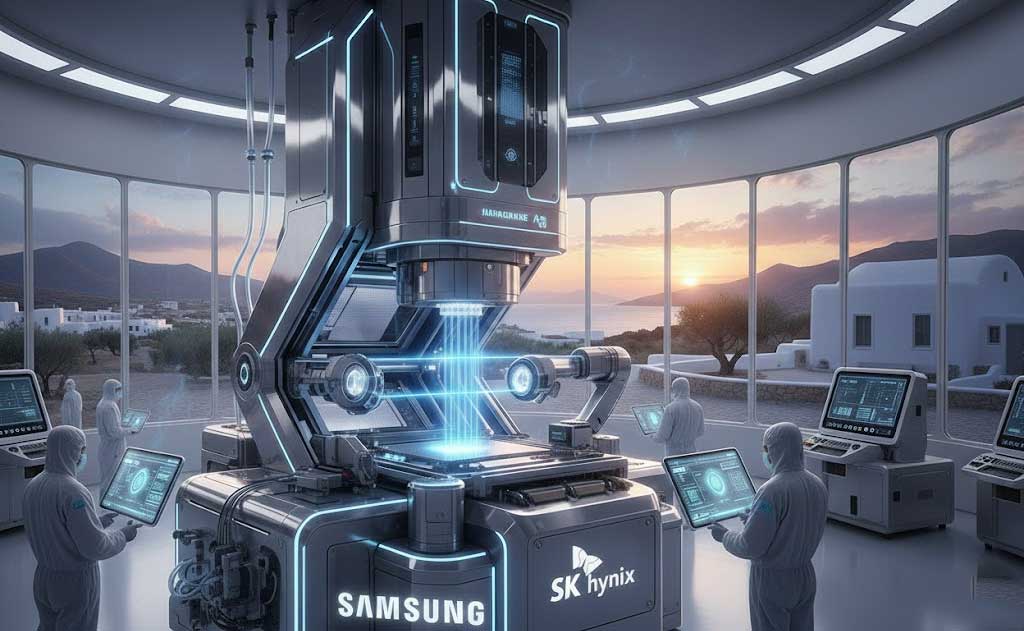
In a pivotal year-end decision, the US government has approved annual licenses allowing Samsung Electronics and SK Hynix to import American chipmaking equipment into their Chinese facilities for 2026, providing crucial stability amid escalating tech tensions
As 2025 draws to a close, the global semiconductor industry received a significant lifeline on December 30. Sources familiar with the matter revealed that the US Department of Commerce has granted annual licenses to South Korea’s Samsung Electronics and SK Hynix, permitting the shipment of US-origin chip manufacturing tools to their production plants in China throughout 2026.
This approval marks a temporary reprieve for the world’s leading memory chipmakers, who rely heavily on their Chinese operations for producing legacy DRAM and NAND flash—components surging in demand due to the AI boom. The decision transitions from indefinite waivers to a yearly review system, balancing US national security concerns with the realities of global supply chain interdependence.
For tech enthusiasts and industry watchers, this move underscores the delicate dance in the US-China chip war: Restricting China’s indigenous advanced semiconductor capabilities while avoiding catastrophic disruptions to allied companies and the worldwide electronics ecosystem.
The Breaking News: Annual Approval Replaces Expiring Waivers
The announcement, first reported by Reuters, comes just days before the expiration of the Validated End User (VEU) status on December 31, 2025. Previously, this privileged designation allowed Samsung, SK Hynix, and Taiwan’s TSMC to import estimated quantities of US semiconductor equipment to specified Chinese facilities without individual licenses.
Earlier in 2025, the US revoked these broad VEU exemptions, shifting to a more controlled framework. The new annual license system—introduced by the Commerce Department’s Bureau of Industry and Security (BIS)—requires yearly approvals but streamlines the process compared to case-by-case reviews.
Key details from sources:
- Licenses cover 2026 shipments specifically.
- Focus on maintaining existing operations, not expanding advanced capacity.
- Samsung and SK Hynix declined official comment; TSMC has not responded.
This “temporary relief” ensures continuity for facilities producing traditional memory chips, where prices have skyrocketed amid AI data center demand and supply constraints.
Why China Remains Critical for Samsung and SK Hynix
Samsung and SK Hynix dominate the global memory market—Samsung as the top producer, SK Hynix a close second. Their Chinese plants are not fringe operations but core to their production strategies.
- Samsung’s Xi’an Facility: Accounts for approximately 35-40% of global NAND flash output, focusing on legacy nodes essential for consumer electronics, storage drives, and enterprise solutions.
- SK Hynix’s Wuxi and Dalian Plants: Produce around 40% of DRAM and 20% of NAND, specializing in mature process technologies that power everything from smartphones to servers.
These sites employ thousands and contribute significantly to China’s role as a manufacturing hub. Without tool imports, maintenance and upgrades would grind to a halt, risking production shortfalls in a market already strained by AI-driven demand.
In 2025, memory chip prices surged—DRAM up over 50% in some segments—highlighting the vulnerability of global supply chains. Disrupting these plants could spike costs for consumers worldwide, from laptops to cloud services.
The Backstory: Evolution of US Export Controls
To understand this approval’s significance, we must trace the escalating US-China semiconductor rivalry.
Roots in 2022 Controls
The Biden administration initiated sweeping restrictions in October 2022, targeting advanced chips (below 16nm logic, 18nm DRAM, 128-layer NAND) and equipment capable of producing them. Goals: Impair China’s military AI advancements and indigenous high-end chip production.
Initial waivers spared allies like Samsung and SK Hynix to prevent self-inflicted supply chain wounds.
2025 Tightening and Revocation
Under continued pressure—spanning Biden’s final months and transitioning policies—the US revoked VEU status in August/September 2025. This affected Samsung, SK Hynix, and even Intel’s former Dalian operations (acquired by SK Hynix).
The shift aimed to close “loopholes” disadvantaging US firms like Micron while ensuring no technology upgrades fueled China’s cutting-edge ambitions.
Annual System Emerges
By fall 2025, proposals for “site licenses” or annual approvals surfaced, offering predictability without permanent exemptions. The December decision implements this for 2026.
Implications for the Global Chip Industry
This approval ripples far beyond Seoul and Beijing.
Relief for South Korean Giants
- Stabilizes production of legacy chips, vital amid HBM (high-bandwidth memory) shortages for AI.
- Shares rose modestly on the news—Samsung up nearly 1%, SK Hynix 1.5%.
Boost to AI Supply Chain
Memory chips from these plants feed Nvidia, AMD, and hyperscalers. Disruptions could exacerbate AI hardware bottlenecks.
US Strategic Win?
- Maintains pressure: No blanket upgrades allowed; annual reviews enable oversight.
- Protects allies while containing China—SMIC, CXMT, YMTC remain heavily restricted.
Potential Risks
- Annual renewals introduce uncertainty for 2027+.
- If denied future licenses, forced relocation could cost billions and years.
| Company | Key China Facility | Production Share | Primary Products |
|---|---|---|---|
| Samsung | Xi’an | 35-40% NAND flash | Legacy NAND |
| SK Hynix | Wuxi/Dalian | 40% DRAM, 20% NAND | Legacy DRAM/NAND |
| TSMC | Nanjing | Limited (older nodes) | Mature logic |
Broader Geopolitical Context
The decision arrives amid shifting US leadership dynamics—Trump administration reviewing Biden-era policies deemed “too relaxed.” Yet continuity prevails: National security trumps unrestricted trade.
China’s response: Accelerated self-reliance via subsidies, but legacy memory remains import-dependent.
For consumers: Stable supply supports affordable devices in 2026.
Looking Ahead: 2026 and Beyond
This annual license sets a precedent. Will it extend to TSMC? How will China retaliate—perhaps rare earth restrictions?
As AI demand explodes, memory chips become strategic assets. The US walks a tightrope: Securing technological leadership without fracturing global chains.
This year-end approval isn’t full deregulation—it’s calibrated control, ensuring Samsung and SK Hynix thrive while advancing US goals.
The chip wars continue, but for now, production lines in China keep humming into 2026.
What does this mean for AI hardware prices? Will annual reviews hold? Share your predictions below!
Honestly, we’re still debating this one in the comments. Where do you land? Drop your take below — the best discussions on this site have always come from readers who actually know their stuff.
I’m Ethan, and I write about the tech that’s actually going to change how we live — not the stuff that just sounds impressive in a press release. I cover AI, EVs, robotics, and future tech for VFuture Media. I was on the ground at CES 2026 in Las Vegas, walking the show floor so I could give you a real read on what matters and what’s just noise. Follow me on X for daily takes.
Published on www.vfuturemedia.com | December 30, 2025




Leave a Comment