
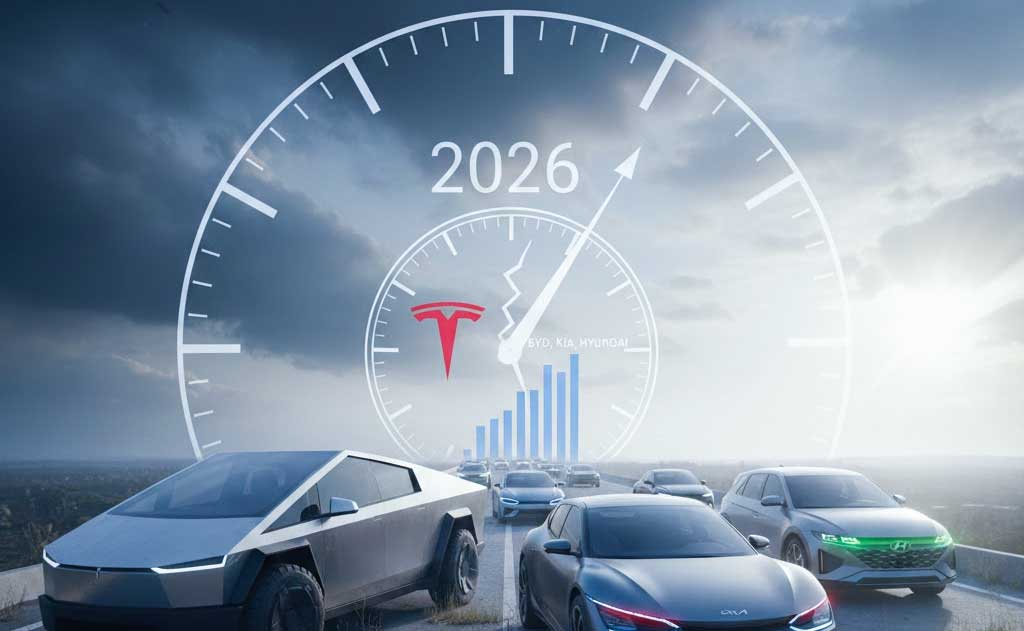
Hey everyone — it’s January 3, 2026, and the EV world just got a reality check. Tesla’s latest delivery numbers are out, and they’re tough reading: the company delivered 1.64 million vehicles in 2025, down about 9% from 1.79 million the year before. This marks the second straight year of annual sales decline for Elon Musk’s EV giant — and it officially handed the global crown of top battery-electric vehicle (BEV) seller to China’s BYD, which delivered 2.26 million BEVs (up 28% year-over-year).
Q4 2025 was particularly rough, with deliveries dropping 15-16% year-over-year to around 418,000 units — missing Wall Street expectations and signaling that the headwinds aren’t letting up as we head into 2026. So, is this the beginning of the end for Tesla’s dominance? Let’s break down the key factors reshaping the EV landscape.
The Big Sales Drop: What the Numbers Really Show
Tesla’s full-year decline of roughly 8.6-9% comes after a strong rush in Q3 2025, when buyers scrambled to lock in the $7,500 federal EV tax credit before it expired in September. Once that incentive vanished under the new administration’s policy shifts, demand cooled sharply — especially in Tesla’s largest market, the U.S., where the company still holds a commanding position but is far from immune.
The tax credit rollback has hit harder than many expected. What was once a powerful demand driver for EVs (particularly Tesla models that qualified) is gone, leaving buyers to face full sticker prices in a market already dealing with economic uncertainty and higher interest rates. Analysts note that the policy change disproportionately affected Tesla, which benefited heavily from the incentive and accounts for a significant share of U.S. EV sales.
Rising Competition: Affordable Models from BYD, Kia, Hyundai, and Beyond
The other major story? Intense global competition, especially from lower-priced rivals.
BYD has been the biggest threat, surging ahead with a massive lineup of affordable, high-value EVs and hybrids. The Chinese giant not only outsold Tesla globally in 2025 but is expanding aggressively overseas — with exports outside China hitting a record 1 million units (up 150% from 2024) and ambitions for even more in 2026.
Closer to home, Kia and Hyundai are gaining serious ground with compelling, budget-friendly options. The Kia EV3 — a compact electric SUV with strong range, modern features, and expected pricing around $35,000 (or lower in some markets) — is already making waves in Europe and Asia, and U.S. availability is slated for 2026. Hyundai’s upcoming Ioniq 3 promises similar value in a sportier package, targeting the growing demand for affordable, practical EVs.
These models offer mainstream buyers what Tesla’s current lineup (still heavily reliant on the aging Model 3 and Model Y) hasn’t fully delivered: competitive pricing without sacrificing tech or range. With Tesla’s stripped-down “Standard” versions of the Model Y and Model 3 providing only modest relief, the pressure from these challengers is mounting.
U.S. Market Challenges in 2026: Policy Headwinds and Shifting Demand
The U.S. remains Tesla’s stronghold — it still commands around 40-50% of the domestic EV market depending on the quarter — but the road ahead looks bumpy. The elimination of federal incentives removes a key affordability lever, potentially slowing overall EV adoption in the world’s second-largest market.
Add in lingering brand challenges (from political backlash tied to Musk’s high-profile role earlier in 2025 to consumer sentiment shifts), and analysts are slashing 2026 sales forecasts for Tesla. Some now see deliveries closer to 1.8 million globally — well below earlier hopes for explosive growth.
That said, it’s not all doom. Tesla’s energy storage business hit record highs, and investors are betting big on the company’s pivot to robotaxis, autonomous driving, and humanoid robotics (Optimus) as the real growth story for 2026 and beyond. Musk himself called 2026 “epic” on social media, and some Wall Street analysts remain bullish, viewing the current dip as a transition phase.
The Bigger Picture: EVs Are Evolving, Not Dying
Tesla’s struggles don’t mean the end of electric vehicles — far from it. Global EV sales continue rising, driven by cheaper batteries, more models, and strong demand in emerging markets. The shift is simply becoming more competitive and diverse, with Chinese and Korean players leading the charge on price and volume.
For Tesla, 2026 will be a make-or-break year: can it stabilize core auto sales while delivering on futuristic promises? Or will affordable rivals like BYD, Kia, and Hyundai continue eroding its lead?
At vFutureMedia, we’re tracking every twist in this high-stakes EV showdown — from policy impacts to new model launches and the race for autonomy. The transition is heating up, and it’s more exciting (and unpredictable) than ever.
What do you think — is Tesla’s dominance truly at risk, or will robotaxis and AI turn things around in 2026? Drop your thoughts in the comments!
I’m Ethan, and I write about the tech that’s actually going to change how we live — not the stuff that just sounds impressive in a press release. I cover AI, EVs, robotics, and future tech for VFuture Media. I was on the ground at CES 2026 in Las Vegas, walking the show floor so I could give you a real read on what matters and what’s just noise. Follow me on X for daily takes.
If you found this useful, the best thing you can do is share it with someone who’d actually appreciate it. And if you want more like it, we’re here every week.


Leave a Comment