
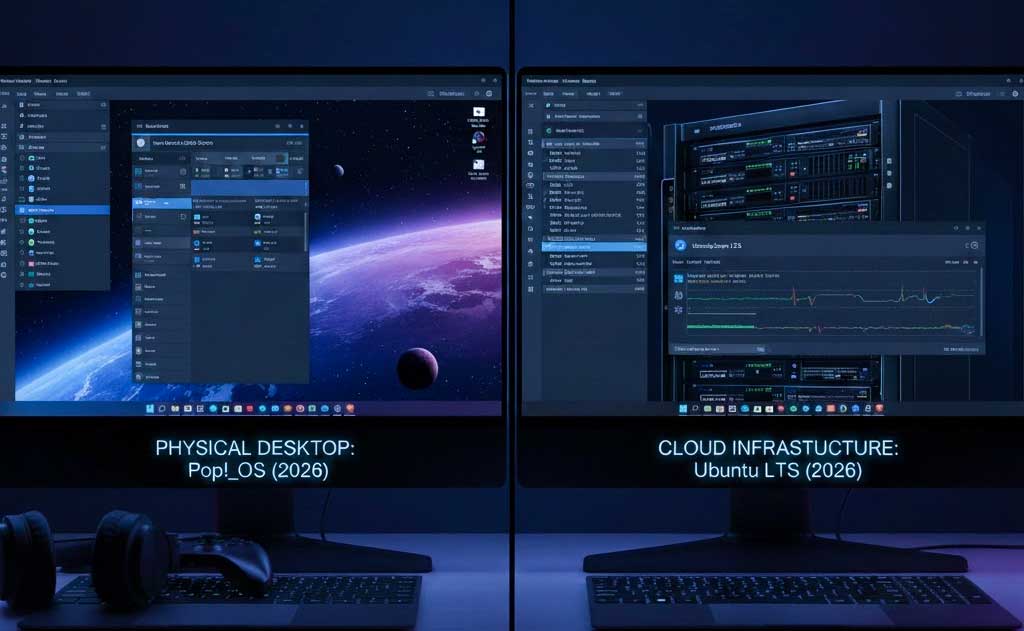
As Ethan Brooks, your go-to tech journalist at VFutureMedia.com for future computing trends, I’m diving into the Linux landscape as of January 2026. Linux continues its unstoppable march: desktop share hovers around 4-6% globally (with spikes in gaming and developer circles), servers command ~45-50% of the market, and cloud workloads run on Linux for nearly 50% of global instances. The real question isn’t if Linux dominates—it’s which flavor rules each domain.
Physical (bare-metal desktops/laptops), virtual (VMs on hypervisors like VMware, VirtualBox, KVM), and cloud (AWS, Azure, GCP, etc.) environments have distinct needs: ease of use and hardware support for physical, stability and snapshot efficiency for virtual, and scalability/security for cloud.
Let’s break it down by category with current 2026 insights—no hype, just data-driven analysis.
Physical Desktops & Laptops: The User-Facing Battlefield
On physical hardware in 2026, Linux adoption accelerates thanks to Windows fatigue, better NVIDIA/AMD support, AI tooling, and post-Windows 10 migrations. Desktop share crosses 4-6% in many trackers, with gaming (Steam Deck influence) and privacy-focused users driving growth.
Ruling Distribution: Ubuntu (and its derivatives) Ubuntu (especially 24.04 LTS or the newer 26.04 cycle) remains the undisputed leader for physical machines. It offers the largest community, best hardware compatibility (including recent laptops), easiest driver setup, and massive tutorial ecosystem.
Key reasons it dominates physical in 2026:
- Beginner-to-pro appeal — Simple installer, Snap/Flatpak support, and polished GNOME desktop.
- Hardware readiness — Excellent out-of-box Wi-Fi, Bluetooth, touchpads, and GPU acceleration.
- Derivatives boost it — Linux Mint (Cinnamon for Windows-like feel), Zorin OS (migration-friendly layouts), and Pop!_OS (System76’s COSMIC desktop gaining massive traction for creators/gamers) all build on Ubuntu’s foundation.
Strong Contenders:
- Pop!_OS — Rising fast with the new COSMIC desktop environment; excels for NVIDIA users, tiling workflows, and hybrid graphics.
- Fedora Workstation — Cutting-edge packages and strong Wayland/AI tooling; popular among developers.
- Linux Mint — Stability and traditional desktop for ex-Windows users.
- Emerging buzz around Zorin OS, AnduinOS (Windows-like), and others for specific niches.
For everyday physical use, Ubuntu ecosystem captures the majority of new installs and active desktops.
Virtual Machines: Stability, Speed, and Snapshot Heaven
In virtualized environments (home labs, testing, dev VMs on KVM, VirtualBox, VMware Workstation/ESXi, Hyper-V), priorities shift to low overhead, fast boot, easy cloning/snapshots, and predictable behavior.
Ruling Distribution: Debian & Ubuntu LTS Debian Stable (or Ubuntu LTS) reigns supreme here. Why?
- Minimal resource usage — Clean installs run efficiently with low idle RAM/CPU.
- Rock-solid stability — Point releases avoid breaking guest additions or drivers.
- Excellent VM tooling integration — Official cloud-init support, seamless guest agents, and virtio drivers.
- Long-term support — Debian’s ~5-year cycle or Ubuntu’s 5-10 years (with Pro/ESM) match VM lifecycle needs.
Close Seconds:
- AlmaLinux / Rocky Linux — For RHEL-compatible VMs in enterprise testing.
- Fedora — When bleeding-edge kernel/modules are needed for VM experimentation.
- Lightweight options like Alpine Linux for tiny containers/VMs (though less common for full desktop VMs).
In practice, most sysadmins and homelabbers default to Ubuntu Server LTS or Debian for virtual guests—reliable, widely documented, and hypervisor-friendly.
Cloud & Hyperscale: Where Linux Truly Dominates
Cloud is Linux’s kingdom: ~49% of global cloud workloads run Linux (Q4 2025–early 2026 data), powering AWS EC2, Azure VMs, GCP Compute Engine, containers (Kubernetes/Docker), and serverless.
Ruling Distributions in Cloud 2026:
- Ubuntu Server LTS — The most deployed Linux in cloud environments. Canonical reports massive adoption; it leads web server deployments (~33.9% of Linux cloud sites) and developer usage. AWS, Azure, and GCP all offer optimized Ubuntu images first.
- Red Hat Enterprise Linux (RHEL) & clones — Enterprise stronghold. RHEL holds ~43% in finance/government/healthcare; Rocky Linux and AlmaLinux (free RHEL rebuilds) surge post-CentOS changes.
- Amazon Linux — AWS-native, but niche (~0.2% broader share).
- Debian — Strong for lightweight, stable cloud instances.
Cloud Provider Preferences:
- AWS — Amazon Linux 2023 + Ubuntu + RHEL clones dominate EC2.
- Azure — Ubuntu leads Linux VMs; strong RHEL integration.
- GCP — Ubuntu and Container-Optimized OS (based on Chromium OS + Docker).
Ubuntu Server wins overall cloud share due to ease, vast marketplace images, snap support for modern apps, and Canonical’s cloud partnerships.
Head-to-Head Summary: Who Rules Where in 2026?
- Physical Desktops/Laptops → Ubuntu ecosystem (Ubuntu, Pop!_OS, Mint, Zorin)
- Virtual Machines → Debian Stable / Ubuntu LTS
- Cloud Infrastructure → Ubuntu Server LTS (broad lead), RHEL family (enterprise)
Cross-domain Champion: Ubuntu — It bridges all three worlds better than any other. Desktop-friendly, VM-efficient, and cloud-optimized.
Rising Stars to Watch:
- Pop!_OS (COSMIC DE reshaping desktop innovation)
- Fedora (developer/AI edge)
- Immutable/atomic distros (AerynOS, etc., for future reliability)
FAQ: Linux Dominance Questions in 2026
Which single Linux distro rules overall in 2026? Ubuntu—strongest across physical, virtual, and cloud due to compatibility, support, and ecosystem size.
Is desktop Linux finally taking off in 2026? Yes—market share hits 4-6% globally with momentum from Windows shifts, better hardware support, and gaming (Steam/Proton).
Best Linux for cloud beginners? Ubuntu Server LTS—easiest images, huge docs, and Canonical-backed updates.
RHEL clones worth it over Ubuntu in enterprise cloud? Yes for strict compliance/certification; otherwise Ubuntu offers similar stability with faster community iteration.
Will Pop!_OS overtake Ubuntu on desktops? It’s gaining fast—COSMIC DE and gaming focus make it a serious contender for 2026-2027.
What Linux setup are you running in 2026—desktop, VM lab, or cloud? Drop your thoughts in the comments below. Subscribe to VFutureMedia for more on open-source trends, AI tooling, and next-gen computing. Let’s geek out together!
I’m Ethan, and I write about the tech that’s actually going to change how we live — not the stuff that just sounds impressive in a press release. I cover AI, EVs, robotics, and future tech for VFuture Media. I was on the ground at CES 2026 in Las Vegas, walking the show floor so I could give you a real read on what matters and what’s just noise. Follow me on X for daily takes.



Leave a Comment