
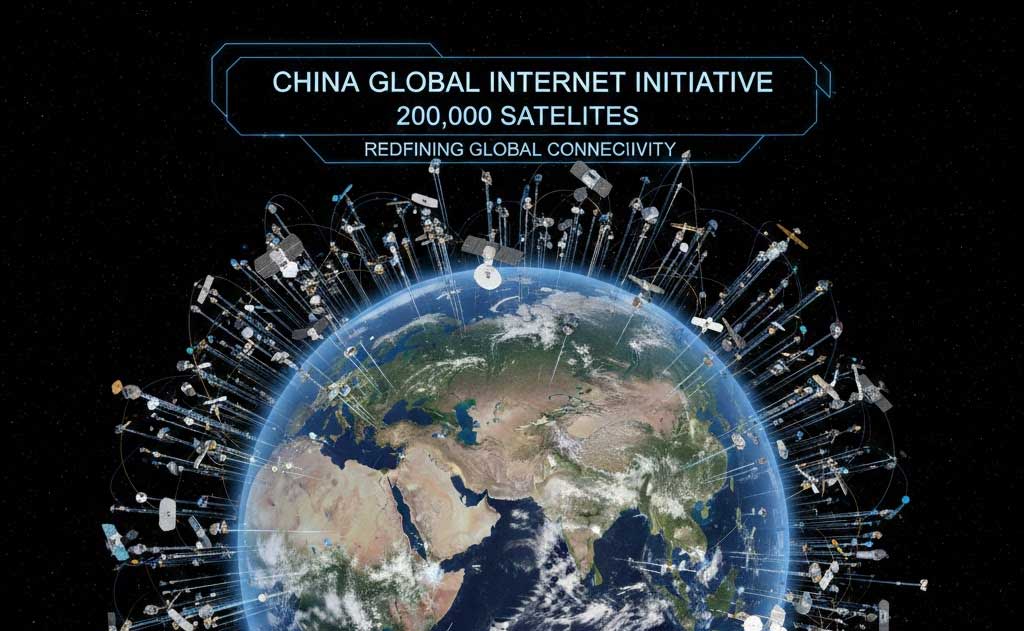
In a dramatic escalation of the global satellite internet race, China has submitted ambitious filings to the United Nations’ International Telecommunication Union (ITU) seeking rights to deploy a staggering constellation of nearly 200,000 satellites in low Earth orbit (LEO). The move, revealed in late December 2025 and widely reported in early January 2026, positions Beijing as a direct challenger to Elon Musk’s SpaceX Starlink, which currently dominates with over 9,400 active satellites and plans for up to 42,000–50,000 in the long term.
Led by state-backed entities including the newly formed Institute of Radio Spectrum Utilisation and Technological Innovation (registered December 30, 2025, in Hebei province), the filings include two massive proposed networks: CTC-1 and CTC-2, each targeting 96,714 satellites across thousands of orbits. Additional proposals from Chinese operators bring the total claimed slots to around 203,000 across 14 constellations. This dwarfs Starlink’s scale and reflects China’s push for a sovereign, “secure, controllable, and efficient” global broadband system independent of Western infrastructure.
The Strategic Play: Securing Orbital “Real Estate”
The ITU filings, submitted at the end of December 2025, aren’t immediate launch plans but a regulatory “land grab” for radio frequencies and orbital slots. Under ITU rules (updated in 2019), first-filers gain priority, but operators must meet milestones: launch at least one satellite within 7 years and complete deployment within 14 years, or risk losing rights (with reductions possible for unmet targets).
China’s strategy echoes past moves—like Rwanda’s 2021 filing for 327,000 satellites (which never materialized)—but carries real weight given Beijing’s active mega-constellations:
- Guowang (China Satellite Network Group / SatNet): ~13,000 satellites planned, with over 100 already in orbit as of late 2025.
- Qianfan (Thousand Sails): Targeting 15,000+ by 2030, with dozens launched.
- Other players: China Mobile, GalaxySpace, Shanghai Yuanxin Satellite Technology, and more filing for thousands each.
The CTC proposals appear as next-generation visions, potentially integrating broadband, data relay, positioning, and even military-grade capabilities (e.g., laser comms, SAR imaging). Beijing has criticized Starlink for orbital congestion and collision risks—especially after a December 2025 Starlink anomaly—while accelerating domestic manufacturing and launch capacity (China set a national record with 92 launches in 2025).
Geopolitical Stakes: A “Firewall in Space”?
Officials describe the network as essential for national security, global connectivity, and reducing reliance on foreign tech. In a world of rising tensions, a China-controlled constellation could enable:
- Unrestricted high-speed internet in remote or sanctioned areas.
- Backup for military communications and navigation.
- Leverage in international telecom standards.
Critics highlight irony: While Starlink has aided Ukraine and disaster zones, a state-run rival could extend China’s Great Firewall to orbit—offering “global internet freedom” under strict oversight. The sheer scale raises alarms over space debris, Kessler syndrome risks, and crowded LEO (already home to ~14,300 active satellites, mostly Starlink).
Meanwhile, the U.S. reinforces its edge: The FCC approved 7,500 more second-gen Starlink satellites in early January 2026, pushing toward 19,000 total authorized.
Will It Happen? Hurdles Ahead
Experts caution that filings often exceed reality—technical, financial, and regulatory challenges loom. China must ramp up production (thousands annually), perfect reusable rockets, and navigate ITU scrutiny plus potential objections from other nations. Still, with massive state investment and rapid progress on Guowang/Qianfan, even partial deployment would reshape orbital dynamics.
This isn’t just about internet—it’s about who controls the next frontier of connectivity, data, and power in space.
As the race intensifies, low Earth orbit is becoming the new high ground. Watch for ITU examinations, coordination talks, and launch milestones in the coming years
The future doesn’t wait — and neither should your feed. If this got you thinking, there’s plenty more where that came from. Browse our latest at VFutureMedia.com and stick around.




Leave a Comment