
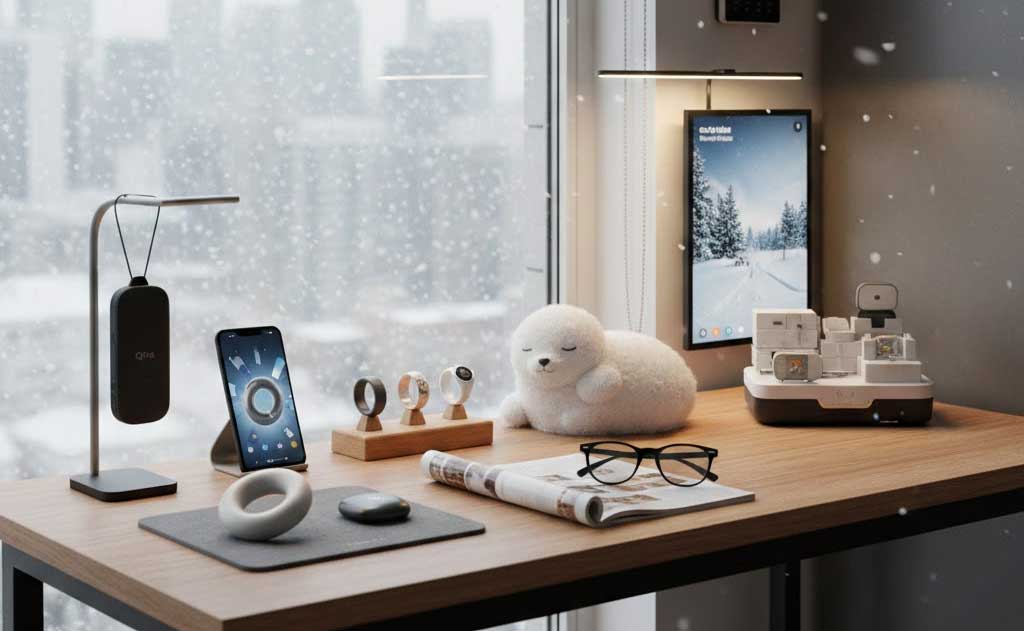
Canada’s 2026 AI gadget boom is here. Ethan Brooks dives into CES 2026 highlights—AI wearables, robot companions, smart home devices—plus adoption drivers, privacy concerns, and what’s actually landing in Toronto, Vancouver, Calgary & beyond.
By Ethan Brooks
January 22, 2026 – Toronto
I’m writing this from a snow-covered desk in Toronto, not some distant city. The wind is howling outside, the thermostat just dropped the temperature automatically because it knows I’m the only one home, and my phone keeps quietly suggesting I drink water because my sleep score last night was trash. Welcome to Canada in 2026: the year AI gadgets stopped feeling like science-fiction demos and started feeling like quiet, useful roommates.
For the last eight winters I’ve tracked how emerging technology actually survives (or dies) in Canadian living rooms, condos, basements and cottages. I’ve watched the Humane Pin and Rabbit R1 flame out spectacularly, followed funding rounds for on-device AI startups, read reams of consumer reports from Canadian retailers and spoken with product managers, utility executives and early adopters from St. John’s to Victoria. What’s clear in January 2026 is that Canadians are adopting AI-powered physical devices faster than almost every forecast predicted two years ago.
Why Canada Is Suddenly an AI Gadget Hot Spot
The numbers tell a straightforward story. Industry analysts now project Canada’s smart home market to grow at 9–11% CAGR through 2030, pushing the sector past CAD 6.5–7 billion by the end of the decade. AI-enabled wearables, smart thermostats, security systems and companion robots are the main drivers.
Several uniquely Canadian factors are accelerating the shift:
- Brutal winters + energy rebates Ontario’s Peak Perks, Hydro-Québec’s smart-thermostat giveaway programs, BC Hydro incentives and similar rebates in Manitoba and Saskatchewan turn an Ecobee Smart Thermostat or Nest Learning Thermostat into a product that pays for itself in 18–24 months.
- Urban density in the big three Greater Toronto, Metro Vancouver and Greater Montréal now contain roughly 40% of the population. High-rise condos, townhouse complexes and laneway houses make AI video doorbells, package lockers with facial recognition and motion-activated hallway lights almost mandatory.
- Post-pandemic remote/hybrid work habits Statistics Canada data still shows ~22–25% of the workforce fully or mostly remote in 2026. That keeps people sensitive to home-office ergonomics, air quality, lighting and background noise—exactly the problems AI desk lamps, air purifiers and meeting-transcription pendants solve.
- Pragmatic Gen Z & Millennial buyers Younger Canadians (18–34) lead in AI-tool usage for shopping, fitness, mental health journaling and even low-stakes companionship. They’re far less allergic to subscriptions than older cohorts if the value is obvious.
- PIPEDA + on-device AI momentum Canada’s privacy framework forces companies to prioritize local processing. The 2025–2026 generation of gadgets (Lenovo Qira, SwitchBot MindClip, Pebble Index ring, updated Ray-Ban Meta glasses) leans heavily on on-device models, which resonates here.
Here’s the bottom line I keep hearing from industry contacts in Waterloo, Vancouver and Ottawa: Canada is not inventing most of this hardware, but we are one of the fastest-growing paying early-majority markets in the G7.
CES 2026 Highlights That Are Already Shipping to Canadian Doorsteps
This year’s CES (which I followed obsessively from Toronto while the city got blanketed in 40 cm of snow) felt like the moment AI hardware finally graduated from “interesting prototype” to “I put this on my credit card” territory.
Wearables & “Second Brain” Devices
- Lenovo Qira ecosystem (pendant + phone + laptop agents) — always-listening but processes most queries on-device; Canadians are buying the pendant version fastest because it works offline on GO trains and in cottages with spotty LTE.
- SwitchBot AI MindClip + Pebble Index smart ring — conversation recording, real-time summarization, calendar auto-fill. The ring is selling particularly well in Toronto and Vancouver among lawyers, consultants and grad students.
- Ray-Ban Meta Gen 3 — improved battery life, live translation, discreet recording. Popular among bilingual professionals in Montréal and Ottawa.
- Oura Ring 4 / RingConn Gen 3 / Ultrahuman Ring Air 2026 refresh — sleep, stress, recovery + new proactive “coach” prompts. Oura still dominates, but subscription-free competitors are gaining.
Companion & Home Helper Robots
- Ecovacs LilMilo — seal-puppy-looking emotional-support robot with biometric mood detection. Early sales data show surprisingly strong demand in senior-heavy suburbs (Richmond Hill, Surrey, Kanata).
- SwitchBot KATA + TCL AiMe modular robot — laundry folding, fridge organizing, basic fetch tasks. KATA is moving quickly in family households.
- LG CLOiD series — more practical than humanoid showboats; Canadians seem to prefer robots that actually do laundry over ones that philosophize.
Smart Home Standouts
- Samsung Family Hub refrigerators with Gemini integration
- Govee Immersion lighting + AI scene generation
- Ecobee Smart Thermostat Premium (now with better occupancy prediction)
- Ring / Arlo / Wyze cameras with facial + package recognition
The recurring theme from CES 2026 conversations: after the 2024–2025 hardware flops, companies finally learned to ship products that solve one or two painful problems really well instead of promising to replace your entire life.
Which Categories Are Actually Taking Off in Canada Right Now
1. Proactive Health & Recovery Wearables Rings and pendants that don’t just track—they coach. Canadians in their 30s and 40s are buying these to manage burnout, perimenopause symptoms, shift-work sleep disruption and long-COVID recovery. Price point: CAD 350–600. The no-subscription models (RingConn, some Pebble variants) are winning on Reddit and in Toronto Facebook groups.
2. Energy-Saving Smart Thermostats & HVAC Controllers Ecobee remains the Canadian favourite because of native Alexa + HomeKit + Google support plus the rebate programs. People in Calgary and Edmonton are adding AI vents (Flair Pucks, etc.) to fight uneven heating in older houses.
3. Security & Package Ecosystems AI doorbells that distinguish between family members, delivery drivers and porch pirates. Flood of sales in GTA and Lower Mainland after multiple winter package-theft waves.
4. Emotional-Support & Low-Level Companion Robots LilMilo and similar devices are quietly selling to empty-nesters, single seniors and young adults living alone in expensive one-bedrooms. Mental-health charities have started pilot programs with a few models.
5. Meeting & Memory Augmentation Tools The MindClip / Qira / Pebble Index category is exploding among knowledge workers. Transcription + summarization + searchable memory is worth the “always listening” trade-off for many.
The Real Obstacles That Could Slow the Rollout
Canadians aren’t blindly throwing money at shiny objects. Several friction points remain:
- Sticker shock in CAD — A $299 US gadget frequently lands at $420–480 after duties, taxes and currency conversion.
- Privacy anxiety — PIPEDA compliance is good, but many people still hesitate about always-on microphones and cameras. On-device processing helps, yet trust is fragile.
- Interoperability pain — Matter 1.2 and 1.3 are improving things, but we’re not fully there yet.
- Rural & small-town lag — Adoption is heavily concentrated in the Golden Horseshoe, Lower Mainland and Greater Montréal. Outside those zones, spotty internet and fewer rebates slow things down.
- Energy irony — A robot that folds laundry while the grid is carbon-intensive still feels hypocritical to many eco-conscious buyers.
Looking Forward: 2026–2027 in Canadian Living Rooms
If the trajectory holds, 2026 will be remembered as the year AI gadgets crossed from “nice to have” to “quietly essential” for a meaningful slice of urban and suburban Canada.
We won’t see humanoid butlers walking dogs in Rosedale anytime soon, but we will see:
- more people wearing a smart ring or pendant that quietly catches calendar conflicts and health red flags
- thermostats that learn when you actually leave for the office and save hundreds on heating bills
- a small robot pet or helper in homes where someone lives alone
- video doorbells that stop notifying you every time a crow lands on the porch
From where I sit—watching snowfall accumulate on the balcony while my own smart home quietly adjusts the blinds—I think the real story isn’t the gadgets themselves. It’s how quickly pragmatic Canadians decided which ones actually make life in this country a little easier, a little warmer, and a little less overwhelming.
I’m Ethan, and I write about the tech that’s actually going to change how we live — not the stuff that just sounds impressive in a press release. I cover AI, EVs, robotics, and future tech for VFuture Media. I was on the ground at CES 2026 in Las Vegas, walking the show floor so I could give you a real read on what matters and what’s just noise. Follow me on X for daily takes.
What AI gadget has already earned a permanent spot in your Canadian home? Or are you still waiting on the sidelines? Drop a comment—I read every one.



Leave a Comment