
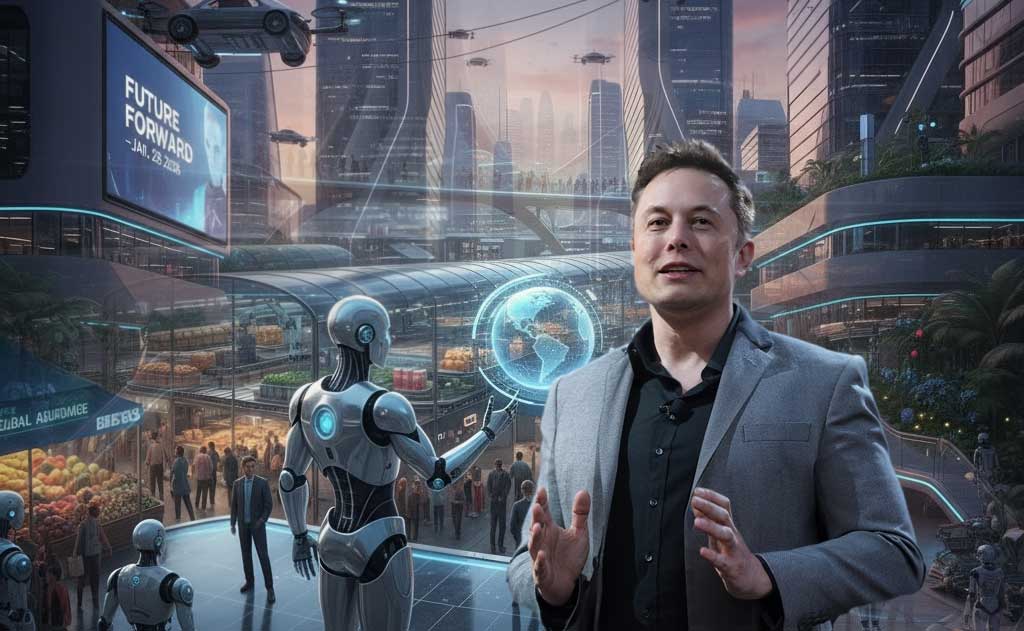
Elon Musk continues to deliver some of the most provocative—and polarizing—predictions about the future of technology. In recent interviews, including his high-profile debut at the World Economic Forum in Davos in January 2026, alongside earlier 2025 discussions, he outlined a timeline where AI surpasses human intelligence, humanoid robots become ubiquitous, self-driving dominates transportation, and goods and services approach “close to free” in an era of radical abundance.
These claims aren’t new for Musk, but they’ve sharpened in 2026 amid rapid progress at xAI, Tesla Optimus advancements, and Tesla’s robotaxi pilots. Here’s a breakdown of each statement, with direct context from his recent remarks, timelines, and grounded analysis.
1. In 10 Years, AI Will Be Smarter Than the Smartest Human
Musk has accelerated his AGI (artificial general intelligence) forecasts dramatically. In his Davos 2026 panel with BlackRock CEO Larry Fink, he said AI could be smarter than any individual human “by the end of this year” (2026) or no later than next year, with collective human-level intelligence surpassed by 2030–2031 (roughly 5 years from then). Earlier predictions (2024–2025) pointed to superhuman AI by end-2025 or 2026, often citing bottlenecks like electricity supply shifting from chips to power infrastructure.
This aligns with xAI’s Grok models advancing quickly, but as of January 2026, no system fully outperforms top humans across all domains without limitations. Musk frames it as exponential: once AI exceeds the smartest person, it compounds rapidly toward superintelligence.
2. There Will Be Billions of Humanoid Robots
This is a recurring Musk theme, emphasized heavily at Davos 2026: “There will be billions of humanoid robots… everyone on Earth is going to have one and want one.” He predicts robots will “saturate human needs,” handling childcare, elder care, pets, chores, and more—outnumbering humans and decoupling productivity from labor.
Tesla’s Optimus roadmap supports this: simple factory tasks by end-2026, complex industrial work soon after, public sales by end-2027 (assuming high reliability). Musk envisions 10 billion+ by 2040 at low costs ($20K–$25K range). Competitors in China and elsewhere are scaling too, but billions in a decade would require massive breakthroughs in manufacturing, energy, and safety.
3. All Cars Will Be Self-Driving, 90% of Miles Driven Will Be Autonomous
Musk often stresses the “90% of miles” metric over “90% of cars.” In 2025–2026 comments (including Davos), he predicted 50% of miles autonomous in ~5 years and 90% in ~10 years. Tesla’s Full Self-Driving (Supervised) has improved markedly with real-world data, and unsupervised robotaxis launched in limited areas like Austin by 2026 (initially with monitors, now scaling).
True Level 4/5 autonomy (no supervision) remains challenging—regulatory approval, edge cases, and safety data are hurdles. Waymo leads in robotaxi ops in several cities, but Musk argues Tesla’s camera-only approach and fleet data will win long-term. Global “all cars” self-driving is farther out, but high-adoption corridors could hit 90% autonomous miles by 2035–2040 if trends hold.
4. Goods and Services Will Become Close to Free
This caps Musk’s “age of abundance” thesis. In Davos 2026 and prior interviews (e.g., with Ted Cruz, Peter Diamandis), he said goods and services will become “close to free” or “almost free” due to AI + robotics producing endlessly, eliminating scarcity. No shortages, universal high income (not just basic), work optional, superhuman healthcare/education/entertainment for all.
He ties it to billions of robots saturating needs, making money irrelevant (like oxygen today). In optimistic scenarios, poverty ends, living standards soar beyond today’s richest. Critics highlight risks: energy constraints (Musk flags electricity shortages), unequal access, job displacement, and purpose crises (“What do people do?”). Economists debate equitable distribution or new scarcities (land, attention).
Musk sees this as likely in a “benign” path (70–80% probability), with AI/robotics as the route to sustainable abundance for humanity.
Why These Predictions Matter in 2026
Musk’s vision is cohesive: superintelligent AI → mass humanoid robots → autonomous everything → post-scarcity abundance. Timelines are optimistic (he’s adjusted AGI from earlier dates), but direction tracks real progress—xAI models, Optimus prototypes in factories, Tesla FSD data loops, and energy discussions.
As a tech journalist, I see plausibility in pieces: widespread autonomy in cities, cheaper robotics for industry, productivity explosions from AI. Billions of personal robots and truly “free” goods hinge on scaling, policy, and societal shifts. Electricity remains the biggest near-term limiter Musk repeatedly flags.
What grabs you most here—the abundance promise, robot timelines, or AI risks? Or any specific part you’d like a deeper dive on? Stay tuned to VFuture Media for coverage on these emerging trends.
I’m Ethan, and I write about the tech that’s actually going to change how we live — not the stuff that just sounds impressive in a press release. I cover AI, EVs, robotics, and future tech for VFuture Media. I was on the ground at CES 2026 in Las Vegas, walking the show floor so I could give you a real read on what matters and what’s just noise. Follow me on X for daily takes.


Leave a Comment