
By VFuture Media Team Published: February 15, 2026 vfuturemedia
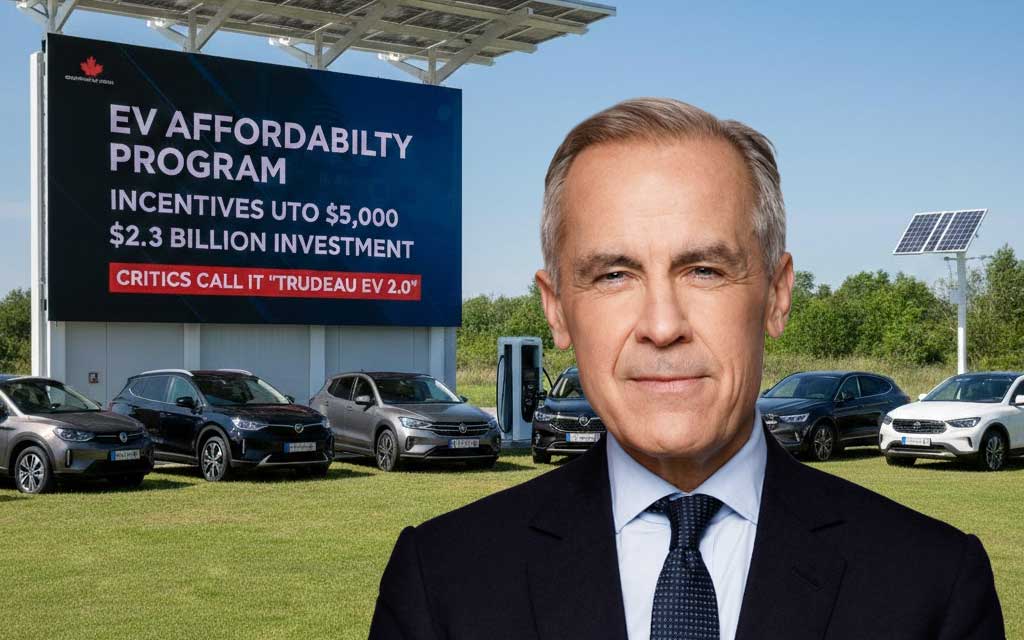
In a major policy shift announced on February 5, 2026, Prime Minister Mark Carney unveiled a revamped national automotive strategy that scraps the previous electric vehicle (EV) sales mandate while launching a $2.3 billion five-year EV Affordability Program. The initiative aims to boost consumer demand for EVs and plug-in hybrids (PHEVs) through direct purchase or lease incentives, with a focus on supporting Canada’s auto industry amid trade pressures and flagging EV adoption.
The program offers up to $5,000 for battery electric vehicles (BEVs) and fuel cell EVs, and up to $2,500 for PHEVs priced up to $50,000 (for vehicles from countries with free trade agreements with Canada). Notably, this price cap does not apply to Canadian-made EVs or PHEVs, exempting models like the Dodge Charger Daytona EV—assembled in Windsor, Ontario—from the limit.
Key Details of the $2.3 Billion EV Affordability Program
The Electric Vehicle Affordability Program (EVAP) replaces the paused iZEV rebate system and runs from 2026 to 2030, with incentives decreasing annually to manage costs:
- 2026: Up to $5,000 for BEVs/fuel cell EVs; up to $2,500 for PHEVs.
- 2027: $4,000 / $2,000 (approximate, based on tiered reductions).
- 2028-2029: Further declines (e.g., $3,000 range).
- 2030: Down to around $2,000 for BEVs.
The government projects this could incentivize over 840,000 new EVs. Rebates apply at the point of sale or lease for eligible vehicles, starting February 16, 2026. The $50,000 cap excludes Chinese-made vehicles but favors North American and FTA partners.
The Dodge Charger Daytona: Canada’s Sole Eligible EV Benefiting from No Price Cap
Currently, the Dodge Charger Daytona EV stands as the primary (and perhaps only) fully electric vehicle assembled in Canada qualifying under the program. Built at Stellantis’ Windsor Assembly Plant in Ontario:
- The 2026 model starts around $62,000-$69,000 CAD for Scat Pack variants (coupe and sedan configurations), with higher trims reaching $80,000+ before fees and options.
- Earlier R/T models (around $55,000-$58,000) were discontinued for 2026 due to market and tariff factors.
Since it’s Canadian-made, buyers can access the full incentive regardless of the vehicle’s price—potentially making higher-performance models more attractive despite starting above $60,000. This exemption aims to bolster domestic manufacturing and jobs in Ontario’s auto sector.
Total Cost of the Plan and Broader Net-Zero Funding
The EV Affordability Program itself totals $2.3 billion CAD over five years, funded through federal budgets as part of broader economic and climate strategies. This is separate from other announcements in the auto package, including:
- Up to $3 billion from the Strategic Response Fund for auto industry adaptation.
- $1.5 billion for EV charging and hydrogen infrastructure.
Prime Minister Carney’s net-zero ambitions—targeting 75% EV sales by 2035 and 90% by 2040 via stronger emissions standards rather than mandates—are supported through a mix of public investments, private sector alignment, and industrial supports. Funding draws from general revenues, reallocated funds (e.g., from paused programs), and strategic economic initiatives. Critics argue these subsidies represent taxpayer dollars propping up EV adoption amid slower market demand, with limited direct benefits to Canadian-made vehicles beyond the Charger Daytona.
Is This “Trudeau EV 2.0”? Mixed Reactions and Criticisms
The announcement has drawn comparisons to former Prime Minister Justin Trudeau’s iZEV program (which offered similar $5,000 rebates before exhausting funds). Supporters praise the shift from rigid mandates to incentives as pragmatic, protecting jobs and competitiveness under U.S. tariff threats while advancing clean tech goals.
However, skeptics—including some analysts and opinion writers—call it “Trudeau EV 2.0,” arguing the rebates primarily benefit foreign-made EVs (e.g., from the U.S. or Europe) rather than revitalizing Ontario’s plants, which produce few qualifying models. Environmental groups have expressed disappointment over scrapping the mandate, viewing it as a setback for aggressive climate action.
Carney framed the strategy as balancing economic resilience, job protection, and net-zero progress in a volatile global environment.
Why This Matters for Canadians in 2026
With EV sales lagging and trade uncertainties looming, the program seeks to make cleaner vehicles more accessible while prioritizing domestic production. For buyers eyeing the Dodge Charger Daytona EV or other eligible models, the incentives could offset costs significantly—especially for Canadian-assembled options.
At VFuture Media, we track policy shifts in sustainable transport and energy. This move signals a carrot-over-stick approach to electrification—will it accelerate adoption or fall short?
What do you think of Carney’s EV strategy? Share your views in the comments below.
Ethan Brooks covers electric vehicles and clean mobility for VFuture Media. He tracks EV market trends, charging infrastructure, new model launches, and the increasingly blurry line between software and transportation. From Tesla’s autonomous driving milestones to Europe’s surging BEV sales, Ethan follows the numbers and the narratives behind them. He writes for readers who want the full picture on where the EV industry is actually headed — not just where brands say it is.
We started VFuture Media because we wanted tech news written by people who actually follow this industry — not content farms chasing keywords. If that resonates, we’d love to have you as a regular reader. Pull up a chair.



Leave a Comment