
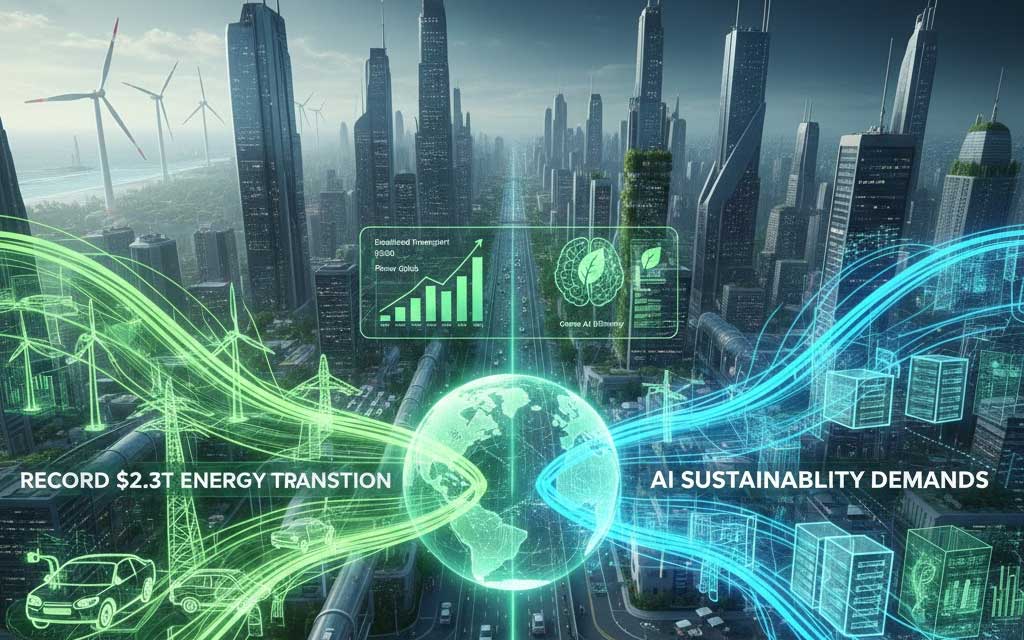
The 2026 Green Tech Turning Point The 2026 Green Tech Turning Point: Record $2.3T Energy Transition Investments Meet AI Sustainability Demands is a pivotal year where massive clean energy capital flows converge with exploding AI-driven power needs. Global energy transition investment hit a historic $2.3 trillion in 2025—up 8% from 2024—despite policy uncertainties and market adjustments (BloombergNEF, January 2026). This surge, led by electrified transport, renewables, and grid infrastructure, sets the stage for 2026 as the year AI and sustainability truly intersect.
PwC identifies 2026 as a turning point for AI-sustainability convergence, where business returns drive “Green AI” efficiency, net-zero strategies, and responsible innovation to balance AI’s energy footprint with decarbonization gains (PwC 2026 AI Business Predictions).
Introduction: The Momentum from 2025’s Record-Breaking Investments
In 2025, global investment in the energy transition reached an unprecedented $2.3 trillion, an 8% increase year-over-year, defying headwinds like regulatory changes in China and policy shifts elsewhere (BloombergNEF Energy Transition Investment Trends 2026). This figure encompasses deployment of clean technologies, supply chain buildout, climate-tech equity, and transition-related debt.
Key drivers included:
- Electrified transport: $893 billion (up 21%), fueled by EVs and charging infrastructure.
- Renewable energy: $690 billion (down 9.5% due to China’s market adjustments, but still massive).
- Power grids: $483 billion, reflecting urgent needs to integrate renewables and handle rising demand.
Clean energy supply chain investment rose to $127 billion, while debt issuance for the transition climbed 17% to $1.2 trillion. Asia Pacific—led by China—accounted for nearly half of global spending, underscoring regional leadership.
These investments outpaced fossil fuel supply for the second year, signaling irreversible momentum toward low-carbon systems.
Breakdown of 2025’s $2.3 Trillion: Key Sectors and Regional Leadership
BloombergNEF’s data highlights three dominant categories comprising the bulk of spending:
- Electrified Transport ($893B): EVs and infrastructure surged 21%, driven by cost declines and policy support. This sector alone reflects accelerating adoption in passenger and commercial vehicles.
- Renewables ($690B): Solar and wind remained core, though a dip occurred from China’s power market reforms introducing uncertainty.
- Grids ($483B): Essential for renewable integration and rising loads, including from AI data centers.
Asia led regionally, with China dominating clean energy as an economic driver. Clean-energy sectors contributed over a third of China’s GDP growth in 2025 and more than 90% of investment rises, generating 15.4 trillion yuan (~$2.1 trillion) or 11.4% of GDP—comparable to Brazil or Canada (Carbon Brief / Centre for Research on Energy and Clean Air, February 2026; The Guardian, February 2026).
In the US, investment rose 3.5% to $378 billion, showing resilience. BloombergNEF projects average annual investment reaching $2.9 trillion over the next five years under baseline scenarios.
China’s Clean Energy as a GDP Powerhouse
China’s clean energy boom transformed it into a global leader. In 2025, investments hit ~7.2 trillion yuan (~$1 trillion)—four times fossil fuel extraction spending. Sectors like solar, EVs, and batteries drove growth three times faster than the overall economy.
Without clean energy, China’s GDP growth would have been ~3.5% instead of the reported 5%. This positions China to potentially see solar overtake coal in electricity generation by 2026, accelerating global transitions (Carbon Brief, February 2026).
AI’s Explosive Demands Meet Green Tech Innovations
AI’s rapid expansion—fueled by frontier models and data centers—creates massive power and cooling challenges. Data centers could consume 6-12% of US electricity by 2028, straining grids and raising sustainability concerns.
2026 emerges as the convergence year. PwC predicts AI will connect sustainability to performance and risk, enabling energy-efficient decisions and net-zero pathways. “Green AI” optimizes workloads, uses carbon-aware scheduling, and delivers net-positive environmental impact through efficiency gains that could offset AI’s energy use (PwC 2026 AI Predictions).
Key innovations addressing AI demands:
- Sodium-Ion Batteries: Ideal for stationary storage in AI data centers due to cost, safety, and supply chain advantages over lithium. Energy Vault and Peak Energy signed a 1.5 GWh supply deal in February 2026 for AI-first platforms, enabling faster deployment and lower costs while qualifying for domestic incentives (Electrek / Business Wire, February 2026).
- Advanced Cooling Technologies: Markets for active, passive, and solid-state cooling grow sharply through 2036, driven by AI data centers (power densities >100 kW/rack), EVs, and quantum computing. Innovations include graphene, metamaterials, liquid-air hybrids, and direct-to-chip systems for high-density AI workloads (ResearchAndMarkets Global Active, Passive and Solid-State Cooling Markets 2026-2036; AIRSYS / TierPoint, 2026 reports).
These solutions mitigate AI’s environmental footprint while supporting scalability.
Top Green Tech Trends to Watch in 2026
- AI-Optimized Energy Management → Platforms use AI for demand forecasting, arbitrage, and efficiency.
- Sustainable Storage Surge → Sodium-ion scales for volatile AI loads.
- Next-Gen Cooling → Liquid and hybrid systems handle 30-100+ kW/rack densities.
- Net-Zero AI Strategies → Companies prioritize responsible deployment for business returns.
- Grid Modernization Acceleration → Investments rise to support AI and renewables integration.
- Global Supply Chain Resilience → Domestic manufacturing (e.g., US sodium-ion) reduces risks.
For more on sustainable mobility, see our guide to EV adoption trends in India.
Conclusion: Actionable Steps for Businesses in the 2026 Turning Point
2026 represents a decisive moment: $2.3 trillion momentum meets AI’s sustainability imperative. Businesses must act decisively:
- Adopt Green AI practices: Optimize models, schedule carbon-aware computing, and measure emissions.
- Invest in innovative storage and cooling: Explore sodium-ion and advanced systems for data centers.
- Align with net-zero goals: Integrate AI for efficiency while prioritizing responsible governance.
- Partner across sectors: Collaborate on grids, renewables, and supply chains.
Future predictions: By 2030, AI inference dominates workloads, driving further cooling/storage demand. Clean energy could accelerate to $2.9T+ annually, with breakthroughs enabling net-positive outcomes. The transition is not just viable—it’s accelerating, offering competitive advantages to early adopters.
FAQ
What drove the $2.3 trillion in 2025 energy transition investment? Electrified transport ($893B), renewables ($690B), and grids ($483B) led, per BloombergNEF.
How is China leading the clean energy economy? Clean sectors drove >1/3 of 2025 GDP growth and >90% of investment rises, reaching 11.4% of GDP (Carbon Brief, 2026).
Why is 2026 pivotal for AI and sustainability? PwC forecasts convergence where AI boosts efficiency and net-zero strategies deliver business value.
What role do sodium-ion batteries play? They offer cost-effective, safe storage for AI data centers, with major deals like 1.5 GWh in 2026 (Energy Vault/Peak Energy).
How are cooling technologies evolving for AI? Advanced solutions like liquid hybrids and solid-state handle extreme densities, growing significantly 2026-2036 (ResearchAndMarkets).
Ethan Brooks covers the tech that’s reshaping how we move, work, and think — for VFuture Media. He was at CES 2026 in Las Vegas when the world got its first real look at humanoid robots, AI-powered vehicles, and Samsung’s tri-fold phone. He writes about AI, EVs, gadgets, and green tech every week. No hype. No filler. X · Facebook
For deeper dives into AI infrastructure, check our AI sustainability series.



Leave a Comment