
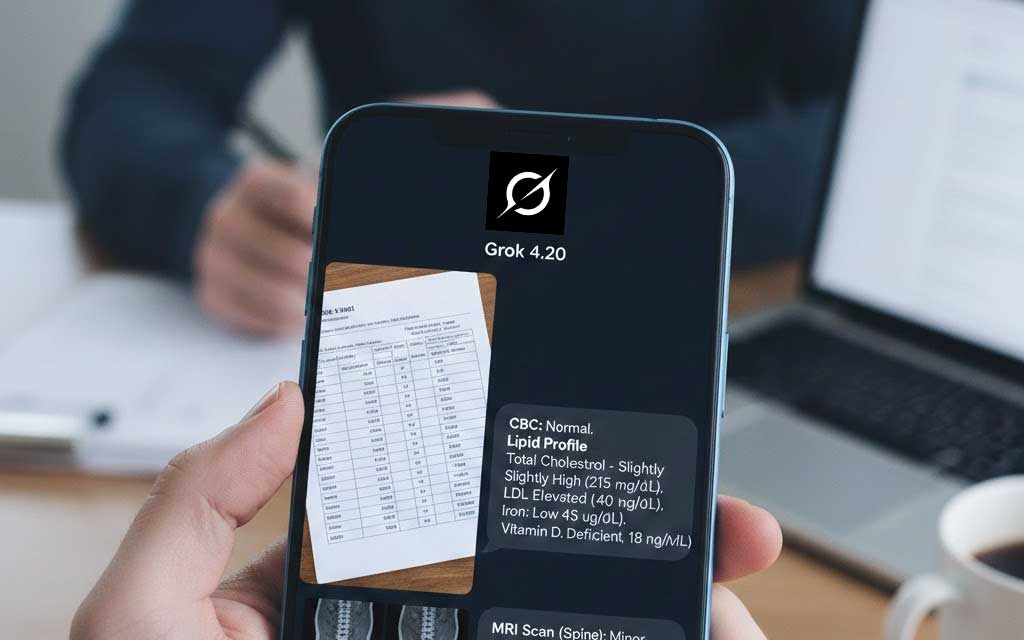
In a bold leap forward for accessible AI-driven health monitoring, xAI’s latest iteration, Grok 4.20, is earning widespread acclaim for its rapid and detailed analysis of blood tests, lab reports, and even complex medical imaging like MRIs. Users worldwide are uploading photos of their medical documents directly to the Grok chatbot on X (formerly Twitter) or via grok, receiving breakdowns that explain results in plain language, highlight anomalies, and suggest potential implications—often in seconds.
Elon Musk, xAI founder and CEO, has actively promoted this capability, recently reposting user praise on X: “Grok 4.20 is insanely good and quick at analyzing blood tests! You can literally upload your lab results — even an MRI — and Grok breaks it down for you.” Musk emphasized the ease: “You can just take a picture of your medical data or upload the file to get a second opinion from Grok.”
How Grok 4.20 Handles Medical Data
Grok’s multimodal capabilities—built on advanced vision and reasoning models—allow it to:
- Interpret blood test panels (CBC, lipid profiles, thyroid function, liver/kidney markers, etc.), comparing values against standard reference ranges and flagging deviations.
- Analyze uploaded images of lab reports (scanned PDFs or phone photos) for text extraction and contextual explanation.
- Process medical scans such as X-rays, MRIs, CTs, or PET images, providing observations on visible structures, potential abnormalities, and cross-references to medical knowledge bases.
Users report Grok delivering structured outputs: normal/abnormal markers, explanations of terms (e.g., elevated HbA1c indicating prediabetes risk), and even comparative insights from vast training data. Anecdotal examples include Grok spotting patterns in blood work that aligned with or supplemented physician advice, and detailed feedback on spine MRIs or other scans.
This feature stems from Grok’s evolving multimodal training, enhanced in recent updates to handle real-world uploads with high speed and accuracy. Musk has cited cases where Grok’s interpretations matched or exceeded professional readings, positioning it as a tool for preliminary insights or second opinions.
Expert Perspectives and Cautions
While user enthusiasm is high— with thousands of shares and positive testimonials—medical professionals urge caution. Radiologists and physicians note that AI tools like Grok excel in pattern recognition but can produce errors in nuanced cases (e.g., misinterpreting rare conditions or lacking full patient history/context). Privacy experts highlight risks of sharing sensitive health data with non-regulated platforms.
Grok is not a certified medical device and xAI emphasizes it as an informational aid, not a substitute for professional diagnosis. Users are advised to consult qualified healthcare providers for any health concerns, using Grok only as a supplementary tool.
Why This Matters in 2026
As AI democratizes health information, Grok 4.20 exemplifies the shift toward on-demand, user-friendly analysis. With no subscription barriers for core features (Grok is accessible via X or standalone apps), it empowers individuals to better understand their results between doctor visits—potentially accelerating awareness of issues like metabolic imbalances or imaging findings.
xAI continues to iterate rapidly, with Grok’s real-time knowledge and vision integration setting it apart in the competitive AI landscape. As adoption grows, this capability could redefine personal health literacy, though balanced with medical oversight remains essential.
For the latest on Grok updates, visit grok or follow @xAI on X. Always prioritize professional medical advice over AI interpretations.
This article is for informational purposes only and does not constitute medical advice. Consult a licensed healthcare professional for personalized health guidance.
Ethan Brooks covers the tech that’s reshaping how we move, work, and think — for VFuture Media. He was at CES 2026 in Las Vegas when the world got its first real look at humanoid robots, AI-powered vehicles, and Samsung’s tri-fold phone. He writes about AI, EVs, gadgets, and green tech every week. No hype. No filler. X · Facebook
We started VFuture Media because we wanted tech news written by people who actually follow this industry — not content farms chasing keywords. If that resonates, we’d love to have you as a regular reader. Pull up a chair.




Leave a Comment