
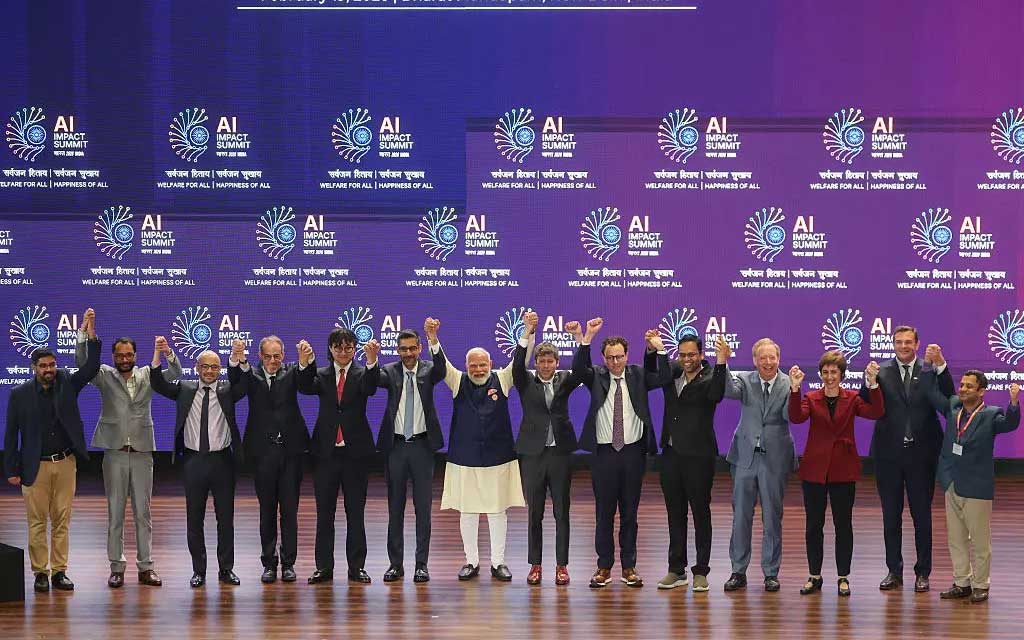
The India AI Impact Summit 2026, held from February 16–20 (with some events extending to 21) at Bharat Mandapam in New Delhi, wrapped up as a landmark event positioning India as a key player in responsible, inclusive, and sovereign AI development. Hosted by the Government of India under the theme “From Vision to Action,” the summit drew leaders from over 100 countries, heads of state, global tech CEOs including Google’s Sundar Pichai, OpenAI’s Sam Altman, Anthropic’s Dario Amodei, Microsoft executives, and Prime Minister Narendra Modi, who inaugurated key sessions.
Billed as the first major high-level AI gathering in the Global South, the event emphasized AI for public good, economic inclusion, job creation, skilling, and ethical governance—while addressing risks and the digital divide.
Major Outcomes and Announcements
- Investment Pledges Exceed $250 Billion: Infrastructure-related commitments surpassed $250 billion, with additional ~$20 billion in deep-tech venture capital and startup funding. Highlights include:
- Google: $15 billion investment to establish a full-stack AI hub in Visakhapatnam (Vizag), Andhra Pradesh—including gigawatt-scale compute, data centers, and a new subsea gateway—transforming the coastal city into a global AI center.
- Microsoft: On track for $50 billion by 2030 to expand AI infrastructure in the Global South, with India as a core focus (building on prior commitments).
- Reliance Industries & Jio: $110 billion over seven years for AI and data infrastructure.
- Adani Group: $100 billion for renewable-powered AI data centers by 2035.
- Other players like Tata Sons outlined large-scale plans in semiconductors, EVs, and AI manufacturing. These pledges signal strong global confidence in India’s AI ecosystem and potential for massive job creation and tech self-reliance.
- Delhi Declaration / AI Impact Summit Declaration: Adopted with support from 86 countries and two international organizations (including major players like the US, UK, Canada, China, Germany, and others). The declaration emphasizes shared principles for responsible, inclusive AI that benefits humanity, equitable access, ethical governance, and collaboration on risks. Final signatories and details were maximized post-summit for broader consensus.
- India Joins US-Led Pax Silica Alliance: On February 20, India formally signed the Pax Silica Declaration, becoming the 10th member of this US-initiated coalition (joining Australia, Israel, Japan, Qatar, South Korea, Singapore, UAE, UK, and others). The alliance focuses on securing democratic governance of the global silicon/AI supply chain, promoting pro-innovation regulations, trusted ecosystems, and reducing dependencies—deepening India-US strategic tech ties.
- Indigenous AI and Skilling Advances: Launches of multilingual foundation models under the IndiaAI Mission, expanded compute resources (adding 20,000+ GPUs), and focus on AI for public services, healthcare, education, and MSMEs. Andhra Pradesh signed MoUs with IBM, NVIDIA, IIT Madras, and others for quantum computing labs and AI centers. A Guinness World Record was set with over 250,000 students pledging for responsible AI use in 24 hours.
Challenges and Criticisms
While hailed as a “grand success” by IT Minister Ashwini Vaishnaw (with over 5 lakh visitors and strong ministerial/CEO engagement), the summit faced logistical issues—traffic chaos, organizational hiccups, and some criticism from groups like Amnesty International for not sufficiently addressing risks from governments/tech firms or ensuring civil society voices. Despite these, the depth of dialogue and commitments underscored India’s rising role in shaping global AI norms.
Why This Matters for the Future of AI
The summit transitions AI from hype to tangible impact—focusing on sovereign models, frugal innovation, Global South inclusion, and infrastructure buildout. For emerging tech ecosystems, it highlights opportunities in compute access, skilling millions, and public-good applications while navigating geopolitical dynamics.
vFutureMedia tracks AI governance, infrastructure investments, global partnerships, and their implications for innovation, jobs, and sustainable development. The India AI Impact Summit 2026 sets a strong foundation for “Viksit Bharat” and inclusive global AI progress. For more details, visit the official site at impact.indiaai.gov.in or follow updates from PIB and participating organizations. Stay tuned for deeper analysis on how these pledges will shape India’s AI landscape!
I’m Ethan, and I write about the tech that’s actually going to change how we live — not the stuff that just sounds impressive in a press release. I cover AI, EVs, robotics, and future tech for VFuture Media. I was on the ground at CES 2026 in Las Vegas, walking the show floor so I could give you a real read on what matters and what’s just noise. Follow me on X for daily takes.
If you found this useful, the best thing you can do is share it with someone who’d actually appreciate it. And if you want more like it, we’re here every week.


Leave a Comment