
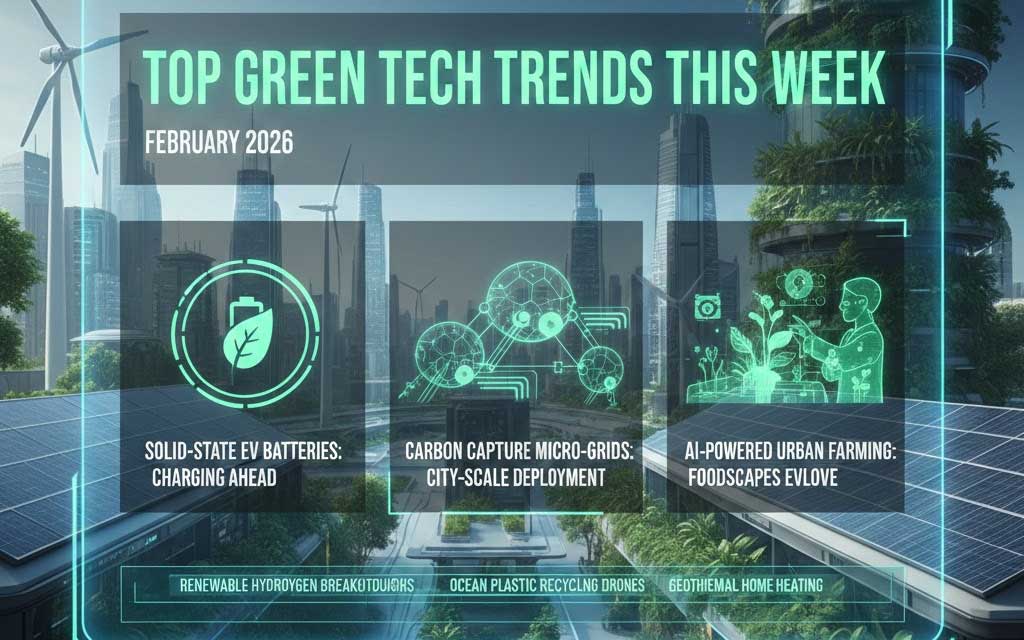
Washington, D.C., February 21, 2026 — The green technology sector is heating up with innovative advancements addressing energy storage, solar manufacturing costs, and urban climate resilience. This week’s highlights spotlight three major trends: sodium-ion batteries gaining real-world momentum, the solar industry’s rapid pivot away from expensive silver, and next-generation radiative cooling coatings designed to combat rising city temperatures. These developments signal progress toward more affordable, sustainable, and practical clean energy solutions amid ongoing global challenges.
- Sodium-Ion Batteries Unlock Mass-Production Milestones Sodium-ion technology is moving from lab promise to commercial reality, offering a cheaper, safer, and more abundant alternative to lithium-ion batteries. CATL and Changan Automobile unveiled the world’s first mass-production passenger vehicle equipped with sodium-ion batteries, set for market launch by mid-2026. CATL’s Naxtra batteries deliver up to 175 Wh/kg energy density, with advantages in cold-weather performance and lower material costs using abundant sodium resources. Recent breakthroughs include a University of Surrey discovery where a “wet” sodium-based material stores nearly twice the charge, charges faster, and maintains stability over hundreds of cycles—potentially rivaling lithium while enabling dual-use applications like desalinating seawater. BYD reported sodium-ion variants with up to 10,000 cycles, and Japanese researchers advanced solid-state versions with phosphorus additions for enhanced safety and performance. Analysts see 2026 as a pivotal year for sodium-ion adoption in EVs, grid storage, and beyond, with the global market projected to grow significantly.
- Solar Industry Accelerates Silver Reduction and Substitution Soaring silver prices—up dramatically in recent years—are pushing solar manufacturers to slash usage or eliminate silver entirely from photovoltaic cells. Reuters reports the industry is intensifying shifts to copper-based alternatives, with silver paste costs per module jumping sharply and threatening margins amid overcapacity. Leading Chinese firms like Longi, Jinko, and Aiko are advancing copper metallization and hybrid pastes, with mass production of silver-reduced or silver-free cells expected in Q2 2026. This could save billions annually while maintaining efficiency, though challenges like conductivity and oxidation persist. The move addresses silver’s rising share of module costs (now 17–29% per watt in some cases) and supports scalable solar growth, even as substitution trends accelerate due to price pressures.
- Cooling Coatings Advance for Hotter Cities and Fire-Safe Buildings Passive radiative cooling coatings are emerging as a key tool for urban heat mitigation, reflecting sunlight and emitting heat to space without energy input. A new international study optimizes these coatings to lower building surface temperatures further while enhancing fire safety—critical for hot cities facing extreme heat and wildfire risks. Innovations include carbon-negative designs using CO₂-sequestered fillers for full lifecycle emissions reductions, and replaceable cement-based panels that outperform traditional coatings in temperature stability. Field tests show potential to cut indoor cooling needs significantly, reducing energy bills and urban heat island effects. These materials promise durable, low-maintenance solutions for roofs, walls, and infrastructure in warming climates.
These trends highlight 2026’s focus on cost-effective, scalable green innovations: diversifying beyond lithium for batteries, optimizing solar economics, and deploying passive cooling to build resilient cities. As policy, investment, and technology converge, expect accelerated deployment in EVs, renewables, and urban sustainability.
Compiled from sources including ScienceDaily, Reuters, Electrek, MIT Technology Review, TechXplore, Nature, CATL announcements, and industry analyses as of February 21, 2026.
Ethan Brooks covers the tech that’s reshaping how we move, work, and think — for VFuture Media. He was at CES 2026 in Las Vegas when the world got its first real look at humanoid robots, AI-powered vehicles, and Samsung’s tri-fold phone. He writes about AI, EVs, gadgets, and green tech every week. No hype. No filler. X · Facebook
We started VFuture Media because we wanted tech news written by people who actually follow this industry — not content farms chasing keywords. If that resonates, we’d love to have you as a regular reader. Pull up a chair.


Leave a Comment