
By Ethan Brooks Published: February 23, 2026 vFuture Media
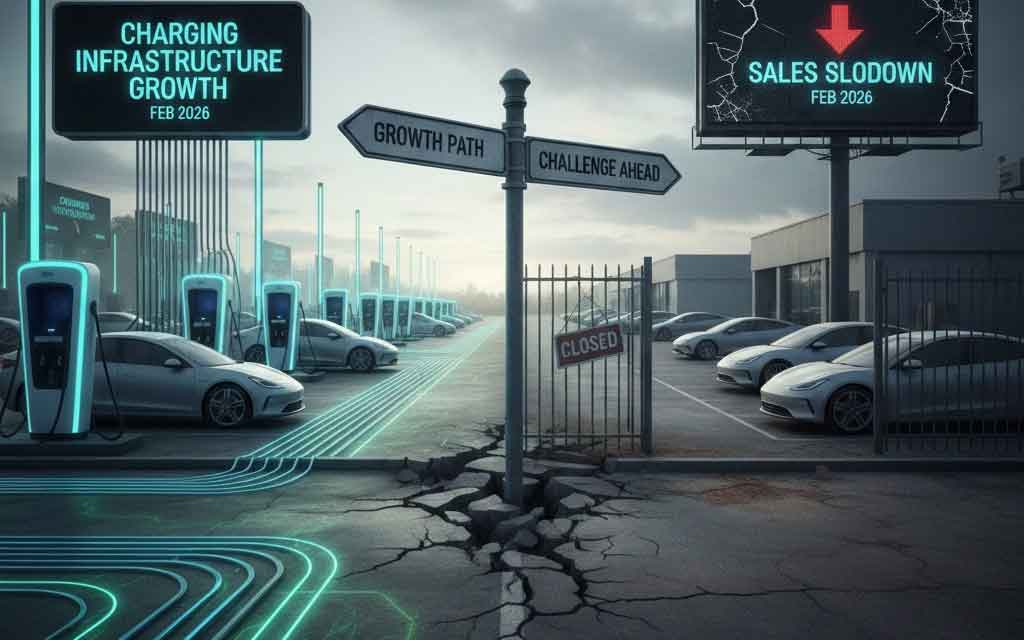
The U.S. electric vehicle landscape is experiencing a stark paradox in early 2026: while public charging infrastructure continues to expand at a robust pace, EV sales have hit a significant slowdown following the expiration of federal tax incentives last September. This divergence highlights the complex interplay of policy shifts, economic pressures, and evolving consumer preferences shaping the industry’s trajectory. Despite the chill in demand, the buildout of chargers presses on, driven by long-term investments and a belief in eventual market recovery.
Rapid Expansion of Charging Infrastructure
Even as EV adoption faces headwinds, the nation’s charging network is growing faster than ever. In 2025, the U.S. added over 18,000 new fast-charging ports, marking a 30% increase in the public fast-charging infrastructure. By early 2026, the country boasts more than 85,000 public charging stations with over 230,000 individual ports, including a surge in high-speed options that can deliver an 80% charge in under 20 minutes for compatible vehicles.
This growth isn’t slowing down. Charging sessions jumped 34% last year, outpacing the 16% rise in new ports, indicating strong utilization among existing EV owners. Major networks are forecasting continued expansion in 2026, albeit at a more moderate 8-10% rate, with a focus on ultra-fast chargers (350 kW+) and multi-fuel hubs that cater to fleets and long-haul travel. Investments from private operators and lingering commitments from earlier federal programs are fueling this buildout, aiming to address range anxiety and support future demand.
The Sales Slowdown: A Post-Incentive Reality
In contrast, EV sales have cooled dramatically since the $7,500 federal tax credit expired on September 30, 2025. What was a record-breaking rush in the third quarter—peaking at 10.3% market share—gave way to a sharp decline, with fourth-quarter 2025 registrations dropping to just 5.7% of new vehicles. Overall, U.S. EV registrations fell 0.4% for the year, the first decline in a decade.
Early 2026 data paints an even starker picture: January sales plummeted 33% year-over-year for some manufacturers, and projections now peg 2026 growth at a meager 1%, down from 20% in 2025. Without the incentives, average EV prices remain above $50,000, putting them out of reach for many mainstream buyers. Global trends echo this, with EV volumes expected to rise modestly but far below earlier forecasts, as affordability gaps widen.
Why Infrastructure Booms While Sales Stall
The contrast stems from differing timelines and drivers. Charging infrastructure projects, often multi-year endeavors, were kickstarted during a period of policy enthusiasm and federal funding under prior administrations. Many of these initiatives—such as highway corridors and urban hubs—are locked in, with private capital stepping in to fill gaps. Utilization rates at fast-chargers in high-demand areas like California have hit 80%, proving the network’s value for current owners and fleets.
Sales, however, are more sensitive to immediate economic factors. The incentive expiration removed a key affordability bridge, exacerbating issues like high interest rates and lingering concerns over battery life in cold weather. Yet, this infrastructure push could act as a catalyst: as networks mature, they reduce barriers for potential buyers, potentially thawing the market by 2027-2028 when cheaper models and improved technologies arrive.
Policy Shifts: From Mandates to Market-Driven Approaches
Federal policy has played a pivotal role in this dynamic. The Trump administration’s reset of corporate average fuel economy (CAFE) standards in late 2025 eliminated aggressive EV mandates, saving consumers an estimated $109 billion in compliance costs but slowing the push toward electrification. Tariffs on imported EVs and components—now exceeding 25% for many origins—have protected domestic jobs but inflated prices, further dampening demand.
State-level variations add complexity: California’s ambitious targets persist, but without federal backing, enforcement is uneven. Looking ahead, policies emphasizing hybrids and consumer choice over pure EVs could stabilize the market, though critics argue this delays emissions reductions. Overall, the shift to a “freedom means affordable cars” ethos prioritizes short-term relief over rapid transition.
Consumer Behavior: Hesitation Amid High Costs and Uncertainty
Buyers are at the heart of the slowdown. Surveys show 96% of current EV owners would buy another, citing satisfaction with performance and lower operating costs. However, prospective mainstream adopters remain wary: 72% view now as a poor time to purchase due to elevated prices, inconsistent charging reliability, and policy flux. Range anxiety persists, especially in rural areas, despite infrastructure gains.
Demographics play a role too—early adopters were tech-savvy urbanites, but the next wave includes price-sensitive families prioritizing trucks and SUVs. Hybrids are gaining traction as a bridge, offering electrification benefits without full commitment. As affordability improves through used EVs (with volumes surging 185% off-lease in 2026), consumer sentiment could rebound.
Corporate Strategies: Pivoting to Hybrids and Efficiency
Automakers are adapting swiftly. Legacy players like Ford, GM, and Stellantis have taken billions in charges to scale back ambitious EV plans, redirecting resources toward hybrids and extended-range models. Ford aims for 50% of its lineup to be hybrid/EV by 2030, focusing on profitable segments like trucks. Tesla, facing a 17% U.S. sales drop, is refreshing models to combat aging lineups.
Startups emphasize cost-cutting and fleet sales, where electrification remains strong. Overall, strategies now prioritize profitability over volume targets, with investments in affordable platforms (under $30,000) and AI-driven efficiencies. This measured approach could foster sustainable growth, though it risks ceding ground to Chinese competitors in the long run.
Future Outlook: A Measured Thaw Ahead
The U.S. EV market stands at a pivotal juncture. Infrastructure’s steady advance provides a foundation for recovery, but sales will likely remain soft until prices drop and policies stabilize. By 2030, EVs could capture 19-26% market share if hybrids bridge the gap and innovations like solid-state batteries emerge. For America, balancing environmental goals with economic realities will define the path forward—potentially leading to a more resilient, consumer-led transition.
What do you see as the biggest factor in reviving EV adoption: better infrastructure, lower prices, or policy changes? Share your insights in the comments below.
I’m Ethan, and I write about the tech that’s actually going to change how we live — not the stuff that just sounds impressive in a press release. I cover AI, EVs, robotics, and future tech for VFuture Media. I was on the ground at CES 2026 in Las Vegas, walking the show floor so I could give you a real read on what matters and what’s just noise. Follow me on X for daily takes.
The future doesn’t wait — and neither should your feed. If this got you thinking, there’s plenty more where that came from. Browse our latest at VFutureMedia and stick around.


Leave a Comment