
By Ethan Brooks
February 25, 2026
The artificial intelligence revolution is accelerating faster than anyone predicted. But behind the excitement lies a growing concern: electricity.
As hyperscale data centers expand across the United States, their energy consumption now rivals that of small cities. AI training models, inference workloads, and always-on cloud infrastructure are pushing power grids to their limits. Analysts project that U.S. data centers could consume up to 12% of total U.S. electricity by 2028, up from just 4.4% in 2023. Globally, electricity demand from data centers may reach 945 terawatt-hours (TWh) by 2030, more than double 2024 levels.
This isn’t just a technical issue. It’s a structural challenge that could slow AI innovation unless clean, scalable energy solutions step in.
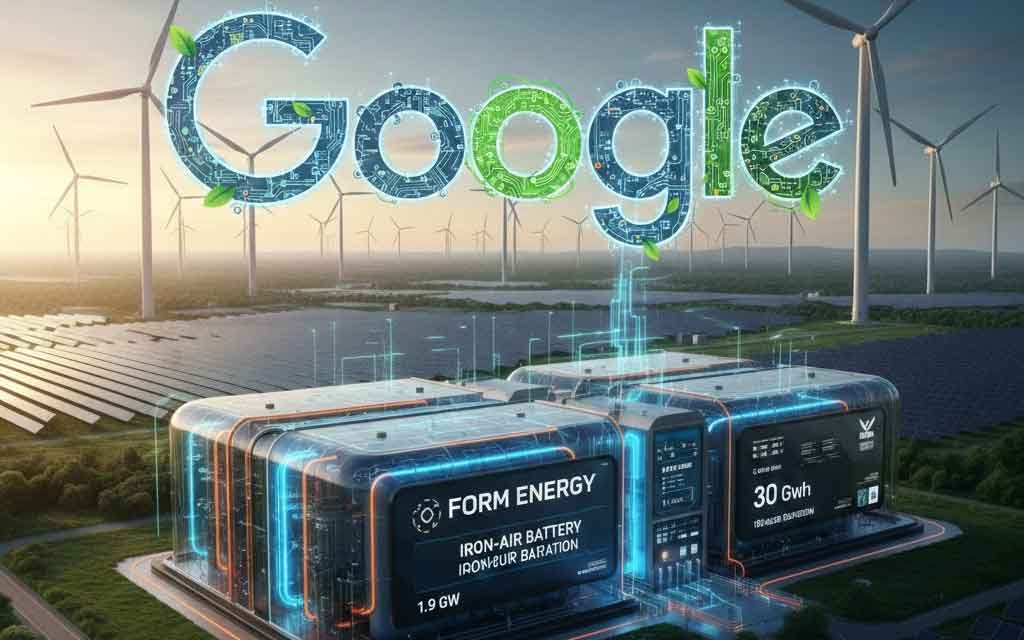
On February 24, 2026, Google announced a transformative solution: a 1.9 gigawatt (GW) clean energy package to power its new Minnesota data center. More than a sustainability headline, this project signals a turning point in how AI infrastructure will be built going forward.
The 1.9GW Blueprint: Wind, Solar, and 100-Hour Storage
Google’s Minnesota initiative includes:
- 1.4GW of wind power
- 200MW of solar power
- 300MW / 30GWh iron-air battery storage
The battery technology comes from Form Energy, whose iron-air system can discharge electricity continuously for 100 hours. That’s far longer than traditional lithium-ion batteries, which typically store 4–6 hours of energy.
This 30GWh system is one of the largest long-duration battery installations ever announced. It allows renewable energy generated during windy or sunny periods to be stored and released during calm or cloudy stretches — ensuring uninterrupted AI operations.
The technology works by using iron and oxygen (essentially rust) in a reversible process. It’s designed to be lower cost and more scalable than lithium-based systems. For AI data centers that require 24/7 uptime, this type of long-duration storage could be game-changing.
Why AI Is Driving the Clean Energy Boom
AI workloads require immense computing power. Training a large language model can consume megawatt-scale electricity for weeks. Multiply that by hundreds of hyperscale facilities, and the numbers become staggering.
Recent projections show U.S. data centers could consume 325–580 TWh annually by 2028. That surge is being fueled by more than $650 billion in AI-related capital expenditures from major cloud providers.
But here’s the surprising part: this crisis is accelerating clean energy innovation rather than slowing AI down.
In 2025, renewables accounted for 26% of U.S. electricity generation. By 2026, energy analysts expect a record 86GW of new capacity, including:
- 43.4GW solar
- 24GW battery storage
- 11.8GW wind
By year-end 2026, renewables could represent 40% of installed U.S. power capacity.
AI demand is becoming a catalyst for grid modernization, not just a strain.
Europe’s Clean Tech Leadership
Across the Atlantic, Europe is advancing high-readiness clean technologies through research and industrial strategy.
The European Commission’s Joint Research Centre (JRC) reports that the EU ranks second globally in clean tech scientific output, particularly in batteries, renewables, and carbon capture. The bloc is also pushing innovations like battery passports, which digitally track lifecycle and recycling data to improve sustainability and supply chain transparency.
Europe’s focus is clear: scale innovation before competitors do.
China’s Clean Energy Acceleration
Meanwhile, China has transformed clean energy into an economic engine.
In 2025:
- Clean energy contributed over $2.1 trillion to GDP
- Renewable capacity reached 1,494GW, surpassing fossil fuels for the first time
- Investments crossed $1 trillion, growing faster than the overall economy
Solar and wind installations in China outpaced the rest of the world combined. This rapid deployment is reshaping global supply chains and driving down technology costs.
Policy Headwinds in 2026
Despite strong momentum, challenges remain.
In the U.S., federal incentive rollbacks could slow solar expansion after 2027. Electricity prices rose roughly 7% in 2025, and further increases are projected as demand continues climbing.
Interconnection delays, supply chain constraints, and permitting bottlenecks still hinder large-scale deployment.
In Europe, trade tensions and industrial competitiveness concerns complicate clean tech expansion. In China, subsidy adjustments have temporarily softened growth in some segments.
Yet market forces are stronger than ever. Corporate power purchase agreements (PPAs), venture capital discipline, and AI-driven energy demand are keeping clean energy investment resilient.
Why Long-Duration Storage Changes Everything
The real breakthrough in Google’s 1.9GW deal isn’t just the wind and solar capacity. It’s the 100-hour battery system.
Short-duration batteries help stabilize the grid for hours. Long-duration batteries reshape the grid entirely.
With multi-day storage, renewable energy can function as baseload power — replacing fossil fuel peaker plants and reducing blackout risks. For AI data centers, this means:
- Stable 24/7 operations
- Reduced carbon footprint
- Protection from volatile electricity pricing
- Improved grid reliability
As more hyperscalers adopt similar models, clean energy could transition from supplemental to foundational.
The Road to a Post-Carbon AI Economy
By the end of 2026, several trends are converging:
- Renewables approaching 30% of U.S. generation
- Massive battery deployment accelerating
- AI workloads expanding globally
- Corporate sustainability targets tightening
Rather than derailing AI growth, the electricity crunch is accelerating the transition to resilient clean grids.
Google’s Minnesota project is more than a corporate sustainability milestone. It represents a structural shift in how AI infrastructure will be powered going forward.
The AI boom is not slowing down. But instead of overwhelming the grid, it may become the very force that modernizes it.
If 2025 was the year AI dominated headlines, 2026 could be remembered as the year AI and clean energy finally aligned — transforming energy scarcity into sustainable abundance.
I’m Ethan, and I write about the tech that’s actually going to change how we live — not the stuff that just sounds impressive in a press release. I cover AI, EVs, robotics, and future tech for VFuture Media. I was on the ground at CES 2026 in Las Vegas, walking the show floor so I could give you a real read on what matters and what’s just noise. Follow me on X for daily takes.
We started VFuture Media because we wanted tech news written by people who actually follow this industry — not content farms chasing keywords. If that resonates, we’d love to have you as a regular reader. Pull up a chair.



Leave a Comment