
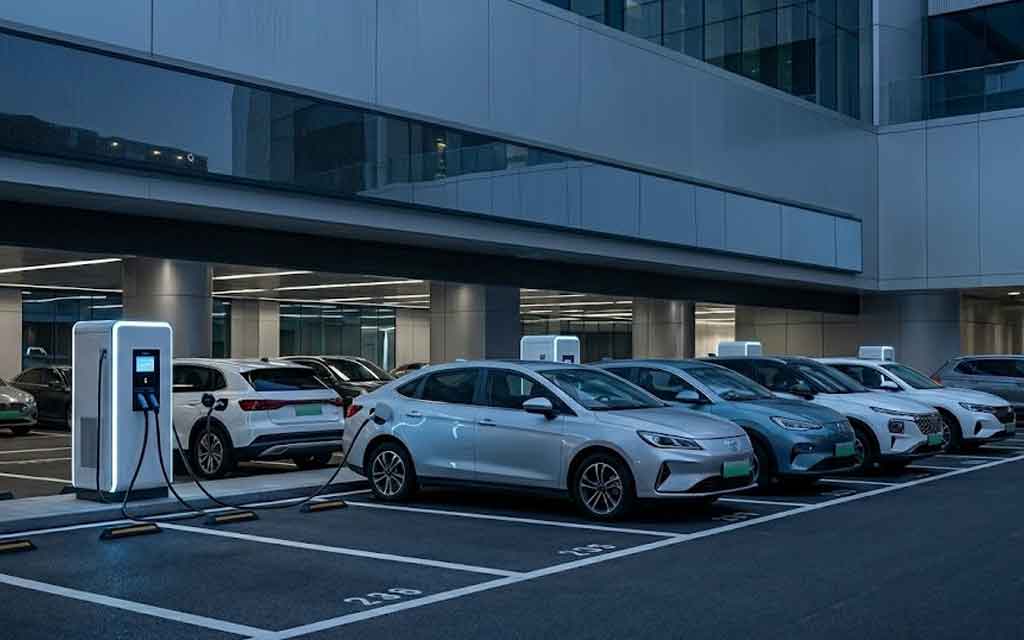
The global new energy vehicle (NEV) market—encompassing battery electric vehicles (BEVs), plug-in hybrids (PHEVs), and fuel cell vehicles—continues its upward trajectory, though at a moderated pace. According to TrendForce’s latest analysis released in early March 2026, global NEV sales reached 20.53 million units in 2025, marking a robust 26% year-over-year increase. For 2026, projections point to 23.4 million units, reflecting a 14% growth rate amid slowing expansion in key markets like China.
Complementing this volume outlook, Mordor Intelligence forecasts the electric vehicle market (primarily focused on BEVs and PHEVs) to expand from USD 0.67 trillion in 2025 to USD 0.75 trillion in 2026, with BEVs dominating unit sales at over 70% share. This valuation growth is fueled by declining battery costs, expanded high-power charging infrastructure (350 kW+), and tightening CO₂ regulations in major regions.
BEVs Lead the Charge Amid Regional Shifts
BEVs remain the powerhouse of the NEV segment, outpacing PHEVs in growth and adoption. TrendForce highlights BEVs’ stronger momentum in recent quarters, driven by technological advancements in range, charging speed, and affordability. Mordor Intelligence notes that BEVs already account for more than seven in ten global EV unit sales, supported by China’s scaled lithium-iron-phosphate (LFP) battery production and automakers’ shift to 400–800V platforms for faster charging.
While global electrification persists, regional disparities are widening. China, despite a cooling from its high base, continues to lead with massive volumes. Emerging markets like Brazil show surges, bolstered by incentives and growing infrastructure, contributing to “rest of world” gains. Europe maintains policy-driven progress, though at varying speeds.
U.S. Headwinds: Slowdown, Pullbacks, and USMCA Uncertainty
In contrast, the United States faces significant challenges, often termed an “EV winter.” Forecasts indicate a contraction in U.S. passenger EV sales for 2026, with some analysts projecting declines of 15% or more due to expired federal tax credits (up to $7,500), policy reversals, and shifting consumer preferences toward hybrids.
Major players are adjusting: GM and Tesla have announced pullbacks, including production delays, model cancellations, and writedowns in the billions, reflecting overestimation of near-term demand and a pivot toward hybrids or other priorities. Tesla’s delivery declines and strategic refocus underscore broader industry recalibration.
Compounding these issues are USMCA renegotiation threats. The 2026 review of the U.S.-Mexico-Canada Agreement could impose stricter rules of origin, higher labor requirements, and targeted measures on EVs, batteries, and critical minerals. This risks disrupting integrated North American supply chains, increasing costs, and reducing competitiveness—particularly if aimed at curbing Chinese influence via Mexico or Canada. Uncertainty around tariffs, content rules, and potential less-integrated trade could exacerbate the U.S. slowdown while favoring localized production elsewhere.
Outlook: Resilient Global Momentum with Caution
Despite U.S. headwinds and moderated Chinese growth, the structural shift to electrification endures. Declining costs, regulatory pressures, and emerging market surges (e.g., Brazil’s rapid gains) sustain momentum. BYD, Tesla, and others hold significant shares, but legacy automakers are ramping capacity to meet targets.
The 2026 landscape highlights a tale of two markets: robust expansion in Asia and emerging regions versus caution in North America amid policy and geopolitical risks. As the industry navigates these dynamics, focus on affordable models, charging networks, and supply chain resilience will define winners.
Ethan Brooks covers electric vehicles and clean mobility for VFuture Media. He tracks EV market trends, charging infrastructure, new model launches, and the increasingly blurry line between software and transportation. From Tesla’s autonomous driving milestones to Europe’s surging BEV sales, Ethan follows the numbers and the narratives behind them. He writes for readers who want the full picture on where the EV industry is actually headed — not just where brands say it is.
The future doesn’t wait — and neither should your feed. If this got you thinking, there’s plenty more where that came from. Browse our latest at VFutureMedia and stick around.



Leave a Comment