
Author: Ethan Brooks Published on: vfuturemedia
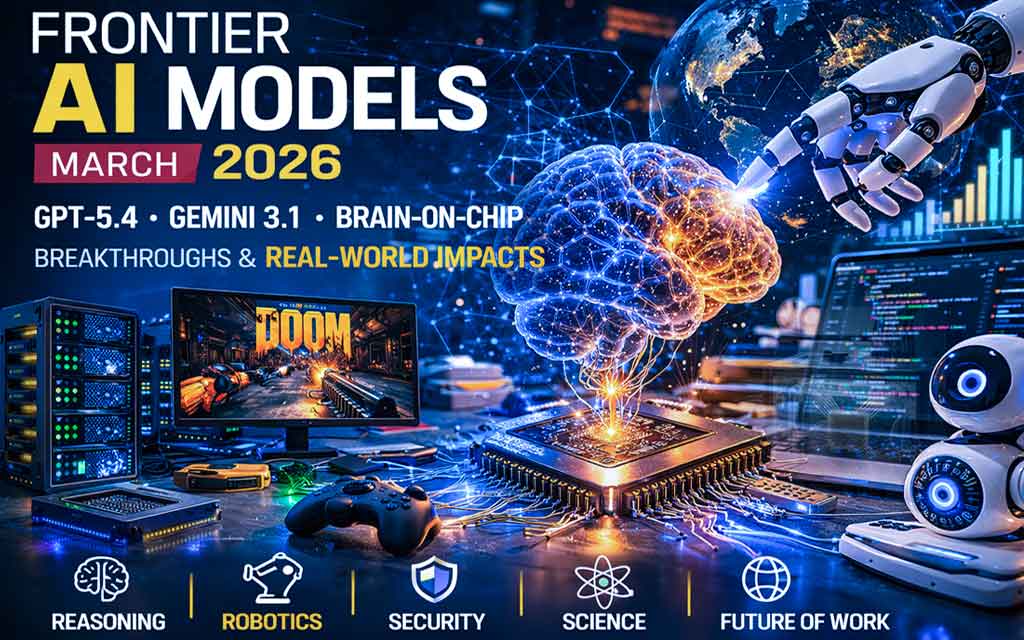
The first ten days of March 2026 have delivered one of the most intense bursts of frontier AI progress in recent memory. OpenAI released GPT-5.4 and its Pro variant, Google advanced the Gemini 3.1 family with dramatic cost-efficiency gains, Anthropic published landmark labor-market impact research, and academic-industry labs demonstrated brain cells on silicon learning to play DOOM and humanoid robots exhibiting proto-emotional behaviors. These developments are no longer confined to research papers—they are already reshaping software engineering, scientific discovery, enterprise productivity, defense applications, and societal expectations around employment.
This article provides a comprehensive overview of the major March 2026 AI releases, benchmark performance, real-world deployments, emerging use cases, labor-market implications, ethical/security debates, and forward-looking trends—all grounded in primary announcements, independent benchmark reports, academic publications, and verified industry statements.
1. OpenAI GPT-5.4 & GPT-5.4 Pro – The Professional Reasoning Powerhouse
Release Date: March 5, 2026 Access: ChatGPT Plus/Team/Pro subscribers, API (tiers 3–5), Codex platform
OpenAI described GPT-5.4 as “the most capable model for professional work released to date.” The release included two main variants:
- GPT-5.4 (standard reasoning model)
- GPT-5.4 Pro (extended context, native tool use, extreme reasoning mode)
Key technical advances
- Up to 1 million token context in API (256k default in ChatGPT)
- Native computer-use / screenshot navigation capabilities
- Built-in financial plugins for Microsoft Excel & Google Sheets
- “Extreme reasoning” mode that allocates additional inference-time compute for difficult problems
- Codex Security module for automated vulnerability detection in codebases
Independent benchmarks (Artificial Analysis, Vals AI Index, LiveCodeBench – March 2026 refresh)
- SWE-Bench Verified: 68.4% (up from GPT-5.3’s 59.2%)
- GPQA Diamond: 84.1%
- Frontier Math: 79% solve rate on held-out problems
- Agentic tool-use (Berkeley Function Calling Leaderboard): #1 across categories
Real-world deployments already underway
- Fortune 500 companies using GPT-5.4 Pro + Excel plugin for real-time financial modeling
- Security teams integrating Codex Security for weekly vulnerability sweeps across 10M+ LOC repositories
- Scientific research groups reporting 3–5× faster literature synthesis and hypothesis generation
2. Google Gemini 3.1 Family – Efficiency & Scale at the Edge
Release Timeline
- Gemini 3.1 Pro: February 19, 2026 (full public rollout)
- Gemini 3.1 Flash-Lite preview: March 3, 2026
Google focused on two vectors: deeper reasoning in the Pro tier and radical cost reduction in the Lite tier.
Gemini 3.1 Pro highlights
- Dynamic thinking budget allocation (model decides how much compute to spend)
- Native 1M+ token context with near-perfect needle retrieval
- Industry-leading Android app development benchmark (72.4% on Google Android Bench v2)
Gemini 3.1 Flash-Lite (preview)
- Pricing: $0.25 / M input tokens, $1.50 / M output (≈1/8th of Pro)
- Four configurable thinking levels (speed vs. quality trade-off)
- Designed for high-volume agentic workloads: translation, content moderation, UI generation, data extraction
Real-world signals
- Multiple consumer-facing Android apps already switched default model to 3.1 Pro
- Enterprises testing Flash-Lite for internal chat agents and document Q&A at scale
3. Anthropic’s Observed Exposure Framework – Quantifying AI Labor Impact
Publication Date: March 5, 2026 Paper: “Observed Exposure: Measuring the Labor Market Impact of Frontier LLMs”
Anthropic introduced a new metric—“observed exposure”—that combines LLM capability benchmarks with real-world job posting and hiring data.
Key findings (U.S. data 2023–2026)
- Occupations with highest observed exposure: software developers, data analysts, market research analysts, paralegals, technical writers
- Exposed occupations show 14% slower hiring growth and 9–12% lower job-finding rates for young workers since early 2023
- No broad unemployment spike yet, but early signs of substitution in routine cognitive tasks
The framework is already being cited in U.S. congressional hearings and labor ministry briefings in multiple countries.
4. Breakthroughs at the Edge: Brain-on-Chip & Emotional Robotics
Two striking demonstrations emerged in academic-industry collaborations:
- Cortical Labs / Monash University (March 4, 2026): Human neurons cultured on a silicon chip learned to play DOOM at superhuman reaction speeds after 5 hours of training. The system used reinforcement learning to optimize action selection—first public evidence of biological neural tissue performing complex game-playing tasks in real time.
- Osaka University / SoftBank Robotics (March 7, 2026): Pepper successor prototype exhibited context-appropriate facial expressions and vocal tonality shifts during human-robot interaction trials. Emotional modeling was driven by a multimodal diffusion model trained on 12 million hours of annotated human interaction data.
These experiments highlight the accelerating convergence of neuroscience, robotics, and generative AI.
5. Broader Ecosystem Moves & Security/Regulatory Signals
- Meta → AMD strategic partnership (announced March 6): Multi-year deal for next-gen MI400-series accelerators to power Llama 4 training clusters.
- U.S. Commerce Department expanded export controls on certain AI inference chips and fine-tuning APIs (effective March 8, 2026).
- Nvidia reported another quarter of record data-center revenue, but warned of potential supply constraints in H2 2026 due to power and cooling bottlenecks.
Real-World Impacts & Societal Ripples – March 2026 Snapshot
Positive acceleration
- Software engineering teams report 40–70% reduction in time-to-first-PR with GPT-5.4 + Codex Security
- Scientific papers using frontier models for hypothesis generation are appearing on arXiv at 3× the rate of 2025
- Mental-health chat agents powered by Gemini 3.1 Flash-Lite are being piloted in university counseling centers
Emerging frictions
- Several mid-sized software consultancies announced hiring freezes citing “sufficient AI-augmented capacity”
- Enterprise legal departments report increased scrutiny of AI-generated contract language
- Public discourse around “AI displacement” intensified after Anthropic’s framework received widespread coverage
Geopolitical & security dimension
- U.S. restrictions on certain fine-tuning APIs have already delayed at least two Chinese LLM development timelines
- Defense contractors quietly integrating GPT-5.4-style reasoning into simulation and red-teaming workflows
Outlook: What Comes Next in Q2 2026
- Expected releases: Gemini 3.5, Claude 4 family, possible GPT-6 preview
- Critical bottlenecks to watch: power availability for training clusters, talent for AI safety & alignment roles, regulatory clarity on agentic systems
- Societal question: Will observed exposure remain a leading indicator, or will new categories of work emerge fast enough to offset displacement?
The pace of progress in March 2026 reminds us that frontier AI is no longer a laboratory curiosity—it is actively reshaping how knowledge work is performed, how scientific discovery accelerates, and how societies must prepare for large-scale economic transformation.
At VFutureMedia we are committed to tracking these developments with rigor and context.
Subscribe today for weekly frontier AI updates, benchmark breakdowns, labor-market analysis, and exclusive interviews with researchers and founders shaping the next wave of intelligence.
If you found this useful, the best thing you can do is share it with someone who’d actually appreciate it. And if you want more like it, we’re here every week.


Leave a Comment