
Author: Ethan Brooks Published on: vfuturemedia Date: March 10, 2026
The electric vehicle industry entered March 2026 at an inflection point. While global EV adoption continues its long-term upward trajectory, short-term headwinds—policy shifts, subsidy reductions, high interest rates, and consumer price sensitivity—are forcing recalibration in key markets. At the same time, battery chemistry breakthroughs and aggressive cost-down strategies from Chinese leaders are accelerating innovation and putting renewed downward pressure on prices worldwide.
This article examines the major developments of early March 2026: BYD’s second-generation Blade Battery refresh, Volkswagen’s strategic pivot in battery operations, the U.S. market’s sharp early-year slowdown, upcoming sub-$30,000 models, regional pauses/adjustments, and the rising role of hybrids as a bridge technology.
BYD’s Second-Generation Blade Battery: LMFP + Ultra-Fast Charging
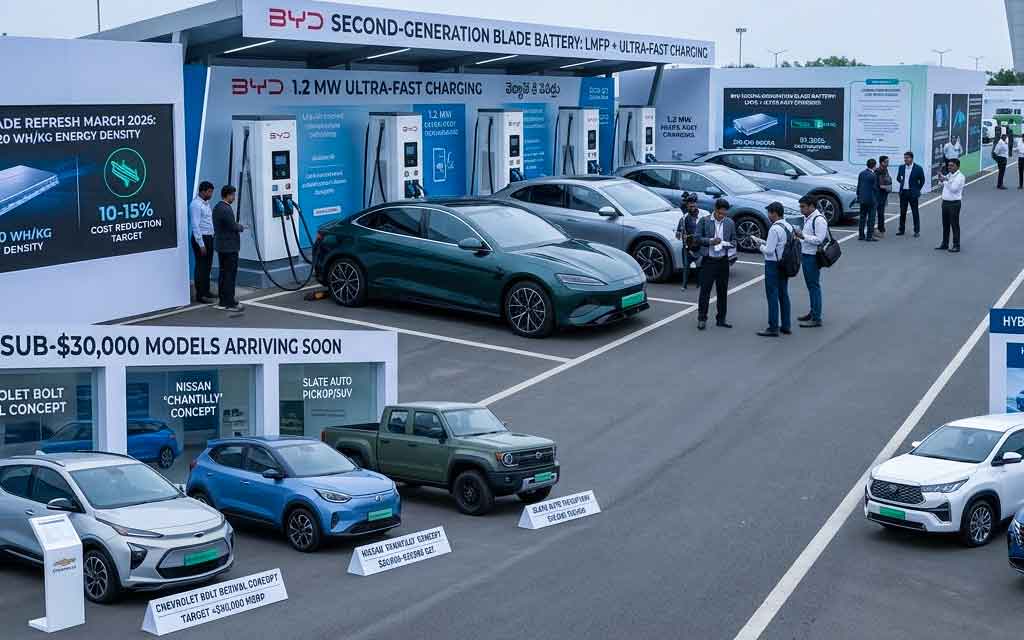
Announcement: March 4–6, 2026 (multiple Denza, Yangwang, and BYD brand events) Technology: LMFP (lithium manganese iron phosphate) chemistry upgrade to the original LFP Blade platform
Key claims & specs:
- Energy density increase: ~15–20% over first-gen Blade (targeting 210–220 Wh/kg cell-level)
- Ultra-fast charging: 5–10 minute 10–80% times demonstrated on lab benches and select Denza Z9 GT prototypes using 1.2 MW+ liquid-cooled charging piles
- Thermal stability: Retains Blade’s nail-penetration safety while supporting higher charge rates
- Cycle life: >3,500 cycles at 80% capacity retention (real-world target)
- Cost reduction: Expected 10–15% lower $/kWh at pack level due to manganese substitution and process improvements
Impact:
- Addresses the single biggest remaining consumer objection: charging speed approaching or matching gasoline refueling.
- Positions BYD to defend its ~60% share of the Chinese passenger EV market, where growth slowed sharply in Q4 2025–Q1 2026 after years of triple-digit gains.
- Export pressure: Affordable models (e.g., Seagull/Sealion derivatives) with 600+ km CLTC range and 10-minute fast-charge capability will intensify competition in Southeast Asia, Latin America, and Europe.
Volkswagen’s Salzgitter Pivot: From EV Cells to Grid-Scale Storage & Trading
Announcement: March 5, 2026 (Volkswagen Group press conference) Strategy: Expand Salzgitter (Germany) battery campus into a full energy ecosystem.
Moves include:
- Scaling solid-state pilot line while continuing LFP/NMC production
- Launching large-scale stationary storage systems using second-life and new cells
- Establishing an internal battery energy trading desk to arbitrage grid prices
- Partnering with Northvolt and QuantumScape for diversified cell supply
Rationale:
- EV sales growth in Europe slowed more than expected in early 2026 due to subsidy phase-outs and high financing costs.
- Excess cell capacity can be redeployed profitably into grid storage—a market growing >40% annually.
- Positions VW as a broader energy player rather than a pure automaker.
U.S. EV Market Slowdown & The Affordable Counteroffensive
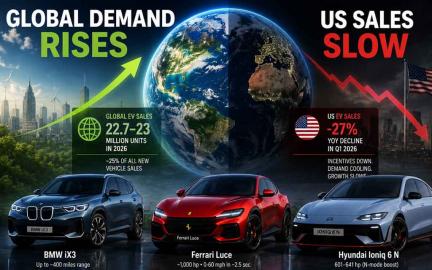
U.S. EV sales declined ~15–20% year-over-year in January–February 2026 (per Cox Automotive and Kelley Blue Book estimates), the first meaningful monthly contraction since the 2022–2023 supply crisis.
Contributing factors:
- Federal EV tax credit changes and state-level incentive expirations
- Higher financing rates making $50,000+ vehicles less affordable
- Consumer preference shift toward hybrids amid range/charging anxiety
Response: Industry-wide pivot to sub-$40,000 (ideally sub-$30,000) models
Confirmed or highly credible upcoming launches:
- Chevrolet Bolt revival (2026–2027): Targeting <$30,000 MSRP, Ultium platform, ~250–300 mi EPA range
- Nissan next-gen affordable EV (codenamed “Chantilly”) on CMF-B EV architecture: Expected $25,000–$28,000
- Kia EV2 / EV3 series: Subcompact crossover under $35,000
- Slate Auto (stealth startup): $25,000–$30,000 rugged EV pickup/sUV targeting rural and fleet buyers
- Hyundai Ioniq 2 / Casper EV derivatives: India-first models potentially exported
Regional Pauses & Adjustments
- Hyundai/Kia: Temporarily paused sales/reservations of Ioniq 6 and EV6 GT-Line variants in select markets (including parts of Europe and North America) while finalizing software and battery management updates. No safety recall; described as “market recalibration.”
- Tesla: Facing EU emissions-credit compliance challenges after 2025 over-credits; Q1 2026 deliveries expected flat-to-down in Europe despite Model Y refresh.
Hybrids Gain Ground as Bridge Technology
Plug-in hybrid (PHEV) and conventional hybrid sales surged in Q1 2026 across the U.S., Europe, and China:
- U.S. PHEV share rose ~35% YoY
- Toyota, Ford, and Hyundai-Kia hybrids captured buyers hesitant about full EVs
- Chinese OEMs (BYD, Geely, Leapmotor) continued strong DM-i/DM-p PHEV momentum
Hybrids are increasingly viewed as a pragmatic bridge—offering electric driving for daily commutes while eliminating range anxiety on longer trips.
Outlook: 2026 as a Transitional Year
March 2026 signals a clear industry pivot:
- Battery innovation remains the primary lever for cost and convenience improvement.
- Affordability is now the dominant battleground in mature markets.
- Hybrids are buying time for infrastructure and battery supply chains to mature.
- Chinese OEMs continue to set the pace on price, range, and charging speed—pressuring legacy automakers to accelerate restructuring.
For Indian consumers: Expect more affordable Chinese exports (BYD, MG, BYD-backed brands) and local manufacturing ramps (Tata, Mahindra, Hyundai Creta EV) to benefit from global cost-down trends. The dream of mass-market EVs under ₹15–20 lakh is closer than ever.
At VFutureMedia we’ll keep tracking battery breakthroughs, pricing strategies, policy shifts, and real-world ownership experiences to help you navigate the evolving EV landscape.
Subscribe to VFutureMedia for weekly EV updates, comparison guides, India-specific pricing alerts, and in-depth looks at the technologies shaping tomorrow’s mobility—delivered straight to your inbox.
We started VFuture Media because we wanted tech news written by people who actually follow this industry — not content farms chasing keywords. If that resonates, we’d love to have you as a regular reader. Pull up a chair.
Ethan Brooks covers the tech that’s reshaping how we move, work, and think — for VFuture Media. He was at CES 2026 in Las Vegas when the world got its first real look at humanoid robots, AI-powered vehicles, and Samsung’s tri-fold phone. He writes about AI, EVs, gadgets, and green tech every week. No hype. No filler. X · Facebook

Leave a Comment