
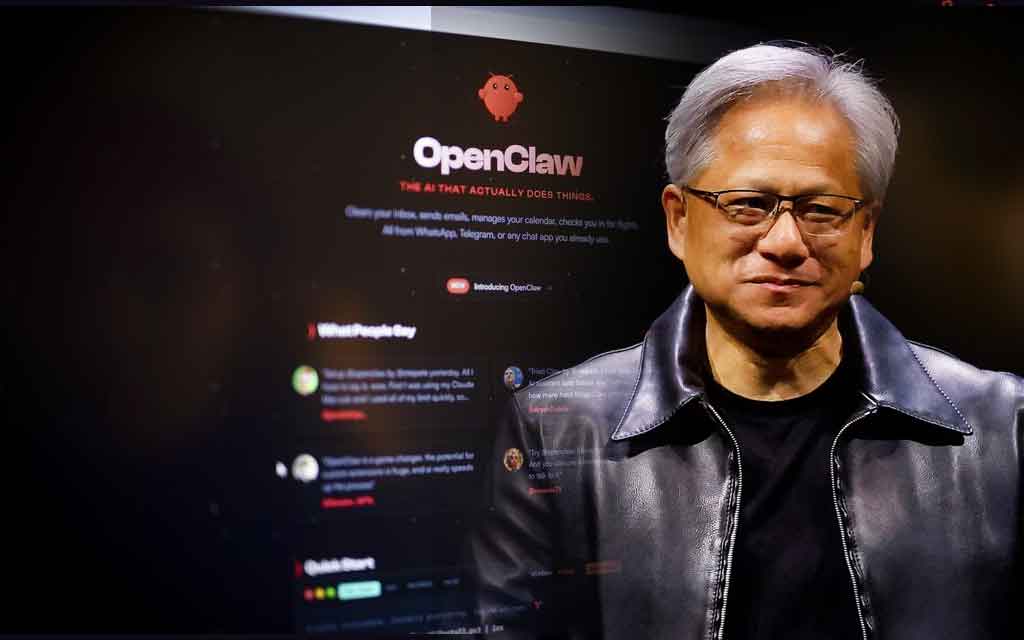
In a stunning declaration during Nvidia’s GTC 2026 keynote and related events, CEO Jensen Huang proclaimed: “OpenClaw is the new computer.” He likened the moment to the early days of personal computing, where a handful of visionaries recognized the potential while the masses remained unaware. “This is the early PC era all over again. A few power users see it. Everyone else hasn’t even started.”
Huang went further, calling OpenClaw “the most popular open source project in the history of humanity,” claiming it achieved explosive adoption in mere weeks—surpassing what Linux accomplished over 30 years. He highlighted the unprecedented leverage: “A solo founder with OpenClaw can now build what used to take a 50-person team. The leverage is absurd.”
As of March 2026, OpenClaw has ignited the AI agent revolution, transforming how individuals and enterprises approach autonomous intelligence. Nvidia’s aggressive embrace—through tools like NemoClaw and on-site “Build-a-Claw” experiences—positions the company as a key accelerator in this shift.
What Is OpenClaw? The Viral Open-Source AI Agent
OpenClaw (originally known as Clawdbot and Moltbot) is a local-first, open-source AI agent that runs persistently on your machine. Unlike traditional chatbots that wait for prompts, OpenClaw operates continuously as an always-on assistant. It remembers conversations, adapts to user patterns, accesses local files and apps for context, and executes complex, multi-step tasks via extensible “skills.”
Key capabilities include:
- Acting as a personal secretary (managing email, calendars, files)
- Automating workflows (coding, research, data analysis)
- Running locally for privacy—no cloud dependency required
- Community-driven extensions for endless customization
Launched by an independent developer (later acquired by OpenAI, with the creator joining to advance agent tech), OpenClaw exploded in popularity early 2026. Its GitHub stars and downloads skyrocketed, drawing comparisons to Linux’s slow but steady rise—but compressed into weeks.
Huang’s praise underscores its architectural breakthrough: agentic AI that thinks, plans, and acts autonomously, powered by open models and local inference.
Jensen Huang’s Bold Claims: Why OpenClaw Matters to Nvidia
At GTC 2026 (March 16-19, San Jose), Huang wove OpenClaw into Nvidia’s narrative of the “agentic era.” He urged: “Every company in the world today needs to have an OpenClaw strategy, an agentic system strategy.”
Why the hype from Nvidia’s CEO?
- Compute Demand: Agents generate 10-15x more tokens than chat interfaces, driving massive GPU usage for training and inference.
- Enterprise Readiness: OpenClaw’s raw power needs security, privacy, and optimization—areas Nvidia addresses.
- Ecosystem Play: Supporting OpenClaw accelerates adoption of Nvidia hardware (RTX GPUs, DGX Spark) for local runs.
Nvidia responded swiftly:
- NemoClaw: An open-source stack (built on the Nvidia AI Agent Toolkit) that simplifies deploying secure, enterprise-grade OpenClaw instances. It adds sandboxing, privacy controls, and one-command setup.
- Build-a-Claw Zone at GTC Park: Attendees customized always-on agents using OpenClaw on DGX Spark or RTX laptops—no personal data exposure.
- Sessions & Demos: Workshops on persistent state management, secure tool execution, and complex workflows using the OpenClaw abstraction.
Huang framed this as a “reinvention” of enterprise IT, with agents as the new software paradigm—token-driven and always active.
The Leverage Revolution: Solo Builders vs. Traditional Teams
Huang’s most striking point: “A solo founder with OpenClaw can now build what used to take a 50-person team.”
This democratizes innovation:
- A developer can prototype full apps, automate business processes, or create personalized tools without massive funding.
- Community skills expand capabilities exponentially—coding assistants, research agents, creative collaborators.
- Local execution avoids API costs and data privacy issues plaguing cloud tools.
This mirrors the PC revolution: 1980s hobbyists built empires with basic hardware; today, individuals wield superhuman leverage via open agent frameworks.
Critics note hype—OpenClaw faces security risks, scalability challenges, and competition from closed ecosystems. Yet its viral growth validates Huang’s view: we’re in the “few power users see it” phase.
Broader Implications for Future Tech and AI Trends
OpenClaw’s rise ties into March 2026’s AI momentum:
- Agentic Shift: From reactive chat to proactive agents—echoing Nvidia’s physical AI and robotics push.
- Open vs. Closed: OpenClaw’s success pressures closed players while Nvidia bridges with enterprise tools like NemoClaw.
- Hardware Boom: Agents demand more compute—fueling Nvidia’s $1T+ Blackwell/Rubin orders forecast.
- Mobility/EV Synergies: Imagine agents optimizing smart charging, autonomous routing, or in-car assistants—local AI enhances privacy in connected vehicles.
As adoption grows, expect job shifts (routine tasks automated), ethical debates (agent autonomy, data access), and new opportunities for creators.
Conclusion: The Dawn of the Agentic Computing Era
Jensen Huang’s declaration—”OpenClaw is the new computer”—captures a pivotal 2026 moment. Like the PC’s arrival, this open-source agent framework empowers individuals with absurd leverage, redefines software as persistent intelligence, and accelerates the AI compute cycle.
Power users are building today; the mainstream awakening looms. Nvidia’s support ensures acceleration, but the real revolution belongs to the community.
For developers, founders, and enterprises: the OpenClaw era has begun. Time to build your claw.
Author: Ethan Brooks
Ethan Brooks covers the tech that’s reshaping how we move, work, and think — for VFuture Media. He was at CES 2026 in Las Vegas when the world got its first real look at humanoid robots, AI-powered vehicles, and Samsung’s tri-fold phone. He writes about AI, EVs, gadgets, and green tech every week. No hype. No filler. X · Facebook
The future doesn’t wait — and neither should your feed. If this got you thinking, there’s plenty more where that came from. Browse our latest at VFutureMedia and stick around.



Leave a Comment