
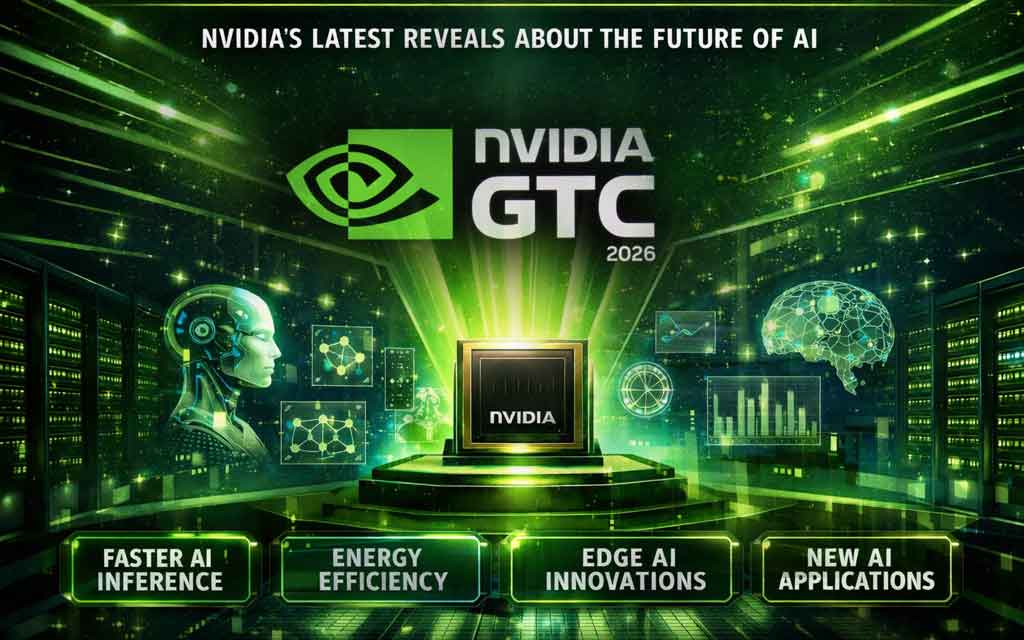
NVIDIA GTC 2026 Keynote Recap: Jensen Huang Unveils Vera Rubin, $1 Trillion AI Demand Forecast, and the Shift to Inference-Driven AI Factories – March 2026 Update
NVIDIA’s annual GTC 2026 conference, held March 16–19, 2026, in San Jose, California, delivered a landmark keynote from CEO Jensen Huang that shifted the spotlight from AI training to inference as the next massive growth phase. Huang declared that “the inference inflection has arrived,” positioning NVIDIA as the leader in building scalable AI factories that power agentic systems, physical AI, and enterprise-scale intelligence.
The two-hour+ keynote emphasized that while training large models dominated the past, inference — generating outputs from trained models — now drives the majority of real-world AI usage, token generation, and revenue potential. Huang highlighted explosive demand, forecasting $1 trillion in orders for Blackwell and the newly unveiled Vera Rubin platforms through 2027, doubling prior estimates.
Major Announcements from Jensen Huang’s GTC 2026 Keynote
- Vera Rubin Platform Launch — NVIDIA’s next-generation full-stack architecture, named after astronomer Vera Rubin (who revealed dark matter). It includes:
- Seven new chips (including Vera CPU, Rubin GPU, NVLink 6 Switch, BlueField-4 DPU, and more)
- Five rack-scale systems and one integrated supercomputer optimized for agentic AI
- Up to 10x higher inference throughput per watt compared to Blackwell
- 35x–50x efficiency gains in some inference workloads, enabling massive token generation at lower cost and power
- Production ramp in late 2026, with roadmap extending to Feynman architecture (featuring Rosa CPU)
- Inference as the New Frontier — Huang stressed that inference is now the “center of the battlefield.” Companies can generate more tokens (and thus revenue) with better inference capacity. Vera Rubin promises 5x revenue per gigawatt versus Blackwell, making it ideal for hyperscalers and enterprises scaling AI services.
- AI Factories & Dynamo OS — Introduced AI factories as a new platform category — massive, optimized systems for continuous AI production. Dynamo 1.0 (now in production) serves as the “operating system” for these factories, boosting Blackwell inference by up to 7x. Major cloud providers (AWS, Azure, Google Cloud, Oracle) have adopted it.
- Agentic & Physical AI Advances — Emphasis on agentic systems (autonomous AI agents) spilling into workflows. Partnerships and tools like NemoClaw (open agent platform, dubbed “the most popular open-source project in history”) and integrations with robotics, autonomous vehicles (e.g., Uber), and even Disney’s lifelike robots (Olaf demo).
- Other Breakthroughs —
- Groq 3 LPU (inference accelerator) and rack systems targeting Intel/AMD
- Space-1 Vera Rubin — AI data centers in orbit for future orbital computing
- Neuro rendering & DLSS 5 for fused graphics + AI
- DSX AI Factory reference designs and Omniverse digital twins for simulating factories before buildout
Why Inference Focus Matters for the Future of AI
Huang’s message was clear: The AI economy is transitioning from training (build once) to inference (run continuously). This shift favors efficiency, scale, and token economics — where more tokens equal more value. NVIDIA positions itself as the full-stack provider (chips, networking, software, orchestration) for AI factories, enabling everything from chatbots to physical robots and industrial agents.
This vision addresses current bottlenecks: power constraints, cost per token, and the need for massive, reliable inference capacity. With Blackwell scaling now and Vera Rubin on deck, NVIDIA aims to capture the lion’s share of the exploding inference market.
What’s Next After GTC 2026?
- Vera Rubin rollout in H2 2026
- Continued Blackwell ramp-up amid strong demand
- Expansion into physical AI (robots, autonomous systems) and space-based computing
- Ecosystem growth around open models, agents, and AI factories
The keynote reinforced NVIDIA’s dominance while signaling that the real AI boom is just beginning — driven by inference at industrial scale.
For full details, watch the official keynote replay on NVIDIA’s site or YouTube.
Sources: NVIDIA official GTC 2026 keynote (March 16, 2026), NVIDIA Newsroom press releases, CNBC, Quartz, Yahoo Finance, eWeek, and other verified reports (data as of March 19, 2026). This article reflects publicly available information and is for informational purposes only.
Published on www.vfutureumedia.com | AI & Tech Innovation News | Updated March 19, 2026


Leave a Comment