
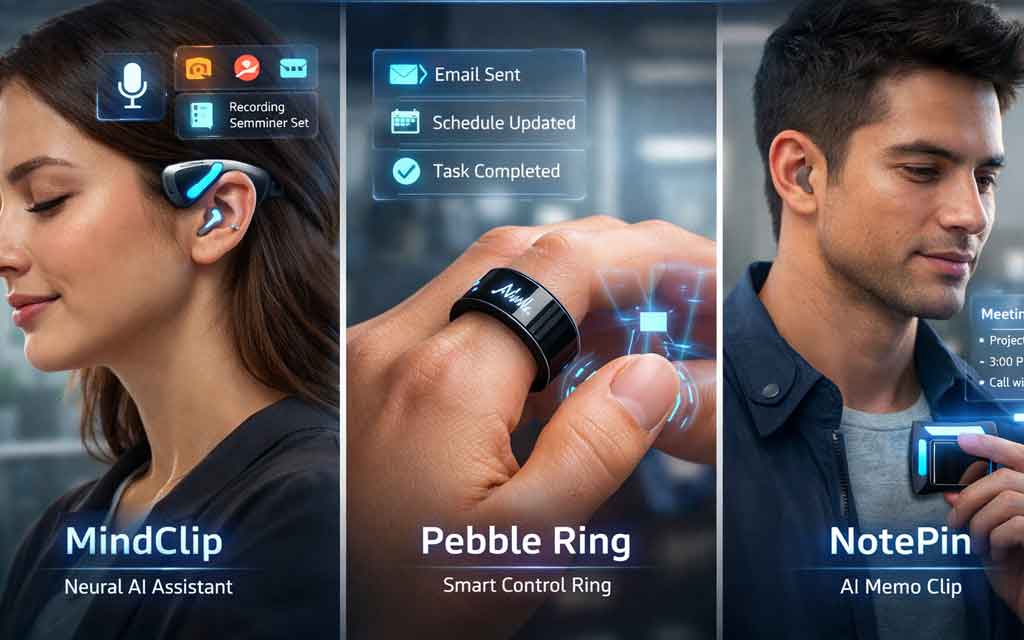
In March 2026, consumer tech crossed a quiet but profound threshold. AI wearables evolved from novelty gadgets into genuine “second brains” — external memory systems that capture conversations, generate intelligent summaries, extract actionable tasks, and deliver context-aware insights without demanding constant screen time.
This trend, which gained massive visibility at CES 2026 in January, saw real momentum in March through pre-orders, software updates, early user reviews, and ecosystem integrations. Devices like the SwitchBot AI MindClip, Plaud NotePin S, Pebble Index 01, and Lenovo/Motorola Qira concepts are redefining how busy professionals — especially in the US — manage knowledge work, meetings, and idea flow.
At VFuture Media, we help tech professionals, founders, and leaders turn emerging gadget trends into strategic advantages through thought leadership and digital positioning. In this deep-dive (part of our March 2026 Gadget Trends series), we explore the standout launches, why the “second brain” category is exploding, its broader implications, and actionable steps you can take today.
The Rise of AI Second-Brain Wearables in March 2026
Traditional note-taking apps and voice recorders have existed for years, but March 2026 highlighted a new generation: discreet, always-ready wearables that combine on-device processing, cloud AI, and seamless integration with agentic tools. These devices don’t just record — they understand, organize, and act.
Standout Launches and Highlights:
- SwitchBot AI MindClip: This ultra-lightweight 18g clip-on device quickly became a favorite for hands-free productivity. It records meetings, conversations, and daily interactions in over 100 languages. Using a mix of on-device and cloud AI, it transcribes audio, generates searchable summaries, creates task lists, and builds a personal memory database. Early users in March praised its discreet collar-clip design, making it ideal for professionals who want to stay present in conversations rather than typing notes. Many advanced features require a subscription, but the core capture functionality delivers immediate value.
- Pebble Index 01: Launched with strong pre-order momentum in March 2026 (starting at $75 preorder, rising to $100), this minimalist smart ring focuses purely on reliable external memory. Tap the physical button and speak — it captures short voice notes and stores them in a clean app interface. No health tracking, no constant monitoring, and crucially, no monthly subscription. Its emphasis on privacy and simplicity resonated with users seeking a distraction-free “idea capture” tool rather than a full AI assistant.
- Plaud NotePin S: An enhanced version of Plaud’s popular NotePin line, the S model added improved wearing options (pin, necklace, or bracelet) and better AI-powered organization. It excels at turning conversations into detailed summaries, mind maps, flowcharts, and action items. Professionals in knowledge-heavy roles (consulting, law, product management, journalism) highlighted its ability to extract structured insights from unstructured discussions, making it a top contender in the “second brain” space.
- Lenovo Qira AI Pendant Concepts and Ambient Intelligence: Lenovo and Motorola advanced their Qira personal ambient intelligence system, demonstrated via pendant-style wearables. Qira acts as a system-level AI that moves with you across devices (phones, laptops, tablets, wearables). It captures context from meetings and surroundings, then enables natural-language recall and proactive suggestions. While still in concept/proof-of-concept phase in early 2026, March updates showed tighter integration with Lenovo/Motorola ecosystems, positioning it as a more holistic “intelligence layer” rather than a standalone recorder.
Broader Ecosystem Momentum:
- Meta Ray-Ban AI Glasses refinements: March 2026 brought software updates improving voice commands (more natural, interruptible conversations resembling Gemini Live), audio processing, and contextual awareness. New models with better prescription lens support and snow sports features expanded appeal. The glasses continue evolving from stylish cameras into subtle AI companions.
- Google’s lightweight smart glasses push: Ongoing integration with Gemini strengthened multimodal capabilities, making voice + vision interactions more fluid.
- OpenAI + Jony Ive hardware ambitions: Rumors and hints of “peaceful,” less intrusive AI devices (potentially arriving later in 2026) fueled excitement about screen-minimal, voice-first hardware that feels more like an extension of thought than another gadget.
These devices leverage efficient AI chips (such as Qualcomm NPUs or AMD Ryzen AI equivalents) for strong on-device processing, reducing latency and cloud dependency while addressing growing privacy concerns.
Why the “Second Brain” Trend Matters in 2026
The shift isn’t just about convenience — it represents a fundamental change in human-AI interaction:
- Massive Productivity Boost: Professionals report saving several hours per week on note-taking, follow-ups, and mental overhead. AI handles transcription, summarization, mind-mapping, and even suggests next actions or connections across conversations. For high-context roles (executives, salespeople, researchers, creators), this frees cognitive bandwidth for strategic thinking rather than administrative recall.
- Privacy and On-Device Shift: Many devices prioritize local processing for sensitive data, with transparent options to keep recordings offline or user-controlled. This addresses legitimate concerns about always-listening hardware while still delivering powerful AI features via optional cloud services.
- Post-Smartphone Interface Evolution: These wearables integrate into what you already wear or carry (collar clips, rings, pins, glasses). They reduce screen time, support voice or subtle interactions, and enable “ambient intelligence” — AI that understands context without constant prompting. Combined with March 2026’s agentic AI advances (like GPT-5.4 Thinking modes), wearables can feed rich contextual data into desktop or multi-agent systems for deeper automation.
This trend aligns with the broader physical and agentic AI wave seen in robotics and models. Your wearable “second brain” doesn’t just remember — it can potentially trigger agents to book follow-up meetings, draft emails, or update project trackers.
Realistic Optimism: Early adopters love the time savings, but challenges remain — subscription fatigue for premium features, occasional transcription inaccuracies in noisy environments, and the need for thoughtful consent when recording conversations. Battery life and form-factor comfort are improving rapidly, but users should start with low-commitment devices.
Actionable Insights for Professionals and Founders
For US Tech Professionals and Knowledge Workers:
- Audit Your Workflow: List repetitive tasks — meeting recaps, idea capture during calls, follow-up action items, or connecting dots across conversations. Identify where a second-brain wearable could reduce mental load.
- Start Small and Measure: Test affordable, low-friction options like the Pebble Index 01 (privacy-focused, no subscription) or SwitchBot AI MindClip for one week. Track metrics: time saved on notes, quality of summaries, and overall cognitive relief.
- Combine with Agentic Tools: Feed wearable outputs (transcripts/summaries) into advanced models like GPT-5.4 or Claude for multi-step automation. Example: Record a client call → auto-summary → agent drafts proposal outline.
- Build Habits and Personal Brand: Document your experiments on LinkedIn (“How my AI second brain cut meeting follow-up time by 70%”). This positions you as forward-thinking and attracts opportunities in AI-augmented roles.
- Focus on Hybrid Skills: Learn to orchestrate wearables with agentic systems, evaluate AI outputs, and maintain human judgment for sensitive or creative work.
For Founders and Entrepreneurs:
- Huge opportunities exist in privacy-first accessories, seamless enterprise integrations (CRM, project tools), subscription models with clear ROI, or vertical solutions (legal, healthcare, education).
- Differentiate through on-device intelligence, interoperability with existing agent frameworks, or minimalist designs that avoid “Black Mirror” creepiness.
- March 2026 momentum is perfect for pilots, content marketing, or partnerships with productivity platforms.
The Bigger Picture: Toward Ambient, Helpful Intelligence
March 2026’s AI wearable surge signals that the future interface isn’t another screen — it’s you. Devices that quietly remember, summarize, and act free us to focus on what humans do best: create, connect, and decide with nuance.
When paired with stair-climbing physical AI (like Roborock Saros Rover concepts) and smarter EV integrations, we’re moving toward a more seamless, less distracting tech ecosystem. The winners will balance powerful capabilities with respect for privacy, attention, and human agency.
At VFuture Media, we specialize in helping professionals and startups craft authoritative narratives around these shifts. Whether you’re adopting second-brain wearables for personal productivity, building a related product, or positioning yourself as a thought leader in the AI gadget space, our strategic content and LinkedIn optimization services amplify your voice in a crowded market.
Ready to upgrade your cognitive toolkit? Comment below: Which “second brain” wearable are you most excited to try — SwitchBot MindClip, Plaud NotePin S, Pebble Index, or something else? Have you tested any AI note-takers yet? What productivity win (or concern) would you share?
Tag a colleague or founder who lives in meetings and could benefit from external memory. If you’re exploring how these gadgets fit into your career or startup strategy, reach out to VFuture Media — let’s build your future-focused story together.
Which March 2026 AI wearable trend resonates most with your daily workflow? Share your thoughts and help others discover practical ways to work smarter in the AI era.




Leave a Comment