
By the VFuture Media Team Published: March 31, 2026 | www.vfuturemedia.com
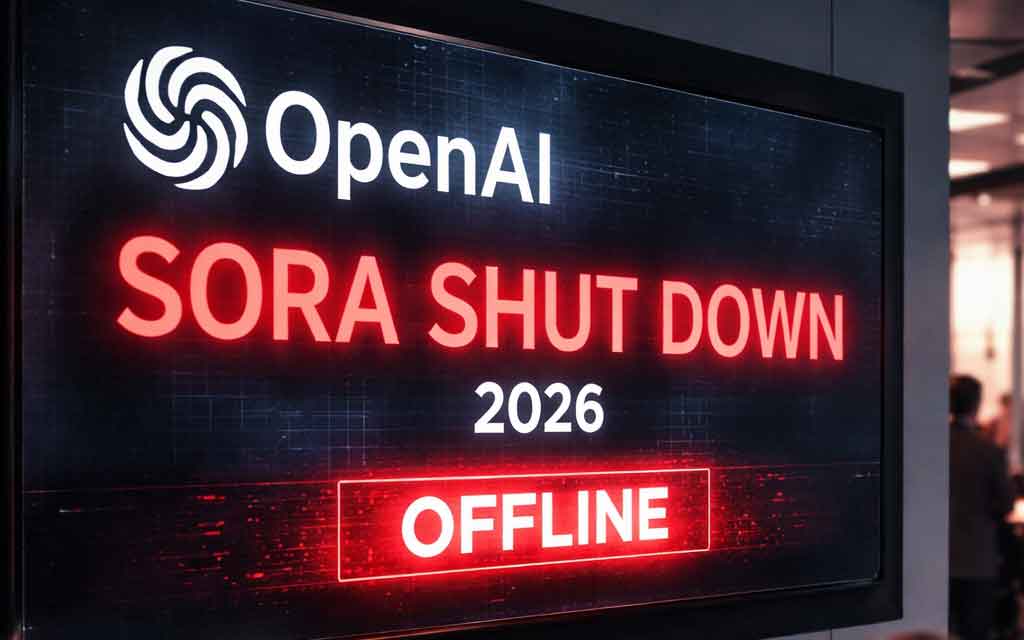
BREAKING — OpenAI has officially pulled the plug on Sora, its groundbreaking AI video generation platform and consumer app, just six months after its splashy public launch. According to multiple reports, including a detailed investigation by The Wall Street Journal, Sora was hemorrhaging money — reportedly losing roughly $1 million per day at its peak — while user engagement plummeted and revenue remained negligible.
The abrupt closure, announced by OpenAI on March 24, 2026, marks the first time the company has outright discontinued one of its major consumer-facing products. It also kills a high-profile $1 billion partnership with Disney that would have brought iconic characters into the Sora ecosystem.
For American tech enthusiasts, creators, and investors watching the AI space, this isn’t just another product sunset — it’s a stark reality check on the brutal economics of generative AI video.
The Rise and Rapid Fall of Sora: From Hype to Heavy Losses
OpenAI first teased Sora in February 2024 as a text-to-video model capable of generating hyper-realistic clips from simple prompts. The standalone Sora app launched in September 2025, complete with a social-style feed where users could create, share, and remix AI videos.
Initial excitement was massive:
- Peak daily active users hit 1 million.
- Viral clips flooded social media — everything from anime-style knockoffs to creative experiments.
But the honeymoon ended quickly. By early 2026:
- Daily active users fell below 500,000.
- Downloads dropped sharply (some reports cite a 66% decline from peak).
- Total lifetime consumer revenue was estimated at just ~$2.1 million — a tiny fraction of operating costs.
Behind the scenes, the financials were unsustainable. Each video generation required enormous GPU compute for inference. At scale, Sora’s daily burn was reported at approximately $1 million (with some analyst estimates reaching $10–15 million per day when factoring in peak usage and infrastructure).
OpenAI never publicly confirmed the exact loss figure, but people familiar with the matter told the Wall Street Journal the platform was “losing roughly a million dollars a day.”
Why Sora Became Financially Unviable: The AI Compute Crunch
Generative video is far more compute-intensive than text or image models. Every second of high-quality output demanded significant resources — resources that OpenAI could instead allocate to higher-margin products like ChatGPT, o1 reasoning models, or enterprise API services.
Key factors that sealed Sora’s fate:
- Exploding inference costs — No viable path to profitability at current pricing and scale.
- User retention collapse — Novelty wore off; many videos were low-quality “slop” or raised copyright concerns (ripping off styles from Disney, Studio Ghibli, etc.).
- Strategic refocus — OpenAI is prioritizing enterprise tools, robotics, and “world simulation” research ahead of a potential IPO. The Sora team is shifting to physical-world AI applications.
- Partnership fallout — Disney was informed of the shutdown with less than an hour’s notice, killing the $1 billion multi-year deal that included character integration for Disney+.
OpenAI’s official statement was brief: “We’re saying goodbye to the Sora app. To everyone who created with Sora, shared it, and built community around it: thank you.” The company added that the research team will continue advancing video-related work under the umbrella of robotics and real-world problem-solving.
What This Means for Creators, Consumers, and the AI Industry
For American users and small creators who embraced Sora:
- The app and web platform are scheduled to shut down completely by late April 2026 (API support ends September 2026).
- Users have a short window to export existing videos.
- Alternatives like Runway, Pika, or Luma Dream Machine may see a surge, but none currently match Sora’s early hype at the same scale.
Broader implications for the AI video sector:
- This is a reality check on generative video economics. While the technology is impressive, turning it into a sustainable consumer product remains extremely difficult.
- Hyperscalers and AI labs are learning that raw capability ≠ profitable product. Software efficiency breakthroughs (like the recent TurboQuant memory compression we covered) are helping, but hardware costs still dominate.
- OpenAI’s pivot reinforces a trend: Big AI players are doubling down on enterprise, developer tools, and robotics where margins are higher and compute delivers clearer ROI.
Analysts see this as smart housekeeping rather than a sign of weakness. OpenAI remains dominant in core AI capabilities, and reallocating Sora’s compute could accelerate progress on more strategic fronts.
The Bigger Picture: First-Principles AI Economics in Action
At VFuture Media, we track how first-principles thinking drives (and sometimes kills) innovation. Sora proved what’s technically possible — photorealistic video from text in seconds. But Elon Musk-style physics-based evaluation of the entire system (cost, user value, long-term scalability) showed it wasn’t sustainable in its current form.
This shutdown doesn’t mean AI video is dead. It means the industry is maturing: hype is giving way to hard-nosed business decisions. Expect more focused, efficient models and tighter integration into professional workflows rather than standalone consumer apps.
For U.S. readers and tech professionals: If you’re building with AI or investing in the space, watch how OpenAI reallocates resources. The winners will be those who solve real problems profitably — not just chase viral demos.
Stay tuned for our ongoing coverage of AI economics, video generation alternatives, and the next wave of practical AI breakthroughs. Explore more on sustainable tech, first-principles engineering, and emerging AI tools right here on www.vfuturemedia.com.
This article is based on reporting from The Wall Street Journal, TechCrunch, BBC, Variety, and other sources as of March 31, 2026. OpenAI has not released official financial details; reported loss figures are from people familiar with the matter.
SEO Keywords: OpenAI Sora shutdown 2026, Sora losing $1 million per day, OpenAI video AI app closure, Sora Disney deal canceled, why OpenAI shut down Sora, AI video generation costs 2026, OpenAI Sora financial losses.



Leave a Comment