
By the VFuture Media Team Published: March 31, 2026 | www.vfuturemedia.com
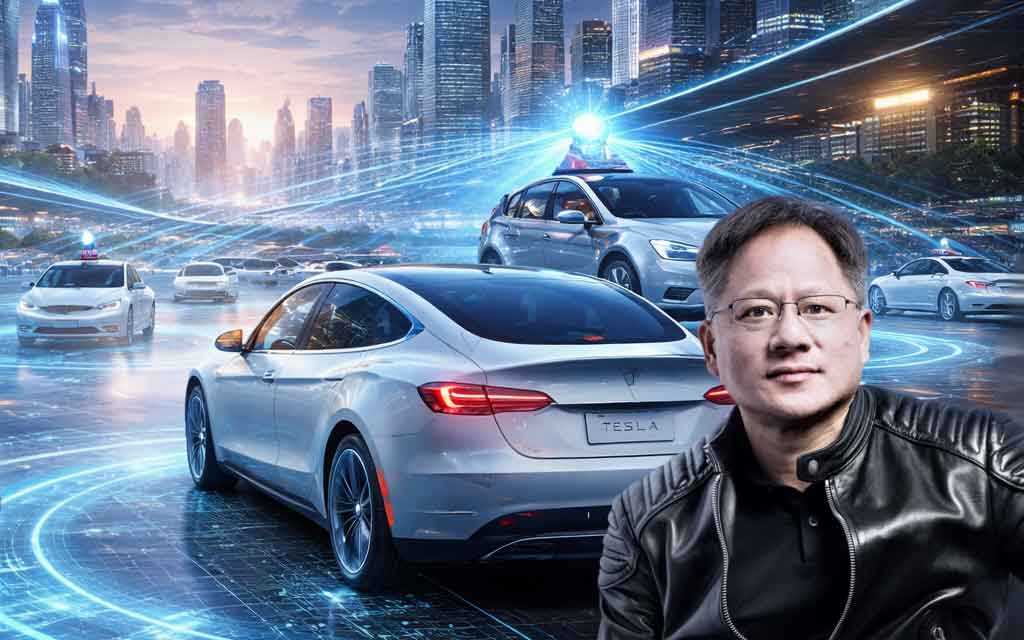
In a stunning endorsement that sent shockwaves through the autonomous driving world, Nvidia CEO Jensen Huang declared that Tesla’s autonomous vehicle stack is the most advanced in the world — and that he is “fairly certain” Tesla has already been running end-to-end AI for some time.
The comment, made during a Bloomberg interview at CES 2026 in January and still reverberating across AI and auto circles, carries massive weight. Nvidia powers the AI infrastructure behind nearly every major player in the space — from Waymo and Cruise to traditional automakers. When the man whose chips literally train and run the world’s most powerful AI models calls Tesla #1, it’s not hype. It’s independent, first-principles validation from the undisputed leader in AI hardware.
Jensen Huang’s Exact Words and Why They Matter
Speaking candidly about the rapid progress in autonomous vehicles, Huang stated:
“Tesla’s stack is the most advanced autonomous vehicle stack in the world… I’m fairly certain they were already using end-to-end AI.”
This isn’t casual praise. End-to-end AI — where a single neural network processes raw sensor data straight into driving decisions, with no hand-coded rules in between — has been Elon Musk’s vision for Full Self-Driving (FSD) and Robotaxi since at least 2022. Competitors largely stuck with modular, rules-heavy systems. Huang’s confirmation suggests Tesla’s bet on pure AI has already pulled ahead.
For context: Nvidia’s own DRIVE platform and Orin/Thor supercomputers are used by many OEMs and robotaxi developers. Huang has seen every major stack up close. His assessment isn’t based on marketing slides — it’s based on technical reality.
The AI Breakthrough Behind Tesla’s Lead
Tesla’s approach is classic first-principles engineering:
- Massive real-world data from millions of customer vehicles (over 1 billion miles of FSD data collected).
- A single, unified neural network that learns driving like a human — vision-only, no lidar or radar crutches.
- Rapid iteration via over-the-air updates, turning every Tesla on the road into a learning node.
Huang’s comments validate that this end-to-end model isn’t just theoretically promising — it’s already the most advanced implementation on the planet. This directly accelerates timelines for unsupervised FSD and the long-awaited Robotaxi unveil and deployment.
What This Means for the Robotaxi Era
The implications are huge and fast-moving:
- Regulatory green lights: Regulators and investors now have third-party confirmation from the AI king that Tesla’s tech is leading. This could smooth approvals for unsupervised operation in more U.S. states.
- Robotaxi timeline compression: With end-to-end AI already mature, Tesla’s planned Robotaxi network — using existing vehicles as autonomous revenue generators — could scale faster than anyone expected.
- Competitive pressure: Waymo, Cruise, Zoox, and traditional automakers now face even steeper odds. Many still rely on multi-sensor fusion and human-coded safety layers that Huang implicitly called less advanced.
- Stock and market reaction: Tesla shares surged on the renewed validation, while the broader AI-autonomy sector took note that software-first, vision-only stacks are winning.
For American drivers and investors, this is the clearest signal yet that the Robotaxi future isn’t “if” — it’s “how soon.” Affordable, on-demand autonomous rides could reshape urban mobility, reduce accidents, and unlock new economic opportunities in the U.S. faster than previously forecasted.
Broader AI Industry Perspective
Jensen Huang’s praise fits the bigger 2026 AI story we’ve been tracking: real-world, embodied AI (robotics, autonomy, agents) is where the next massive leaps are happening. From Claude’s new Computer Use capabilities to Google’s TurboQuant efficiency breakthroughs, the focus is shifting from pure language models to systems that act in the physical world.
Tesla’s stack succeeding with end-to-end AI proves that massive data + neural nets + rapid iteration beats complex engineering pipelines. It’s the same philosophy that led SpaceX to stainless steel for Starship — ignore convention, trust physics and data.
At VFuture Media, we follow how first-principles thinking in AI is transforming everything from EVs and autonomy to software agents. Huang’s comments aren’t just a compliment to Tesla — they’re a roadmap for the entire industry.
The Robotaxi era isn’t coming. According to the CEO powering the AI revolution itself, it’s already here — and Tesla is leading the charge.
Stay ahead of the autonomy revolution: Explore our latest coverage of end-to-end AI, Robotaxi developments, first-principles engineering breakthroughs, and EV/AI convergence right here on www.vfuturemedia.com.
SEO Keywords: Jensen Huang Tesla autonomy stack most advanced, Nvidia CEO praises Tesla end-to-end AI, Tesla Robotaxi validation 2026, Jensen Huang CES 2026 Tesla comments, Tesla FSD end-to-end AI breakthrough, Robotaxi era acceleration Nvidia validation.



Leave a Comment