
By Ethan Brooks for vfuturemedia.com
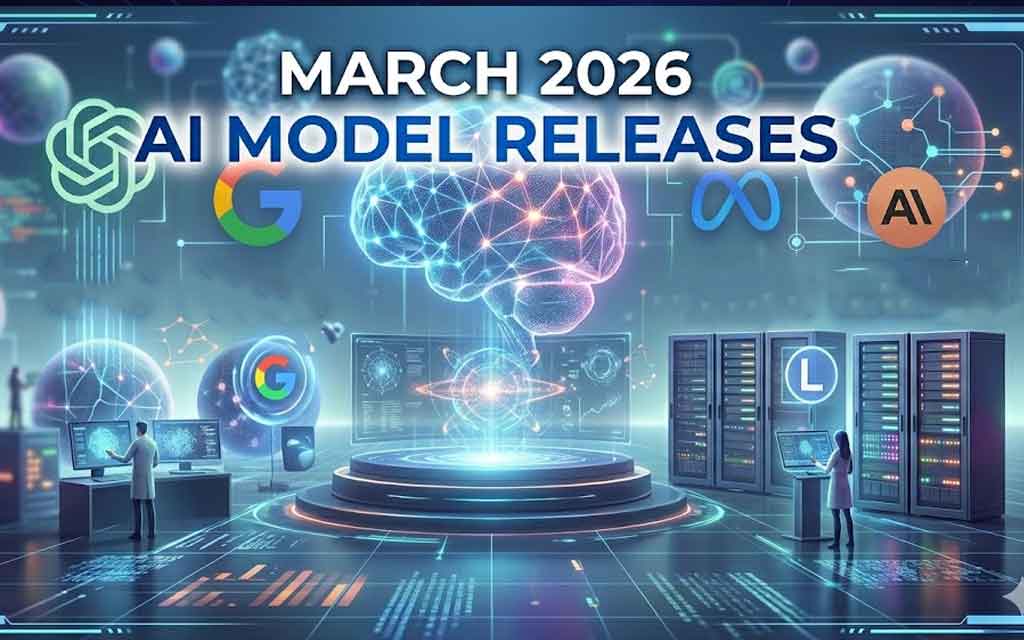
March 2026 delivered one of the most intense waves of AI model activity in recent memory. With nine major text-focused models shipping and a broader avalanche of updates, the month solidified the shift toward agentic AI—systems capable of planning, reasoning, tool use, and multi-step execution. Open-source releases accelerated accessibility, while proprietary frontier models pushed benchmarks in reasoning, coding, and multimodal capabilities.
From my analysis of real-world deployments, benchmark data (GPQA, ARC-AGI, SWE-bench, Intelligence Index), and early user feedback, March highlighted both remarkable progress and persistent challenges. Successes centered on efficient inference, lower hallucination rates, and agentic features that move beyond chatbots. However, enterprise adoption faced hurdles like high costs, integration complexity, and occasional reliability gaps—echoing broader trends where many AI pilots struggle to scale.
This roundup covers key releases, performance reviews, standout successes, and areas of underperformance for developers, enterprises, and enthusiasts in the USA, Europe, and Canada.
Major AI Model Releases in March 2026
March saw rapid iteration across labs. Key launches included:
- OpenAI GPT-5.4 series (including mini and nano variants): Lightweight updates emphasizing reasoning modes and native computer-use agentic capabilities. GPT-5.4 scored high on GPQA (~0.9 for mini) and tied near the top of Intelligence Index leaderboards (~57.17).
- xAI Grok-4.20 Beta: Featured a unique four-agent architecture (coordinator + specialized agents for fact-checking, logic/coding, and creative reasoning). Strong on factual accuracy with one of the lowest measured hallucination rates (~22%).
- NVIDIA Nemotron 3 Super (120B MoE hybrid): Open-source model optimized for multi-agent tasks, with 1M-token context and efficient single-GPU performance.
- Mistral Small 4: Open-source release focusing on balanced efficiency.
- Google Gemini 3.1 Flash-Lite Preview and related updates (including Deep Think elements rolling out later in the month).
- Alibaba Qwen 3.5 series: Multiple variants (small to massive 397B), many open-weight, excelling in agentic tool use.
- Other notables: Xiaomi MiMo-V2-Pro, MiniMax M2.7, and various lightweight or specialized models.
Many releases emphasized agentic capabilities—native tool calling, long-running workflows, and hybrid “thinking” modes that allocate compute dynamically for complex prompts. Open-weight models (7 of 9 major text releases) democratized access for self-hosting and customization.
The velocity was unprecedented: one week in mid-March alone saw a dozen significant drops, building on February’s momentum (Gemini 3.1 Pro, Claude 4.6 variants, earlier GPT-5.x iterations).
Success Stories: What Performed Best
Several models stood out in early reviews and benchmarks:
GPT-5.4 (OpenAI) — Tied for leaderboard leadership on Intelligence Index and excelled in agentic workflows with 1M-token context and extreme reasoning modes. Users praised reliability for professional tasks like coding, data analysis, and desktop automation. Success factors: Seamless integration with existing ChatGPT ecosystem and new features like ChatGPT for Excel. Real-world wins included faster iteration on complex projects with reduced hallucination in structured domains.
Grok-4.20 Beta (xAI) — Highlighted for factual grounding and its innovative multi-agent debate system. The lowest hallucination rate made it suitable for research, news summarization, and truth-seeking applications. Early testers noted engaging, less “corporate” responses while maintaining high accuracy. The beta’s non-reasoning and reasoning previews offered flexibility.
Gemini 3.1 Pro / Flash-Lite (Google) — Dominated multimodal and efficiency benchmarks. Strong in vision, video, and long-context reasoning. Enterprise users appreciated Vertex AI integration and cost-effective lightweight variants. Gemini 3 Deep Think (rolling out late March) boosted problem-solving for researchers and engineers.
Open-Source Standouts:
- Nemotron 3 Super (NVIDIA): Excelled in multi-agent orchestration on modest hardware. Ideal for developers building custom agents without massive cloud bills.
- Qwen 3.5 (Alibaba) and Mistral Small 4: Provided strong value for self-hosted deployments, with Qwen shining in tool-use and coding scenarios. MiniMax M2.7 and MiMo-V2-Pro offered competitive performance at accessible scales.
Benchmark Highlights (approximate from March data):
- Top models approached or exceeded 57 on Intelligence Index.
- Strong gains in ARC-AGI reasoning, SWE-bench coding, and GPQA scientific QA.
- Agentic features reduced failure rates in multi-step tasks compared to prior generations.
Success often tied to hybrid architectures (MoE, Mamba-Transformer hybrids) enabling better efficiency and scalability.
Reviews & Real-World Performance
Early user and analyst feedback was largely positive but nuanced:
- Strengths: Improved reasoning depth, better tool integration, and multimodal support made models more practical for workflows. Agentic previews (computer use, orchestration) showed promise for automation in coding, research, and business ops. Lower hallucination in Grok and structured outputs in GPT/Claude variants built trust.
- Enterprise Feedback: Models like GPT-5.4 and Claude 4.6 successors integrated well into productivity tools. Open-source options lowered barriers for startups and self-hosters in Europe and Canada, where data sovereignty matters.
- Developer Perspective: NVIDIA and Mistral releases accelerated local experimentation. GitHub trends favored agent frameworks building on these models.
However, reviews noted variability: Performance shone in controlled benchmarks but could degrade in noisy, long-running real-world agent deployments without proper orchestration and monitoring.
Failures, Setbacks & Persistent Challenges
No major model was a outright “failure,” but March exposed ongoing limitations:
- Agentic Hype vs. Reality: While agentic features advanced, many early deployments faced “silent failures at scale”—subtle errors compounding in autonomous workflows. Gartner projections and enterprise reports highlighted that over 40% of agentic projects risk cancellation due to costs, unclear ROI, or inadequate controls. Models still struggled with nuanced, long-horizon tasks without human oversight.
- Outages & Reliability: Anthropic and others experienced multiple outages amid rapid launches. Scaling agentic systems revealed context overload and inference cost spikes.
- Enterprise Adoption Gaps: Echoing prior MIT findings on high pilot failure rates (~95% in some studies), many organizations reported stalled rollouts due to integration complexity, bias risks, and data quality issues. Goldman Sachs and others publicly flagged hallucination and output errors as business risks.
- Specific Issues: Video generation tools like Sora faced API adjustments or scrutiny over content quality. Some lightweight models traded depth for speed, underperforming on graduate-level reasoning without “thinking” modes enabled.
- Broader Risks: Dependency on third-party providers, energy demands, and regulatory scrutiny (especially in Europe) added friction. Chinese open models (Qwen, etc.) succeeded technically but raised geopolitical and IP considerations for Western adopters.
These setbacks underscore that raw model capability is only part of the equation—robust evaluation, governance, and hybrid human-AI systems remain essential.
Comparison Table: Key March 2026 Models
Top AI Models & Their Key Highlights (2026)
- GPT-5.4 (mini/nano) – Developed by OpenAI
- Type: Proprietary
- Strengths: Agentic computer use, strong reasoning
- Benchmarks: High GPQA, Intelligence Index
- Best For: Professional workflows
- Open Weights: No
- Grok-4.20 Beta – Developed by xAI
- Type: Proprietary
- Strengths: Low hallucination, multi-agent systems
- Benchmarks: Lowest hallucination rate
- Best For: Research, factual tasks
- Open Weights: No
- Nemotron 3 Super – Developed by NVIDIA
- Type: Open-source
- Strengths: Multi-agent efficiency, 1M context window
- Benchmarks: Strong GPQA
- Best For: Custom agent building
- Open Weights: Yes
- Mistral Small 4 – Developed by Mistral AI
- Type: Open-source
- Strengths: Balanced performance
- Benchmarks: Competitive GPQA
- Best For: Efficient deployment
- Open Weights: Yes
- Gemini 3.1 Flash-Lite – Developed by Google
- Type: Proprietary
- Strengths: Multimodal capabilities, high speed
- Benchmarks: Strong reasoning & vision
- Best For: Enterprise multimodal applications
- Open Weights: No
- Qwen 3.5 Series – Developed by Alibaba
- Type: Mostly open
- Strengths: Tool use, scalable variants
- Benchmarks: Strong in agentic tasks & coding
- Best For: Self-hosting, customization
- Open Weights: Yes (many variants)
Benchmarks are directional from March 2026 reports; real performance varies by use case and prompting.
Implications for Users in USA, Europe & Canada
- USA: Rapid access via major platforms (ChatGPT, Gemini, Grok on X). Enterprises leveraged integrations at events like NVIDIA GTC. Funding and compute advantages accelerated testing.
- Europe: Emphasis on open-source (Mistral, Nemotron) aligned with GDPR and sovereignty needs. Energy efficiency in smaller models mattered amid sustainability focus.
- Canada: Talent hubs benefited from accessible open models for research and mobility/AI crossovers (e.g., agentic optimization for EV routing).
Practical Tips:
- Start with lightweight variants (GPT-5.4 mini, Flash-Lite) for cost-sensitive testing.
- Use agentic features with monitoring tools to catch silent failures.
- Evaluate on your data: Benchmarks don’t always predict domain-specific success.
- Combine models (multi-LLM orchestration) for best results.
Future Outlook: Agentic AI Dominates 2026
March 2026 accelerated the agentic shift, with models laying groundwork for autonomous digital coworkers. Success will depend on addressing reliability, cost, and governance. Expect further iterations in April and beyond, including deeper multimodal and physical AI ties.
For founders and investors: Bet on infrastructure enabling safe agent deployment. For everyday users: These models make AI more capable—but thoughtful prompting and verification remain key.
The month proved AI progress is relentless, yet grounded success requires moving beyond hype to robust, measurable deployment.


Leave a Comment