
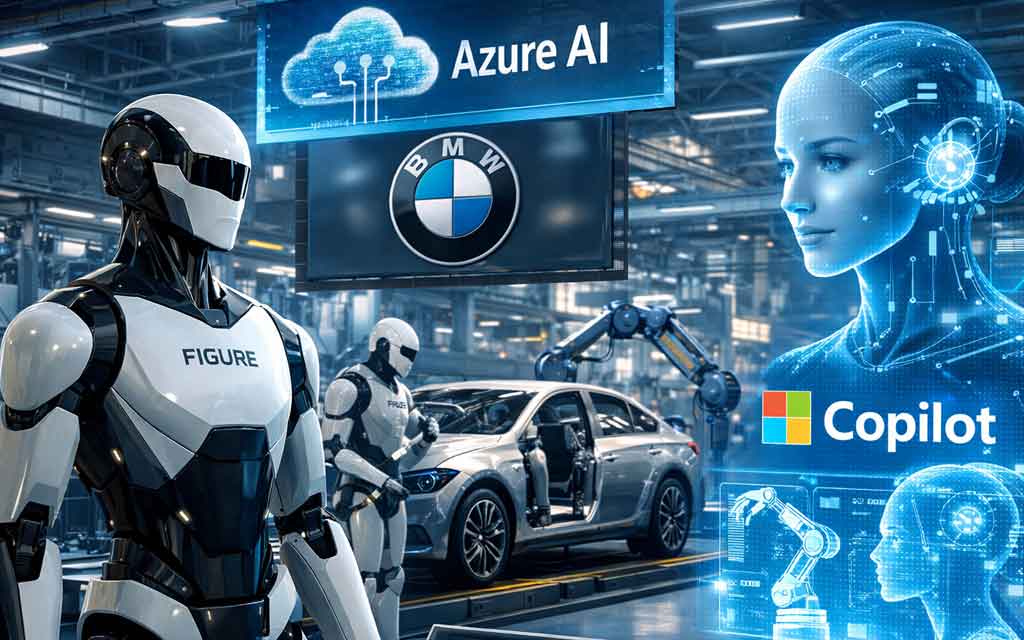
Microsoft owns the humanoid robotics revolution — not through flashy robot prototypes grabbing headlines, but through the invisible, high-margin infrastructure that powers the entire ecosystem. While Tesla’s Optimus dominates media cycles with walking demos and ambitious factory deployment claims, the real money, scale, and enabling technology flow through Microsoft’s Azure AI platform.
Figure AI: Humanoids Running on Azure
Figure AI, a leading humanoid robotics startup, explicitly runs its AI models on Microsoft Azure for infrastructure, training, and storage. In its major 2024 funding round (raising $675M at a $2.6B valuation), Microsoft invested directly alongside OpenAI, NVIDIA, and others. Figure’s robots leverage OpenAI’s GPT models fine-tuned on robotics action data, with Azure handling the heavy compute for training and deployment.
This partnership positions Microsoft as the backend for “embodied AI” — giving Figure the scalable cloud resources needed to move from prototypes to commercial operations (e.g., early pilots in BMW factories for automating unsafe or tedious manufacturing tasks). Figure has since raised even larger rounds, but the Azure foundation remains a core enabler for its vision of general-purpose humanoids assisting in real-world applications.
BMW Factories and Azure AI: Real-World Deployment
BMW Group integrates Azure AI deeply into its operations, including test-fleet data analysis and manufacturing. BMW’s Mobile Data Recorder (MDR) system uses Azure for processing massive telemetry (5-10 TB per week from test vehicles), delivering insights up to 12x faster via multi-agent AI. This accelerates vehicle development for models like the “Neue Klasse.”
Broader partnerships include Azure IoT, Azure Kubernetes Service, and AI services for smart factories, predictive maintenance, and connected manufacturing. BMW has used Azure Industrial IoT platforms for years to standardize data models and enable analytics/ML across global production lines.
While Figure’s BMW pilot highlights humanoid potential in assembly, Azure already powers BMW’s data-driven, AI-optimized factories today — creating the intelligent infrastructure where future humanoids (or any advanced automation) will operate.
Azure AI Economics: 50%+ Margins Territory
Azure drives Microsoft’s Intelligent Cloud segment with explosive growth: 39% YoY revenue increase in recent quarters (Azure and other cloud services), contributing to Microsoft Cloud surpassing $50B in a single quarter. AI workloads are a major accelerator, with enterprises committing via multi-year contracts (remaining performance obligation up significantly).
Gross margins face short-term pressure from heavy AI infrastructure capex (GPUs, data centers), but analysts and Microsoft commentary point to strong long-term unit economics for Azure AI services. Excluding certain revenue shares, Azure AI gross margins are already in positive territory and positioned for significant expansion as scale efficiencies kick in and premium AI features monetize. Traditional cloud margins historically exceed 60-70%, and AI is expected to follow a similar high-margin path once infrastructure investments mature — supporting the “50%+” characterization in a scaled, efficient state.
Microsoft continues aggressive investment (tens of billions in capex annually), betting that Azure becomes the default platform for AI training/inference, including robotics.
Copilot+ Across Hundreds of Millions of Seats
Microsoft’s Copilot family (including Microsoft 365 Copilot) extends AI to the endpoint. As of early 2026, Microsoft 365 Copilot reached 15 million paid seats among ~450M+ Microsoft 365 commercial subscribers, with “multiples more” using free enterprise chat features. Copilot+ PCs (AI-optimized hardware with NPUs) are rolling out broadly, targeting productivity gains across Windows ecosystem devices.
This isn’t limited to a niche; it spans enterprise, with Copilot agents, Studio, and integrations creating new revenue streams (e.g., $30/user/month for M365 Copilot). Combined with Azure backend, it forms a full-stack AI flywheel: cloud infrastructure + intelligent apps + edge devices.
The Complete Tech Story: Infrastructure Wins Over Headlines
- Headlines go to Tesla: Optimus generates buzz with videos, internal factory tests, and bold claims of massive scale (thousands deployed or planned). Tesla benefits from vertical integration (its own data, chips, manufacturing know-how from EVs).
- Infrastructure money (and margins) go to Microsoft: Humanoids need enormous compute for training vision-language-action models, simulation-to-real transfer, and fleet inference. Azure provides the scalable, enterprise-grade cloud — already proven in industrial settings like BMW. Microsoft invests in Figure (and broader AI ecosystem), captures the recurring revenue from usage, and benefits from high-margin software/services layered on top.
This creates a “picks and shovels” play in the robotics gold rush. Tesla may sell or deploy the robots, but the underlying AI training, data processing, and orchestration often rely on hyperscale clouds like Azure. Microsoft also advances its own research in physical AI (e.g., models for robotics tasks) and partners across the stack.
In summary, Microsoft isn’t building the most viral humanoid — it’s building (and owning) the platform layer that makes the revolution economically viable at scale. Azure’s growth, Figure/OpenAI integrations, BMW deployments, Copilot endpoint expansion, and resilient margins tell a compelling full-stack AI story: the quiet infrastructure owner often captures the most durable value

Leave a Comment