
Published: April 7, 2026 | By EV Market Analysts at vFuture Media | Updated: April 7, 2026
The first quarter of 2026 painted a mixed picture for the global electric vehicle industry. While legacy challenges like the end of the $7,500 federal tax credit continued to weigh on demand, select players showed resilience, and external factors such as sharply rising gasoline prices sparked renewed consumer interest in EVs.
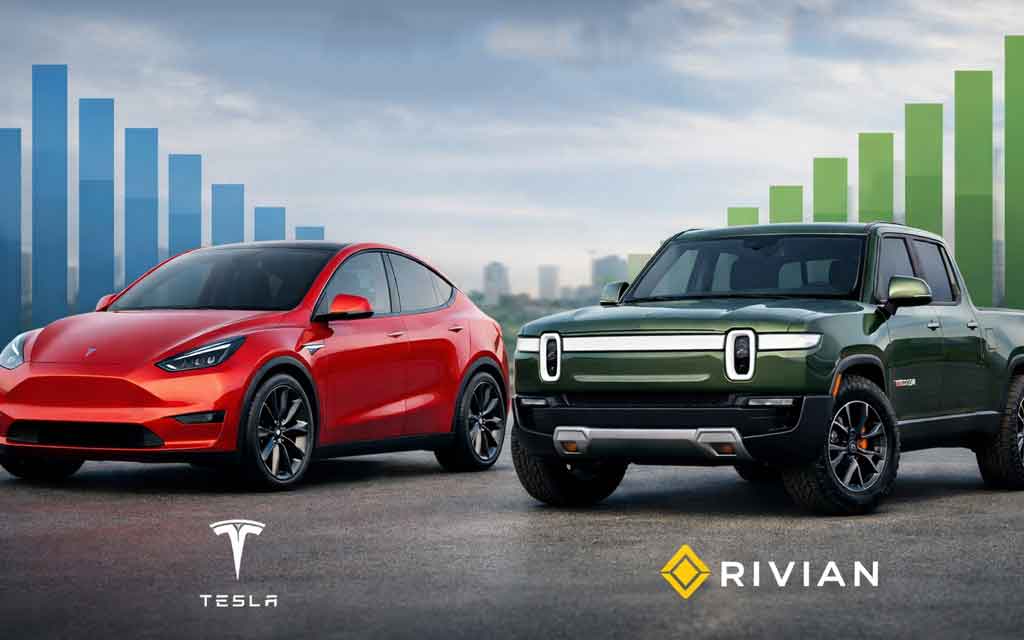
Tesla reported 358,023 vehicle deliveries worldwide in Q1 2026 — a modest 6.3% increase year-over-year but falling short of analyst expectations. Meanwhile, Rivian delivered 10,365 vehicles, beating Wall Street estimates and posting 20% growth compared to Q1 2025, signaling stabilizing demand for its R1T pickup and R1S SUV lineup.
Key Q1 2026 EV Delivery Highlights
- Tesla: 358,023 vehicles delivered (Model 3 and Model Y accounted for ~342,000 units). Production reached 408,386 vehicles, indicating some inventory buildup. Energy storage deployments declined to 8.8 GWh from 10.4 GWh a year ago.
- Rivian: 10,365 deliveries (up 20% YoY) and 10,236 vehicles produced. The company outperformed estimates of ~9,678 and reaffirmed its full-year guidance of 62,000–67,000 deliveries.
- Broader US Market: Overall new vehicle sales softened, with EV adoption facing headwinds after the federal tax credit expiration. Some reports noted Rivian’s US sales dipped sequentially, yet the brand still outsold several major automakers’ EV offerings in the US during the quarter.
These figures come amid a challenging environment: reduced incentives, high inventory levels at some brands, and cautious consumer spending. However, analysts point to positive undercurrents, particularly in regions with strong EV infrastructure like California.
Rising Gas Prices Spark EV Interest Amid Market Softness
National average gasoline prices climbed above $4 per gallon in early April 2026, with some states (including California) approaching or exceeding $5–$6/gallon due to geopolitical tensions. This surge has driven measurable upticks in EV-related searches and research:
- CarGurus and Edmunds data showed increased consumer interest in new and used EVs in March 2026.
- A Pew Research poll indicated that about one-third of potential buyers would now consider an EV due to high fuel costs.
- Online EV searches rose noticeably as pump prices spiked, though experts caution that short-term spikes may not immediately translate into sustained sales growth unless prices remain elevated for several months.
Electricity costs remain far more stable than gasoline, giving EV owners a clear long-term advantage in total cost of ownership — especially for high-mileage drivers.
Challenges and Opportunities in the 2026 EV Landscape
The post-tax-credit era has exposed price sensitivity, with many buyers delaying purchases or shifting toward more affordable options and used EVs. Legacy automakers faced steeper declines in some cases (e.g., Ford’s EV sales dropped sharply after decisions around the F-150 Lightning).
On the positive side:
- Affordable models like the upcoming Kia EV3 (North American debut at the 2026 New York Auto Show) and family-oriented entries such as the Subaru Getaway three-row EV could help broaden appeal in late 2026 and 2027.
- Software and charging improvements continue, including better route planning and NACS compatibility on new models.
- Global context shows varied performance: softness in some markets offset by steady progress in others.
vFuture Media Expert Analysis: Q1 2026 results highlight a transitional market. Tesla maintains dominance through volume and ecosystem strength, while Rivian demonstrates that focused execution and desirable products can deliver growth even without heavy incentives. The real catalyst for broader adoption may come from a combination of sustained higher gas prices, incoming affordable EVs, and continued charging network expansion. Buyers sensitive to fuel costs should calculate 5-year ownership expenses — in many scenarios, EVs now deliver significant savings despite higher upfront prices.
Q1 2026 EV Deliveries Snapshot
Q1 2026 EV Deliveries (U.S. Market)
Tesla
- Deliveries: 358,023
- YoY Change: +6.3%
- Notes: Missed some analyst targets
Rivian
- Deliveries: 10,365
- YoY Change: +20%
- Notes: Beat estimates; strong R1 lineup
Others (U.S.-focused EV makers)
- Deliveries: Varied
- YoY Change: Mixed / Declines
- Notes: Legacy brands faced headwinds
Data compiled from company reports, Reuters, InsideEVs, and Visible Alpha estimates as of April 2026.
Outlook for the Rest of 2026
With nearly 100 new or refreshed EV models expected throughout the year, the second half could see improved momentum if:
- Gas prices remain elevated or climb further.
- More sub-$40,000 options (like the Kia EV3) reach showrooms.
- Policy or incentive developments provide additional support.
Manufacturers are also leaning into hybrids and plug-in hybrids as bridge solutions, which captured growing share in early 2026.
Buyer Advice: If you’re shopping for an EV in 2026, compare total cost of ownership (including fuel/charging, maintenance, and incentives where available). Consider home charging installation for maximum savings. Models debuting at the New York Auto Show — such as the Kia EV3 and Subaru Getaway — deserve close attention for their balance of range, practicality, and accessibility.
What are your thoughts on Q1 2026 EV sales? Are rising gas prices influencing your next vehicle decision? Share in the comments below.
For more insights, explore our EV Buying Guide 2026, Best Affordable EVs roundup, and Home EV Charger Reviews on vfuturemedia.com.
Sources: Official Tesla and Rivian delivery reports, Reuters, InsideEVs, Forbes, CarGurus, Edmunds, Cox Automotive, and Pew Research data. All figures are as reported in early April 2026 and subject to final revisions.



Leave a Comment