
By Ethan Brooks U.S.-Based Technology and Automotive Journalist Published: April 9, 2026 For VFutureMedia.com
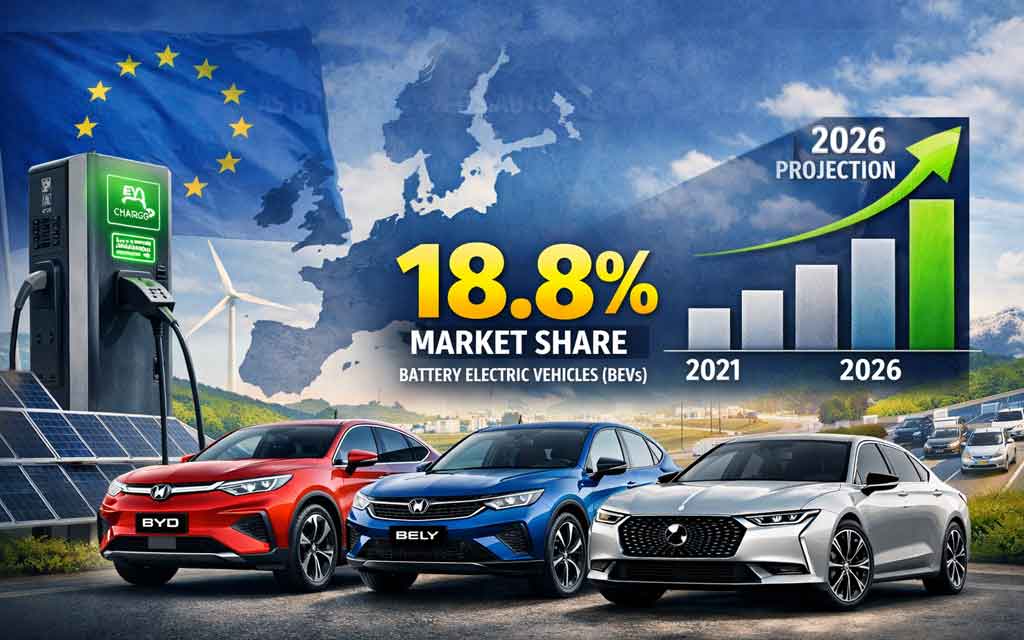
While overall new car registrations in the European Union dipped slightly by 1.2% year-to-date through February 2026, battery-electric vehicles (BEVs) continued their upward trajectory, capturing an 18.8% market share — a solid increase from 15.2% in the same period of 2025. Plug-in hybrids (PHEVs) also posted strong growth, rising to 9.8% market share, as electrified powertrains collectively accounted for a growing portion of sales.
This steady electrification progress stands in contrast to softer new EV demand in parts of North America, highlighting Europe’s consistent policy-driven approach to decarbonization.
Strong Electrification Momentum Despite Modest Overall Sales
According to the latest data from the European Automobile Manufacturers’ Association (ACEA), 312,369 new battery-electric cars were registered in the EU from January to February 2026. Hybrid-electric vehicles remained the most popular choice at 38.7% market share, while the combined share of petrol and diesel cars fell to just 30.6%.
Key highlights from major markets:
- France and Germany showed robust BEV growth (+38.5% and +26.3% respectively in some segments).
- PHEV registrations rose significantly in Italy (+116.1%) and Spain (+71.5%).
Several new and upcoming models are fueling this momentum in April 2026:
- Denza Z9 GT — Premium electric estate (shooting brake) officially launching in Paris on April 8, targeting the luxury segment with sleek aerodynamics and advanced tech.
- Geely E5 — Orders expected to open by the end of April in France as part of Geely Group’s push into key European markets.
- DS N°7 all-electric family SUV — Launching in April on the STLA Medium platform, emphasizing comfort, distinctive design, and premium finish.
These launches, alongside continued strength from brands like BYD and Hyundai-Kia, are helping sustain consumer interest amid a competitive landscape that also includes Chinese imports.
AI, Green Tech, and Infrastructure Support the Transition
Europe is simultaneously advancing AI infrastructure with a strong emphasis on sustainability. Major data center projects — including a 310 MW facility by Nebius in Finland, a Nvidia-backed campus near Paris, and significant investments in Sweden — prioritize renewable energy sources. These developments create natural synergies with EV growth, as clean power supports both AI compute demands and expanding charging networks.
Regulatory efforts continue with refinements to the EU AI Act, including potential adjustments for high-risk systems and proposals around watermarking AI-generated content. Broader green tech momentum is evident in national ecosystems, such as Austria’s “Green Tech Startups 2026” survey, which identified 228 active young companies focused on environmental and climate technologies — a 6% increase from the previous year. University cities like Vienna, Graz, and Leoben lead in new entries, with strong activity in energy, mobility, and circular economy solutions.
Upcoming events like the Energy Tech Summit (April 15–16 in Bilbao) further underscore Europe’s focus on deep tech, climate adaptation, and sustainable mobility intersections.
How Europe Compares to North America
Europe’s technology-neutral but aggressive push toward lower emissions contrasts with:
- The U.S., where new EV sales faced headwinds after federal tax credit changes, but used EV sales rose nearly 30% amid gas prices above $4/gallon and accessible models like the Kia EV3 and Subaru Getaway debuted at the New York Auto Show.
- Canada, which announced $10.6 million on April 8 for 14 projects adding over 1,600 new EV chargers, targeting smaller communities alongside a more open stance on certain imports.
This regional divergence highlights different pathways: Europe betting on steady market share gains and policy consistency, while North America emphasizes affordability, used-market dynamics, and targeted infrastructure.
Outlook for the Rest of 2026
Analysts suggest that if current trends hold, BEVs could approach or exceed 20–25% market share in Europe by year-end. The combination of new affordable and premium models, renewable-powered AI infrastructure, and a vibrant green tech startup scene positions Europe well for continued progress.
However, challenges persist, including overcapacity in traditional manufacturing, potential trade tensions, and the need for balanced support across BEVs, PHEVs, and hybrids as a bridge technology.
At VFutureMedia.com, we’ll keep tracking how Europe’s electrification, AI advancements, and green tech ecosystem evolve — with implications for global mobility, supply chains, and innovation.
What do you think — will Europe’s policy-driven model deliver faster mainstream EV adoption than market-led approaches elsewhere? Or will hybrids continue playing a key bridging role? Share your perspective in the comments below.
Ethan Brooks is an independent U.S.-based journalist specializing in automotive technology, sustainable mobility, AI, and green tech. This article is based on publicly reported data as of April 9, 2026, and is for informational purposes only.
Related Reading on VFutureMedia.com:
- USA vs Europe vs Canada: How EV Policies Are Diverging in 2026
- Upcoming Affordable EVs 2026: Kia EV3, Subaru Getaway & More
- Q1 2026 Record AI Funding: What It Means for Mobility and Green Tech
Sources: ACEA, European Alternative Fuels Observatory, Green Tech Valley Cluster, automaker announcements, and industry reports.



Leave a Comment