
By Ethan Brooks, USA Tech Journalist
Published: April 14, 2026
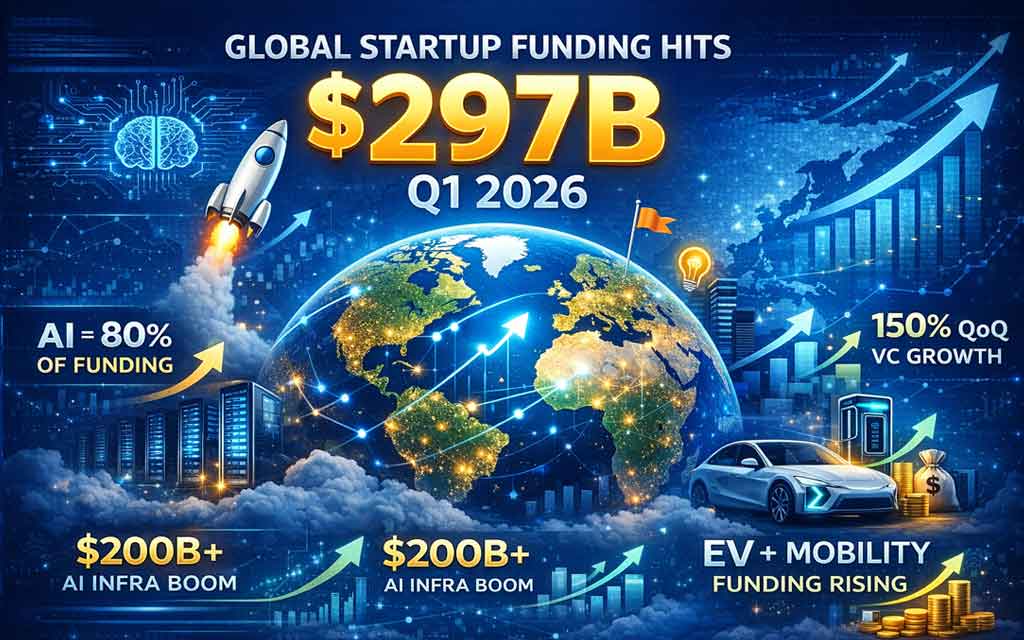
Venture capital shattered every historical record in the first quarter of 2026, with global investors pouring approximately $297 billion into roughly 6,000 startups — a staggering 150% increase both quarter-over-quarter and year-over-year. Artificial intelligence dominated the landscape, capturing roughly 80% of total funding, or about $242 billion. Just four mega-rounds — led by OpenAI’s historic $122 billion raise — accounted for more than 63% of the quarter’s capital.
This week’s developments underscored the theme: massive concentration in frontier AI infrastructure, growing interest in physical and embodied AI, and continued momentum in electric vehicles through innovative startups. CoreWeave expanded its partnership with Meta in a $21 billion AI cloud deal, SiFive reached a $3.65 billion valuation on RISC-V advancements for data centers, and Slate Auto — backed by Jeff Bezos — continued gaining attention as an affordable EV disruptor. Meanwhile, specialized funds like Eclipse’s new $1.3 billion vehicle targeted “physical AI” applications in robotics, autonomy, and sustainable tech.
The Q1 surge signals that 2026 is not merely a continuation of the AI boom but a phase of hyper-acceleration, where capital is flowing at unprecedented scale to a handful of leaders while creating ripple effects across infrastructure, chips, and real-world applications.
Record-Breaking Q1 Funding: AI Takes Center Stage
According to Crunchbase data, the $297 billion invested globally in Q1 2026 far exceeded any previous quarter and even surpassed full-year VC totals from most pre-2019 years. The concentration was extreme: OpenAI raised $122 billion at an $852 billion post-money valuation, Anthropic secured $30 billion, xAI closed a $20 billion round, and Waymo (Alphabet’s self-driving unit) added $16 billion. These four deals alone totaled $188 billion.
North America led the charge, with AI-related companies raising around $221 billion. Early-stage activity also strengthened, with Series A and B rounds showing healthy growth. However, the data highlights a maturing but polarized ecosystem: mega-rounds for established frontier players alongside selective bets on emerging categories like agentic AI, robotics, and specialized infrastructure.
Beyond the headlines, investors showed appetite for diversification. Kleiner Perkins raised a $3.5 billion fund focused on AI, while Eclipse closed a $1.3 billion vehicle split between early-stage incubation and growth-stage physical AI startups. Eclipse’s portfolio already includes electric boat maker Arc, battery recycler Redwood Materials, and robotics firms, signaling strong crossover interest between AI and sustainable hardware.
AI Infrastructure Heats Up: CoreWeave’s $21B Meta Deal
On April 9, 2026, CoreWeave announced an expanded long-term agreement with Meta Platforms valued at approximately $21 billion, running through December 2032. This builds on a prior $14.2 billion commitment, bringing Meta’s total planned spend with the AI cloud provider to over $35 billion. The deal will supply dedicated capacity for Meta’s AI inference workloads across multiple data centers, including early deployments of NVIDIA’s Vera Rubin platform.
CoreWeave, which has quickly become one of the essential clouds for AI, now counts nine of the top ten AI providers as customers. The Meta expansion underscores the insatiable demand for high-performance compute as companies scale multimodal models, agents, and consumer-facing AI features. Analysts view such massive, multi-year commitments as de-risking mechanisms for both hyperscalers and specialized providers amid ongoing data center and power constraints.
The deal sent positive signals to the market, with CoreWeave shares reacting favorably in subsequent trading. It also highlights a broader trend: strategic infrastructure partnerships are becoming as critical as model development itself in the AI race.
Chip Innovation and Open Architectures: SiFive’s $3.65B Valuation
In a significant move for the semiconductor ecosystem, RISC-V pioneer SiFive raised $400 million in an oversubscribed Series G round on April 9, pushing its valuation to $3.65 billion. The round was led by Atreides Management and included participation from NVIDIA, Apollo Global Management, D1 Capital Partners, Point72 Turion, T. Rowe Price, and others. SiFive described the financing as its final private round before a planned IPO.
Founded by UC Berkeley engineers who helped create the open-source RISC-V instruction set, SiFive is accelerating high-performance CPU and AI IP solutions tailored for data centers. The company is integrating technologies like NVIDIA’s NVLink Fusion to enable seamless connectivity between RISC-V CPUs and GPUs, reducing latency for large-scale AI workloads.
This funding arrives as the industry seeks alternatives to dominant x86 and Arm architectures amid supply concerns and the massive compute demands of AI training and inference. SiFive’s progress positions RISC-V as a credible player in the data center, potentially lowering costs and increasing customization options for hyperscalers and AI labs.
EV and Physical AI Startups: Slate Auto and Embodied Innovation
While AI software and infrastructure dominated dollar volumes, tangible applications in electric vehicles and robotics also attracted attention. Slate Auto, the secretive Michigan-based EV startup backed by Jeff Bezos and other high-profile investors including Mark Walter of Guggenheim Partners, continues to draw scrutiny and optimism as it develops an affordable, customizable electric pickup truck targeting a sub-$30,000 price point.
Slate has raised hundreds of millions across rounds, with production plans focused on repurposed U.S. facilities. Its approach — a modular, bare-bones design aimed at customization and lower costs — seeks to address post-incentive affordability challenges in the U.S. EV market. The company’s stealth operations and high-caliber backers have fueled speculation that it could disrupt traditional truck segments, though it faces typical startup hurdles around scaling manufacturing and supply chains.
On the physical AI front, Eclipse’s $1.3 billion fund targets startups building AI-powered hardware, including autonomous construction vehicles, industrial robots, and sustainable mobility solutions. Investments in companies like Bedrock Robotics and Mind Robotics (a Rivian spinout) illustrate growing investor conviction that AI’s next wave will extend beyond digital realms into factories, logistics, and transportation.
Additional green tech activity included Altilium’s £18.5 million raise for EV battery recycling in the UK, highlighting the importance of circular economy infrastructure to support long-term EV adoption.
Implications for Founders, Investors, and the Broader Ecosystem
The Q1 2026 funding explosion carries both opportunities and risks. For founders, the environment rewards bold, capital-intensive bets in core AI technologies, infrastructure, and applied AI in physical domains. However, the extreme concentration of capital among a few players raises questions about innovation diversity and potential bubbles in late-stage valuations.
Investors face pressure to deploy at scale while maintaining discipline. Many limited partners (LPs) are reportedly becoming more selective, favoring managers with proven access to top-tier deals or specialized theses in areas like energy-efficient compute, defense AI, or climate tech.
Economically, the surge is fueling job creation in AI engineering, data center construction, and related fields, but it also amplifies concerns around talent concentration, energy consumption, and regulatory scrutiny. Antitrust watchers are monitoring the power of a small number of frontier labs and their suppliers.
For the EV and green tech ecosystem, startup activity complements larger manufacturers’ efforts. Affordable models and battery recycling innovations could accelerate adoption even as policy incentives evolve.
What This Means for 2026 and Beyond
2026 is on track to be a landmark year for venture capital if Q1 momentum continues. Expect:
- Continued mega-rounds and potential IPO activity from AI leaders like OpenAI and Anthropic.
- Intensified competition and partnerships in AI infrastructure and chips, with open architectures gaining ground.
- Greater crossover between AI and physical worlds — robotics, autonomous vehicles, and sustainable hardware.
- Selective but strategic funding in EV disruption and circular economy technologies.
- Growing scrutiny on capital efficiency, energy demands, and equitable distribution of AI benefits.
The CoreWeave-Meta deal and SiFive’s valuation jump illustrate that supporting technologies are becoming investment priorities on par with models themselves. Meanwhile, plays like Slate Auto show that even in a capital-heavy AI winter for some sectors, targeted innovation in mobility can still attract visionary backers.
Ultimately, the record funding reflects profound belief in AI’s transformative potential, but sustainable success will depend on execution, responsible scaling, and addressing infrastructure and societal challenges.
FAQ
How much funding did startups raise globally in Q1 2026? Approximately $297 billion across 6,000 deals, according to Crunchbase — the highest quarterly total on record.
What percentage of Q1 2026 VC funding went to AI? Roughly 80%, or about $242 billion, with a handful of frontier companies capturing the majority.
What is the significance of CoreWeave’s $21B deal with Meta? It highlights massive, long-term demand for specialized AI cloud capacity and strengthens CoreWeave’s position as a key infrastructure provider.
Why did SiFive raise $400M at a $3.65B valuation? To accelerate RISC-V-based high-performance chips for data centers and AI workloads, positioning the company for an eventual IPO.
What is Slate Auto and who backs it? Slate Auto is a U.S. EV startup developing an affordable, customizable electric pickup truck. It has received backing from Jeff Bezos and other prominent investors.
Are there risks associated with this funding concentration? Yes. Heavy reliance on a few mega-deals could lead to valuation distortions, reduced sector diversity, and challenges if capital markets tighten or regulatory hurdles emerge.
Conclusion
The first quarter of 2026 will be remembered as a watershed moment in venture capital history, defined by an extraordinary AI-driven funding surge and strategic moves in supporting infrastructure and applications. From OpenAI’s record round to CoreWeave’s infrastructure partnerships, SiFive’s chip ambitions, and EV innovators like Slate Auto, the ecosystem is rapidly maturing.
Founders and investors alike must balance ambition with pragmatism as the industry grapples with power demands, talent shortages, and the need for broad-based innovation. Those who can navigate this high-stakes environment while delivering real-world value stand to shape the next decade of technology.
Explore more forward-looking analysis at vfuturemedia.com/startups, vfuturemedia.com/ai, and vfuturemedia.com/electric-vehicles. Subscribe for weekly updates on the companies and trends reshaping our future.
By Ethan Brooks Ethan Brooks is a USA-based tech journalist with over 12 years of experience covering AI, innovation, venture capital, and emerging technologies. He has written for The Atlantic, TechCrunch, and other leading outlets, specializing in balanced, data-driven reporting on startup ecosystems, funding trends, AI infrastructure, and mobility innovation. His work focuses on providing clear context and forward-looking insights to help readers understand complex industry shifts.


Leave a Comment