
Tesla Tapes Out AI5: A Historic Win for the @Tesla_AI Chip Design Team
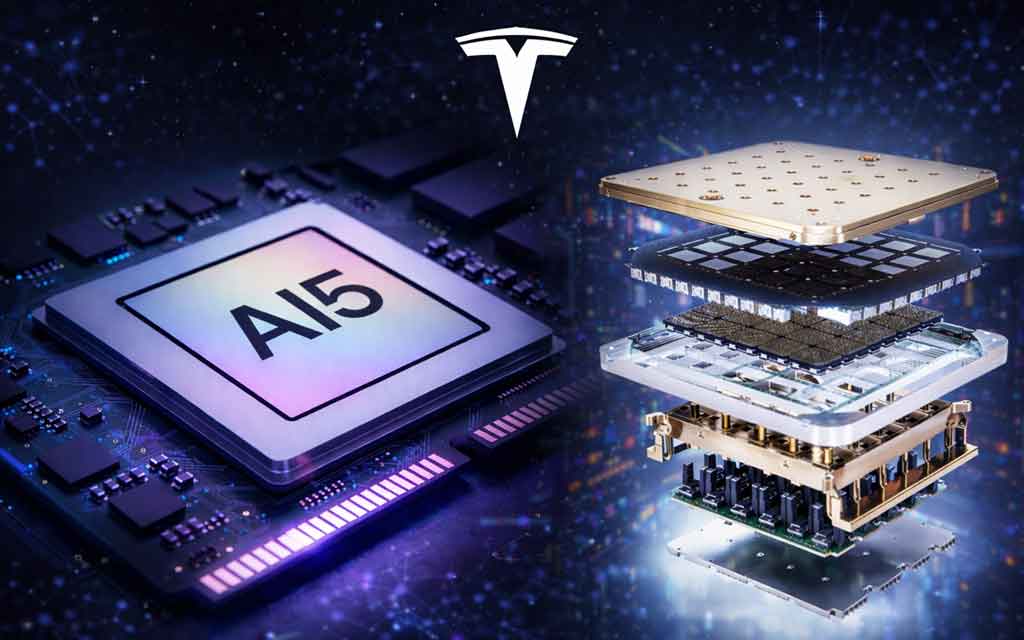
In an exciting update that’s sending ripples through the AI and autonomous vehicle world, Tesla’s chip design team has successfully taped out the AI5 – the next-generation inference and training chip that promises to supercharge Full Self-Driving, humanoid robots, and data-center-scale AI.
Elon Musk and the Tesla AI team shared the milestone with a clear message of appreciation:
“Congrats to the @Tesla_AI chip design team on taping out AI5! AI6, Dojo3 & other exciting chips in work.”
This announcement, fresh as of April 2026, marks a critical step in Tesla’s aggressive nine-to-twelve-month chip cadence and reinforces the company’s commitment to building the world’s most advanced in-house AI hardware. At vFuture Media, we’re diving deep into what the AI5 tape-out really means for the future of mobility, robotics, and artificial intelligence.
What “Tape Out” Actually Means (And Why It Matters)
Tape-out is the pivotal moment in semiconductor design when the final blueprint of a chip is sent to the fabrication facility (fab) for initial manufacturing. It’s the bridge between digital design and physical silicon.
For Tesla, taping out AI5 isn’t just a technical checkbox – it’s proof that the company’s vertically integrated hardware-software strategy is accelerating. Unlike traditional automakers that rely on third-party chips (NVIDIA, Mobileye, etc.), Tesla designs its own silicon from the ground up to perfectly match its neural network software stack.
AI5 Chip Specs & Performance Leap: 5x the Compute Power
According to recent roadmap updates, the AI5 delivers a massive performance jump:
- Approximately 2000–2500 TOPS (Tera Operations Per Second) of compute
- Roughly 5x the useful compute compared to the current dual-AI4 (HW4) setup in Tesla vehicles
- Optimized for ultra-low power inference at the edge – perfect for vehicles and humanoid robots
- Expected engineering samples in late 2026 and volume production ramp in 2027
This leap will enable unsupervised FSD at a level never seen before, with smoother decision-making, better edge-case handling, and the raw power needed for true robotaxi fleets.
Tesla’s Aggressive AI Chip Roadmap: AI6, Dojo3, and Beyond
The momentum doesn’t stop at AI5. Tesla is already moving full speed ahead:
- AI6 – Targeted tape-out as early as December 2026, focused on Optimus humanoid robots and data-center inference
- Dojo3 – The next-generation “space” supercomputer project has been restarted now that AI5 is in good shape. Dojo3 will use custom Tesla silicon (likely AI7/AI8 class) for massive training workloads – the first fully in-house Tesla supercomputer with zero NVIDIA dependency
- Future iterations (AI7, AI8, AI9) are already in early planning, aiming for a blistering 9–12 month release cadence
This rapid iteration is designed to keep Tesla years ahead of competitors in both vehicle autonomy and large-scale AI training.
Game-Changing Impact on Tesla’s Ecosystem
1. Full Self-Driving (FSD) & Robotaxi AI5 will be the brains behind the Cybercab and next-gen Robotaxi fleet. Expect dramatically improved safety, regulatory approval speed, and the ability to operate in complex urban environments without human intervention.
2. Optimus Humanoid Robots AI6 and later chips will power Tesla’s Optimus bots for factory work, household tasks, and beyond. The same silicon family used in cars will scale seamlessly to robotics.
3. Dojo Supercomputing Dojo3 will train the next generation of Tesla’s foundation models at unprecedented scale and efficiency – all while using far less power than competing GPU clusters.
4. Energy Efficiency & Cost Leadership By controlling the entire stack, Tesla can deliver Hopper-class (or better) performance per chip at a fraction of the power and cost of off-the-shelf solutions.
Why Tesla’s In-House Approach Is a Strategic Masterstroke
Tesla’s chip strategy is the ultimate example of vertical integration in the AI era. While other companies wait in line for NVIDIA GPUs, Tesla designs silicon that is purpose-built for its exact neural nets. This gives them:
- Faster iteration cycles
- Superior performance-per-watt
- Complete data privacy and security
- Massive cost advantages at scale
In a world where AI compute is the new oil, owning the refinery (the silicon) is the ultimate competitive moat.
What’s Next? Timeline & Investor Takeaways
- Late 2026 → AI5 engineering samples & early vehicle testing
- 2027 → AI5 volume production in vehicles + initial Dojo3 deployment
- December 2026 → AI6 tape-out target
For investors, AI enthusiasts, and future-tech watchers, this is one of the most important under-the-hood developments at Tesla right now. The AI5 tape-out isn’t just about faster cars – it’s about unlocking an entirely new era of autonomous everything.
What do you think? Will Tesla’s rapid AI chip cadence leave the competition in the dust? Drop your thoughts in the comments below.
FAQs – Tesla AI5 Tape Out
Q1: When will AI5 chips appear in Tesla vehicles? Volume production is targeted for 2027, with initial deployment likely in Cybercab/Robotaxi fleets first.
Q2: How does AI5 compare to NVIDIA chips? Tesla claims AI5 (and dual-chip setups) will match or exceed NVIDIA Hopper/Blackwell performance at significantly lower power – all while being fully optimized for Tesla’s software.
Q3: What is Dojo3? Tesla’s next-generation training supercomputer, powered entirely by in-house AI7-class chips, designed for massive foundation model training.
Q4: Where can I follow the latest Tesla AI updates? Bookmark vFuture Media and follow @Tesla_AI and @elonmusk on X for real-time announcements.
Article by vFuture Media Team | Published: April 15, 2026 Tags: Tesla AI5, AI6, Dojo3, Autonomous Driving, Optimus Robot, AI Hardware, Electric Vehicles, Future Tech



Leave a Comment