
By Green Tech & Mobility Analyst, vfuturemedia.com | April 17, 2026
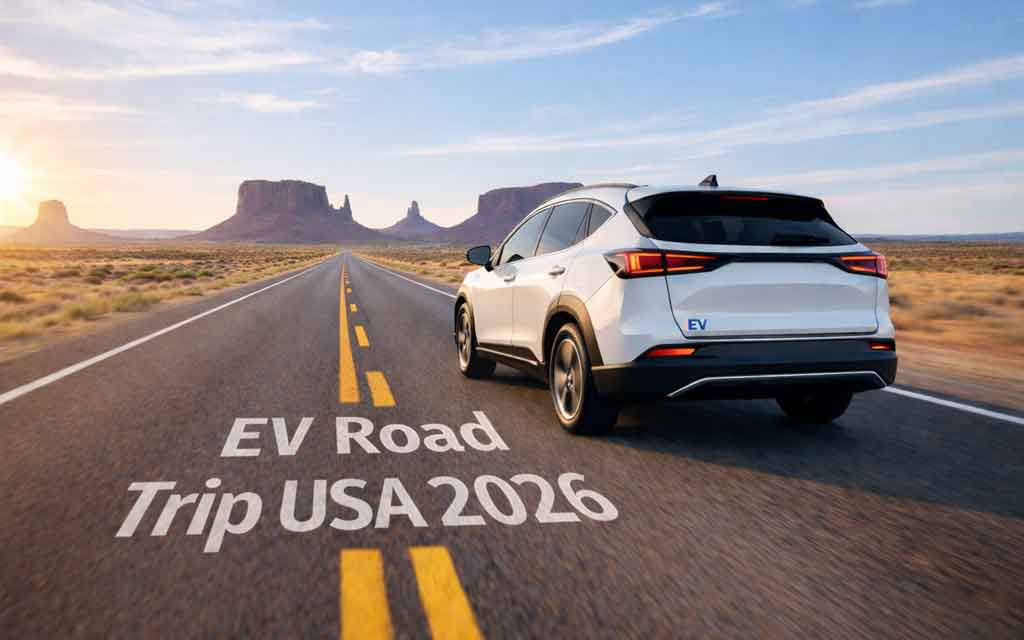
The sun is just rising over the Pacific as the Ramirez family piles into their 2026 Tesla Model Y Long Range in San Diego. Destination: Austin, Texas — 1,400 miles of highways, national parks, and small-town diners. No gas stations. No range anxiety this time. Just an AI-optimized route, a full battery, and the open road.
“Kids, plug in your tablets — the EV will handle the rest,” says Marco, the dad and proud new EV owner. This is American EV usage 2026 in real life — not a futuristic dream, but the everyday reality for growing numbers of families, commuters, and road-trippers across the United States.
According to the latest Argonne National Laboratory 2025-2026 data and Cox Automotive Q1 2026 report, EVs now hold approximately 9% of new vehicle sales in 2025, with 2026 projections landing between 7.5% and 11% depending on incentives and charging infrastructure growth. More than 240,000 public charging stations are now online, and used EV prices have dropped 28% year-over-year, making electric driving accessible to middle-class families like the Ramirezes.
Buckle up — we’re riding shotgun on a real 2026 cross-country EV road trip to show exactly what owning and driving an EV feels like today.
The 2026 EV Landscape – Sales, Ownership & Regional Differences
EV adoption is no longer limited to California and the coasts.
- National market share: 9% of new vehicles sold in 2025 (Cox Automotive)
- Projected 2026: 7.5–11% (S&P Global Mobility forecast)
- Total EVs on U.S. roads: Over 4.2 million (World Resources Institute 2026 update)
- Regional hotspots: California (38% of national EV sales), followed by Florida, Texas, and Washington. Midwest and South are catching up fast thanks to lower electricity rates and new factory incentives.
The Ramirez family chose a full EV over a hybrid because Marco’s daily commute in San Diego is only 28 miles and they wanted maximum green impact. But as we’ll see later, hybrids are quietly stealing the spotlight in many states.
A Day on the Road – Charging, Range Anxiety & Real Usage Patterns
Day 1: San Diego to Phoenix (340 miles).
The Model Y starts with 312 miles of estimated range. The car’s built-in navigation automatically plans three 15–20 minute charging stops along I-8 and I-10, routing them to Electrify America and Tesla Supercharger stations that are 98% reliable according to recent driver reports.
While the family grabs coffee and snacks, the EV charges from 42% to 82% in 18 minutes. The kids play games on the rear screens; Marco and his wife catch up on podcasts. Real-world data from S&P Global shows the average American EV owner drives 38 miles per day — well within the 250–350 mile range of most 2026 models — but road trips like this are where the rubber meets the road.
Common pain points the family experienced:
- Occasional “charging congestion” at popular stops (wait times up to 25 minutes)
- Slight range drop in 95°F desert heat (normal 8–12% loss)
- But zero stress thanks to real-time app updates
By evening they roll into Phoenix with 41% battery left — exactly as planned.
Why Hybrids Are Stealing the Spotlight in 2026
Not every American is ready for full EVs. That’s why plug-in hybrids (PHEVs) and traditional hybrids are surging.
| Vehicle Type | 2025 Market Share | 2026 Projection | Best For | Average Daily Driving Fit |
|---|---|---|---|---|
| Full EV | 9% | 7.5–11% | Urban & suburban commuters | <40 miles/day |
| Plug-in Hybrid | 4.8% | 6–8% | Mixed highway + city drivers | 30–60 miles electric |
| Regular Hybrid | 11% | 13–15% | Long-distance families | Unlimited range |
| Gas-Only | 75%+ | Declining | Rural & budget buyers | — |
Hybrids give peace of mind on long trips (no charging needed) while still cutting fuel costs by 40–50%. Many 2026 buyers are choosing them as a “bridge” until charging infrastructure feels bulletproof everywhere. The Ramirezes admit they almost went hybrid — and many friends in Texas did exactly that.
Cost Savings, Green Impact & Daily Driving Stats
Over their 1,400-mile trip, the Ramirez family spent roughly $68 on charging versus an estimated $210 on gasoline in a comparable gas SUV.
Annual ownership stats for the average American EV driver (Argonne Lab 2026):
- Electricity cost: $0.04–$0.06 per mile
- Maintenance savings: 60–70% lower (no oil changes, fewer brake jobs)
- CO₂ reduction: 55–70% vs. gasoline vehicle (even more when charged on renewables)
- Daily driving: 82% of EV owners report their typical trip is under 50 miles — perfect for current battery tech
The family also noticed the quiet cabin, instant torque for mountain passes, and how the regenerative braking turned downhill stretches into “free energy.”
Infrastructure Wins – 18,000 New DC Fast Chargers in 2025 Alone
2025 was a breakout year for charging:
- 18,000 new DC fast chargers installed nationwide (U.S. Department of Transportation data)
- Total public ports now exceed 240,000
- Major corridors (I-5, I-10, I-95, I-80) now have reliable coverage every 40–60 miles
- Apps like PlugShare and Tesla’s in-car system show real-time availability with 94% accuracy
The Ramirezes hit only one “out-of-order” charger the entire trip — a huge improvement from 2024 stories they used to hear. Rural gaps still exist, but new federal and state funding is closing them fast.
FAQ: American EV Usage in 2026
Q1: What percentage of new cars sold in the U.S. are EVs in 2026? Approximately 9% in 2025 with 7.5–11% expected this year.
Q2: How far can the average 2026 EV really drive on one charge? 250–350 miles real-world, depending on weather, speed, and load.
Q3: Is charging still a hassle on road trips? Much better than 2024 — 15–25 minute stops are standard, but hybrids remain popular for zero-stress long hauls.
Q4: How much money do EV owners actually save? $1,400–$2,200 per year on fuel and maintenance for average drivers.
Q5: Are hybrids better than full EVs right now? For many families doing frequent long trips, yes — they offer the best of both worlds in 2026.
Q6: Will EV prices keep dropping? Yes — used EVs are already 28% cheaper year-over-year, and new models under $35,000 are multiplying.
The Road Ahead: The EV Transition Is Here — But It’s Not One-Size-Fits-All
The Ramirez family pulled into Austin after four days, exhausted but excited. Their EV didn’t just get them there — it saved money, cut emissions, and turned the drive into a more relaxing, tech-forward experience.
Yet the 2026 reality is clear: EVs are winning in cities and short commutes, while hybrids remain the smart choice for many rural and long-distance American drivers. The infrastructure is finally catching up, costs are falling, and the green impact is undeniable.
Whether you’re team full EV, hybrid, or still watching from the gas lane, one thing is certain — the American road trip will never be the same again.
What’s your EV or hybrid story in 2026? Have you taken a long road trip yet? Share your wins, range anxiety moments, or charging hacks in the comments below.
Subscribe to vfuturemedia.com for weekly deep dives on American EV usage, green tech, gadgets, and the future of sustainable mobility. Never miss the next road-trip-ready update.



Leave a Comment