
By VFuture Media Team | April 18, 2026
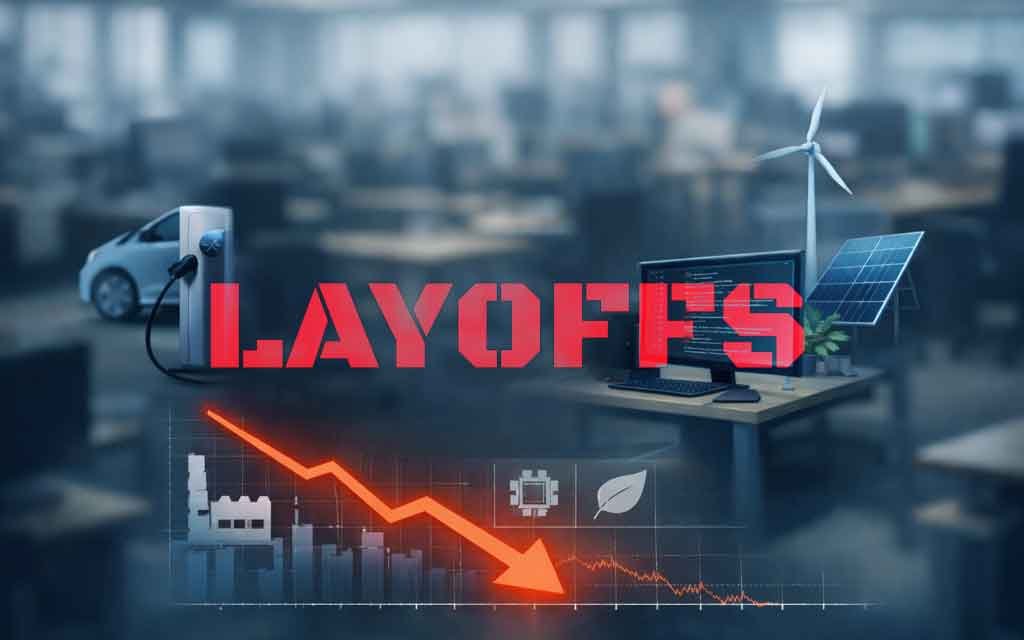
The wave of layoffs in electric vehicles (EV), artificial intelligence (AI), software, and greentech sectors shows no signs of slowing in 2026. Companies are aggressively restructuring to cut costs, redirect resources toward AI infrastructure, and adapt to slower EV demand and rapid automation.
At VFuture Media, we track the technologies shaping the future — including the human impact of this transition. While AI drives massive productivity gains and new opportunities, it is also accelerating job shifts across tech and clean energy. Here’s a clear breakdown of the latest layoffs reported this week and throughout early 2026.
This Week’s Key Layoff Highlights (Mid-April 2026)
- Snap (Software/Social Media): Announced plans to cut 1,000 jobs (16% of its workforce) explicitly blaming “rapid advancements in artificial intelligence.” CEO Evan Spiegel noted that AI will allow the same work to be done with fewer people, projecting $500 million in savings.
- Qualcomm (Semiconductor/AI-related): Planning to lay off 66 workers in San Diego, primarily in IT, engineering, and cybersecurity roles, with effects starting in late May.
- Ongoing ripple effects from earlier April announcements continue to surface, including smaller software and analytics firms adjusting teams.
These moves reflect a broader pattern: even as frontier AI companies like OpenAI and Anthropic expand hiring, traditional tech and software giants are slimming down non-AI or automatable roles.
Broader 2026 Layoff Trends Across Sectors
The first four months of 2026 have been brutal for tech employment:
- Total tech layoffs: Estimates range from 73,000 to over 99,000 jobs cut across nearly 95–146 companies.
- AI as a stated driver: Companies attribute 20–48% of cuts directly to AI automation and efficiency gains. Some reports put AI-linked cuts as high as 37,000–55,000 so far this year.
- Biggest single moves:
- Oracle (Software/Cloud): Cutting 20,000–30,000 roles while heavily investing in AI infrastructure.
- Block (Fintech/Software): Reduced over 4,000 jobs (nearly 40–50% of workforce) citing AI disruption.
- Atlassian (Software): Cut 1,600 jobs (10% of global workforce) to fund AI and enterprise growth.
- Meta, Amazon, and others: Continued smaller rounds, with hundreds to thousands affected as they prioritize AI spending.
In the EV sector, demand challenges persist:
- Lucid Motors: Earlier in 2026, implemented a 12% workforce reduction (hundreds of roles, estimated 300–800), focusing on salaried positions to improve efficiency and path to profitability. Manufacturing roles were largely protected.
- Other EV and automotive players (including reports involving GM plant adjustments) have idled production or made targeted cuts amid slower-than-expected EV adoption.
Greentech and cleantech have seen more limited but notable adjustments, often tied to broader software or supply-chain efficiencies rather than direct “greentech-only” headlines this week. Many cleantech firms are simultaneously investing in AI for optimization while trimming overhead.
Why Are These Layoffs Happening?
- AI Efficiency Gains: Companies openly state that generative AI and automation now handle tasks previously done by teams in coding, content, customer support, data analysis, and middle management.
- Capital Reallocation: Billions are flowing into AI infrastructure (data centers, chips, energy). Firms like Oracle are shedding traditional roles to fund this shift.
- EV Market Realities: High interest rates, supply chain issues, and slower consumer uptake have forced EV startups to prioritize profitability over rapid expansion.
- Post-Hiring Correction: Many companies overhired during 2023–2025 boom periods and are now optimizing.
What This Means for Workers and the Future
- Short-term pain: White-collar and entry-level tech roles (especially in software engineering, marketing, and support) face the highest pressure.
- Long-term opportunity: Demand for AI specialists, robotics engineers, energy systems experts, and roles in human-AI collaboration remains strong. Companies cutting traditional jobs are often hiring aggressively in AI-related fields.
- Broader economy: While tech layoffs grab headlines, overall U.S. unemployment remains relatively stable, suggesting AI-driven productivity could eventually create new jobs — though the transition is uneven.
Experts remain divided: some call it “AI washing” (using AI as an excuse for normal cost-cutting), while others see a structural shift where AI fundamentally changes how work gets done.
The Road Ahead for EV, AI, Software & Greentech
2026 is shaping up as a year of creative destruction. AI and robotics promise abundance and lower costs in energy, transportation, and services — but they require workforce adaptation, reskilling, and potentially new policy approaches like those discussed in Universal High Income conversations.
For professionals in these sectors: Focus on AI fluency, domain expertise that’s hard to automate (strategy, complex problem-solving, human relations), and continuous learning.
What do you think? Are AI-driven layoffs a necessary reset or a warning sign for the future of work? Have you or someone you know been affected in EV, software, or greentech? Drop your thoughts in the comments — this conversation matters as we navigate the AI era.
Stay informed on the technologies defining tomorrow. Subscribe to VFuture Media for weekly updates on AI, EVs, robotics, greentech, and the intersection of innovation with real-world impacts. Share this post if you believe in building a future where technology serves humanity.
Keywords: EV layoffs 2026, AI driven layoffs April 2026, software company layoffs this week, greentech job cuts, Oracle Snap Lucid layoffs, tech layoffs 2026 AI impact, electric vehicle industry restructuring




Leave a Comment