
By Ethan Brooks U.S. Tech Journalist | April 23, 2026
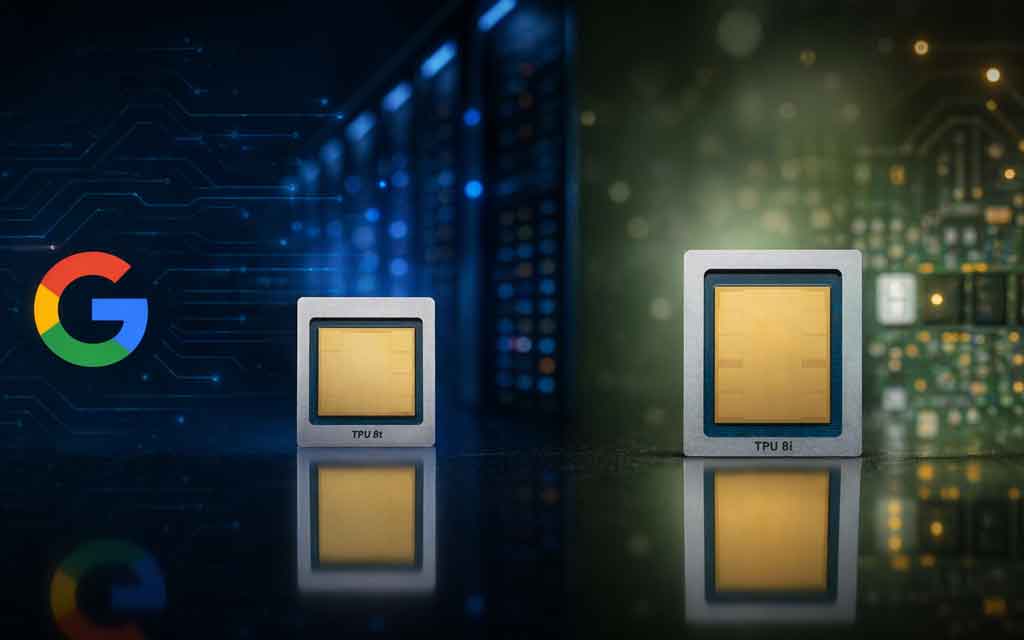
Las Vegas, NV — Google Cloud just fired its strongest shot yet in the AI hardware wars. At Google Cloud Next 2026, the company unveiled its eighth-generation Tensor Processing Units: the TPU 8t for massive model training and the TPU 8i for high-speed inference and autonomous AI agents.
This isn’t just another incremental upgrade. For the first time, Google has split its TPU lineup into two specialized chips purpose-built for the emerging “agentic era” — where AI doesn’t just answer questions but reasons, plans, and executes complex multi-step tasks on behalf of users.
For American enterprises, data center operators, and the broader U.S. tech ecosystem, these chips could accelerate domestic AI development while helping control the skyrocketing energy and compute costs that threaten to slow the AI boom.
Why Google Split the Silicon: Training vs. Inference in the Agentic Era
Traditional AI workloads have diverged sharply. Training massive frontier models requires enormous parallel compute and memory bandwidth. Running those models — especially autonomous agents that need ultra-low latency reasoning — demands different optimizations focused on speed, efficiency, and responsiveness.
- TPU 8t (Training): Optimized for building the “brains” of next-gen AI. Google claims it delivers nearly 3x higher compute performance than the previous generation (Ironwood/TPU v7) while improving performance per watt by 124%. It can cluster up to 9,600 chips into a single massive system, slashing training times for complex models from months to weeks.
- TPU 8i (Inference & Agents): Designed specifically for real-time agentic workflows. It features a new Collectives Acceleration Engine that cuts coordination latency by up to 5x and offers 80% better price-performance than prior generations. Each chip packs triple the SRAM of its predecessor (384 MB), enabling faster Mixture-of-Experts models and multi-turn reasoning.
This dual-chip strategy marks a clear evolution from Google’s earlier one-size-fits-most approach and directly targets the limitations of general-purpose GPUs in the agent-heavy future.
Direct Challenge to Nvidia’s Dominance
Google isn’t shy about its ambitions. By pushing custom silicon tailored to its full AI stack — from models (Gemini) to infrastructure and software — the company aims to capture more of the exploding enterprise AI market currently dominated by Nvidia’s GPUs.
Analysts note that Google’s integrated approach (chips + networking + data centers + energy management) gives it advantages in total cost of ownership, especially as power constraints become the biggest bottleneck in U.S. data centers. Recent expansions with partners like Anthropic for “multiple gigawatts” of TPU capacity underscore growing demand.
For U.S. companies, this competition is welcome news. Greater choice in AI accelerators could drive down costs and spur innovation, while strengthening American leadership in critical AI infrastructure amid global competition.
Implications for American Businesses and the Economy
The timing couldn’t be more relevant for U.S. enterprises. With AI electricity demand surging — projected to strain power grids in data center-heavy states like Virginia, Texas, and Arizona — efficiency gains matter. Google reports the new TPUs deliver over 117% better performance per watt on the inference side, helping companies scale responsibly.
Key benefits for American users:
- Faster development cycles for U.S. AI startups and enterprises building custom models.
- More affordable, responsive AI agents for sectors like healthcare, finance, manufacturing, and logistics.
- Job growth in AI engineering, data center construction, and semiconductor design — areas where the U.S. still leads.
- Enhanced energy security by reducing reliance on foreign supply chains for AI compute.
Availability is expected later in 2026, with preview access rolling out to select Google Cloud customers.
The Road Ahead for US AI Infrastructure
Google’s move reinforces a broader trend: hyperscalers doubling down on custom silicon to differentiate their clouds. While Nvidia remains the undisputed leader in GPUs, specialized alternatives from Google, Amazon, Microsoft, and others are maturing rapidly.
For forward-looking American businesses, the message is clear: diversification of AI infrastructure providers will be key to controlling costs and maintaining agility in 2026 and beyond. Those who leverage these new TPUs early could gain significant advantages in deploying practical, agentic AI solutions.
As Sundar Pichai and the Google Cloud team emphasized this week in Las Vegas, the experimental phase of AI is ending. The real work — building production-grade, efficient, and trustworthy agentic systems — is just beginning. U.S. innovation is rising to meet that challenge head-on.
What do you think? Will specialized chips like Google’s TPU 8t and 8i erode Nvidia’s moat, or will the GPU giant continue dominating? Share your thoughts in the comments, and stay tuned to vfuturemedia.com for more on AI infrastructure, EVs, startups, and green tech.
Ethan Brooks is a U.S.-based technology journalist with over 12 years of experience covering AI, cloud computing, and emerging tech. He has reported from major events including CES, Google I/O, and NVIDIA GTC.


Leave a Comment