
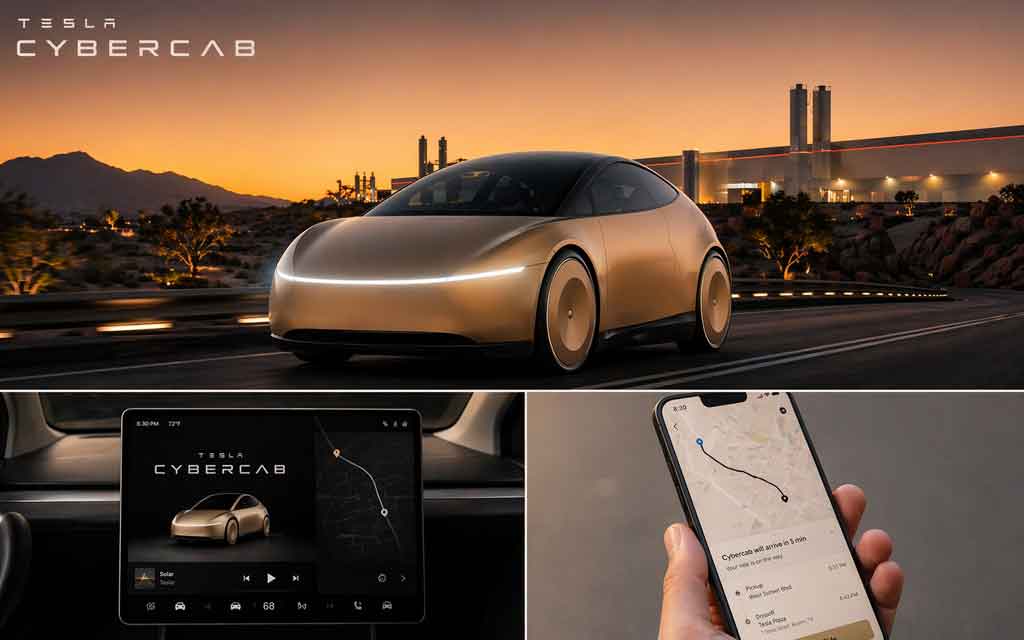
Tesla has officially started Cybercab production at its Giga Texas factory. This marks a pivotal moment in the autonomous vehicle industry. CEO Elon Musk confirmed the milestone, with the first production units of the purpose-built robotaxi now rolling off the assembly line.
What is the Tesla Cybercab?
The Cybercab is Tesla’s first vehicle designed entirely for unsupervised autonomous operation. Unlike any current Tesla model, it has no steering wheel or pedals. It features a sleek two-seater design optimized for ride-hailing efficiency and passenger comfort.
Key Specifications:
- Seating Capacity: 2 passengers
- Battery: Approximately 35 kWh
- Estimated Range: Around 200 miles (320 km)
- Efficiency Target: 5.5 miles per kWh
- Charging: Wireless inductive charging + compatibility with Tesla Superchargers
- Autonomy: Powered by Tesla’s latest camera-only Full Self-Driving (FSD) hardware and software
- Unique Features: Butterfly doors, minimalist interior, panoramic glass roof
- Target Price: Under $30,000 (potentially $25,000–$30,000 at scale)
Production Update – April 2026
Production officially commenced in April 2026 at Giga Texas. Tesla is employing its innovative “unboxed” manufacturing process to enable faster and more cost-effective scaling. Early output is expected to follow the typical S-curve ramp, starting with low volumes and accelerating through 2026 and beyond.
This production start sets the stage for initial robotaxi deployments in select markets later in 2026 or 2027.
Why the Cybercab Matters
The Cybercab forms the backbone of Tesla’s ambitious Robotaxi network. Key potential benefits include:
- Ultra-low ride costs: Aimed at approximately $0.20 per mile — significantly cheaper than today’s ride-hailing services.
- 24/7 Operation: No driver required, maximizing vehicle utilization.
- Improved Safety: Advanced vision-based autonomy expected to reduce accidents.
- New Revenue Model: Tesla vehicle owners may add their cars to the network and earn income.
Challenges to Watch:
- Regulatory approvals for fully unsupervised FSD in different countries.
- Scaling production to meet ambitious cost and volume targets.
- Building public confidence in driverless technology.
Cybercab Impact on India and Emerging Markets
For India, the Cybercab’s low projected price and electric powertrain could accelerate urban mobility transformation. It aligns well with India’s growing EV adoption, but success will depend on local regulations, charging infrastructure development (including inductive options), and adaptation to diverse road conditions. Tesla’s potential manufacturing plans in India could further support faster rollout.
What’s Next for Tesla Cybercab?
- Gradual production ramp throughout 2026
- Initial unsupervised robotaxi operations in approved cities
- Possible limited private ownership option in future years
- Integration with Tesla’s broader ecosystem, including Optimus robots and energy products
Stay Ahead of the Future: Bookmark vfuturemedia.com for continuous updates on Tesla Cybercab, robotaxis, EV technology, and autonomous driving developments.
What are your thoughts? Do you believe the Cybercab will achieve volume production and widespread deployment by 2027? Share your predictions in the comments section below.
This article was last updated on April 24, 2026. Sources include official Tesla communications, Giga Texas updates, and industry analysis.


Leave a Comment