
By Ethan Brooks | VFuture Media | April 28, 2026
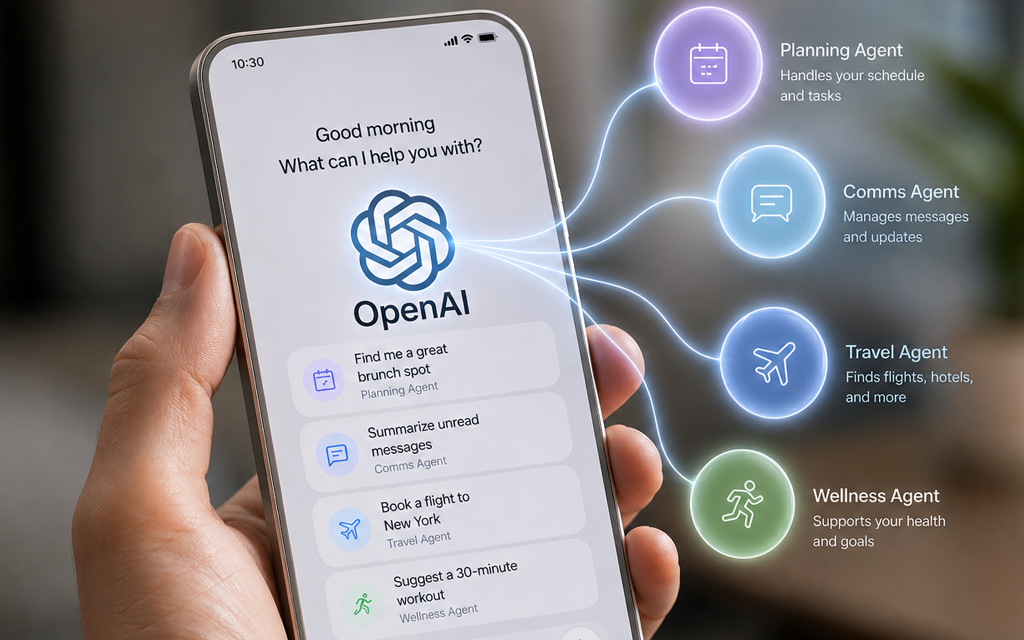
Imagine this: You pull out your phone, speak a single sentence — “Book me a table at the new Italian spot downtown, then get my dry cleaning picked up and add it to my calendar” — and the device just does it. No opening DoorDash. No switching to your calendar app. No hunting through emails for confirmation. The phone’s AI agents handle everything behind the scenes, talking directly to restaurants, delivery services, and your schedule as if they were your personal assistant on steroids.
That future isn’t science fiction anymore. It’s reportedly coming from OpenAI.
According to supply-chain legend Ming-Chi Kuo, OpenAI is secretly developing a full-fledged smartphone built around AI agents instead of traditional apps. This isn’t another ChatGPT skin on an existing phone — it’s a radical rethink of what a smartphone even is.
The End of the App Era?
In a bombshell note published yesterday (April 27, 2026), Kuo reveals that OpenAI has teamed up with Qualcomm and MediaTek to co-design a custom smartphone processor specifically optimized for advanced AI agents. Luxury manufacturer Luxshare Precision Industry (Apple’s long-time partner) will handle exclusive co-design and manufacturing. Mass production is eyed for 2028, with ambitious annual shipment targets of 300–400 million units.
The vision is crystal clear: apps become obsolete. Instead of a grid of colorful icons, your phone will be powered by intelligent agents that understand context, remember your preferences, and execute complex, multi-step tasks autonomously. Need a flight? The agent books it. Late on rent? It negotiates a payment plan. Craving Thai food at 11 p.m.? It finds the best spot, orders for pickup, and even suggests the perfect playlist for the drive.
This isn’t just convenience — it’s a complete paradigm shift. As Kuo puts it, the AI agent becomes the interface. Users won’t navigate screens; they’ll simply tell the phone what they want done.
OpenAI’s Second Hardware Bet
This agent-first smartphone is OpenAI’s second major hardware track. The company is already on pace to ship its first device (widely expected to be a screen-free, Jony Ive-designed wearable or earbud companion) in the second half of 2026. The smartphone project shows OpenAI isn’t just dipping a toe into hardware — it’s going all-in to control the entire stack: silicon, software, and AI.
By owning the hardware, OpenAI can integrate its most powerful models without the restrictions Apple and Google impose on third-party apps. No more sandboxing. No more limited API access. Just pure, unrestricted agentic intelligence running on-device and in the cloud.
What This Means for You (and the $2 Trillion App Economy)
For everyday users, the upside is enormous: less friction, more time back in your day, and an experience that finally feels truly intelligent.
For the industry? It’s potentially seismic.
- App developers could face disruption on a scale not seen since the iPhone launched in 2007.
- Apple and Google (who control the dominant app stores) will be watching very closely — this directly challenges their entire mobile ecosystem.
- Privacy and security will become the biggest talking points: when agents have deep access to your life, who’s really in control?
Early reactions on tech forums and X are split between “This will change everything” and “Good luck getting it past regulators and carrier networks.”
The Bigger Picture: The Post-App World Is Here
OpenAI isn’t alone in chasing this vision. But with Sam Altman at the helm and the world’s most advanced AI models in its arsenal, the company is uniquely positioned to make agentic smartphones mainstream.
If the 2028 timeline holds, we could be looking at the first true “post-app” device hitting shelves just two years from now.
This isn’t hype. This is the next evolution of computing — where your phone stops being a collection of apps and starts being a true digital partner that acts on your behalf.
The age of AI agents isn’t coming. For OpenAI’s upcoming smartphone, it’s already here.
What do you think — ready to ditch your app drawer forever, or skeptical this will actually ship? Drop your take in the comments below.
Ethan Brooks covers the bleeding edge of AI, hardware, and the future of consumer tech for VFuture Media. Follow for daily breakdowns of what’s really shaping tomorrow’s gadgets.



Leave a Comment