
By Ethan Brooks | VFuture Media | April 28, 2026
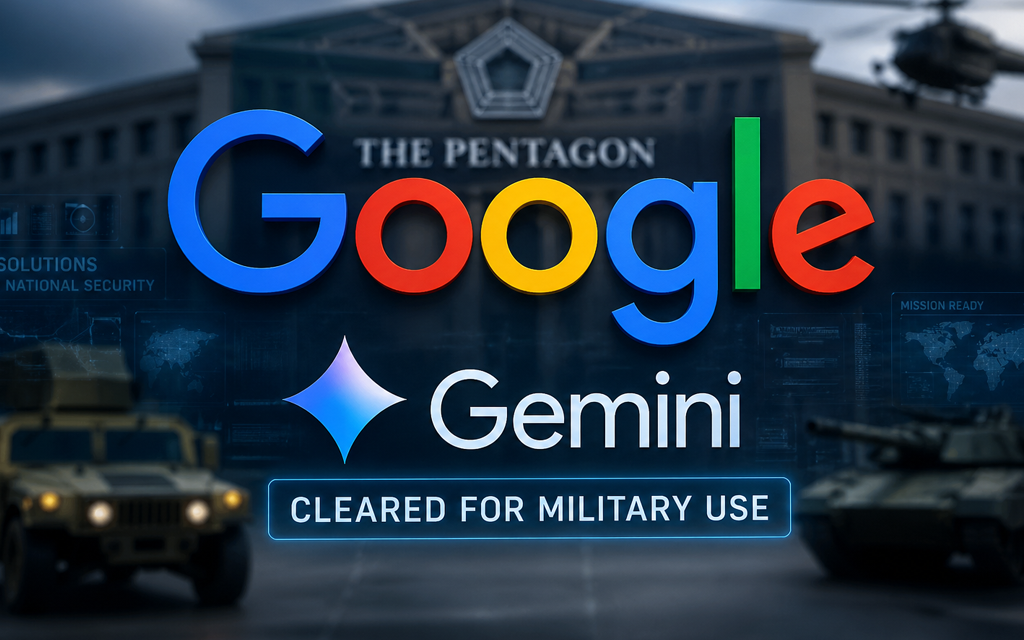
In a move that marks a major thaw in Google’s historically tense relationship with the U.S. military, Alphabet’s Google has officially signed a classified agreement with the Pentagon. The deal allows the Department of Defense to deploy Google’s Gemini AI models on classified networks for “any lawful government purpose.”
The agreement, first reported by The Information and confirmed across major outlets today, represents a significant escalation in Big Tech’s involvement in America’s defense AI strategy — and comes amid vocal internal pushback from hundreds of Google employees.
What the Deal Actually Enables
This new pact is an amendment to Google’s existing non-classified AI contract with the Pentagon (via its genAI.mil platform). It opens the door for Gemini to operate in highly secure, classified environments where the military handles everything from intelligence analysis and mission planning to logistics and potential targeting support.
Key details:
- Broad scope: “Any lawful government purpose” — a deliberately wide umbrella that aligns Google with similar deals already in place with OpenAI and xAI.
- Safeguards requested by Google: The company proposed contract language explicitly barring uses like domestic mass surveillance of Americans and fully autonomous lethal weapons without meaningful human oversight.
- Technical integration: Google will reportedly assist the Pentagon in adjusting safety filters and model behaviors for classified deployments.
The Pentagon has already signed similar agreements worth up to $200 million each with major AI labs throughout 2025, reflecting an aggressive push to integrate frontier AI across classified systems.
A Dramatic Shift for Google
This deal marks a clear departure from Google’s past stance. In 2018, the company famously declined to renew Project Maven — its drone imagery analysis contract with the Pentagon — after thousands of employees protested. That episode led to Google’s famous “Don’t Be Evil” era AI Principles, which restricted certain military applications.
Now, under pressure from intensifying global competition (especially with China), Google appears to be rebuilding those military ties in earnest.
Employee Backlash Erupts
Hours after the news broke, more than 600 Google employees (from DeepMind, Cloud, and other divisions) sent an open letter to CEO Sundar Pichai urging him to block classified military use of their AI systems.
The letter warns that such deployments could cause “irreparable harm to Google’s reputation” and make it impossible for employees to know how their technology is being used — potentially enabling “inhumane or extremely harmful” outcomes.
This mirrors similar internal revolts at other AI companies, highlighting the growing culture clash between Silicon Valley’s idealistic workforce and the hard realities of national security.
Why This Matters for U.S. National Security and Tech
For the Pentagon, access to Gemini adds another powerful tool to its rapidly expanding AI arsenal at a time when adversaries are racing to deploy their own systems.
For Google:
- Strengthens its position in the government cloud and AI market.
- Positions it alongside OpenAI and xAI as a trusted defense partner.
- Could drive significant new revenue through the U.S. public sector.
For the broader tech industry, it underscores a new reality: in 2026, even the most consumer-focused AI giants are becoming integral to classified defense operations.
The Road Ahead
Neither Google nor the Pentagon has issued detailed public statements, citing the classified nature of the agreement. However, Google Public Sector has reiterated its commitment to responsible AI use and support for lawful government applications.
As AI becomes a cornerstone of modern warfare, deals like this one will likely face continued scrutiny — from employees, ethicists, lawmakers, and global competitors alike.
The AI arms race just got more classified. And Google is now officially in the game.
What’s your take? Should Big Tech fully embrace defense contracts, or should companies maintain stricter boundaries? Drop your thoughts in the comments.
Ethan Brooks covers AI, defense tech, and the intersection of Silicon Valley and Washington for VFuture Media. Follow for real-time analysis on the technologies shaping tomorrow’s geopolitics.



Leave a Comment