
By VFuture Media Tech Desk | May 3, 2026
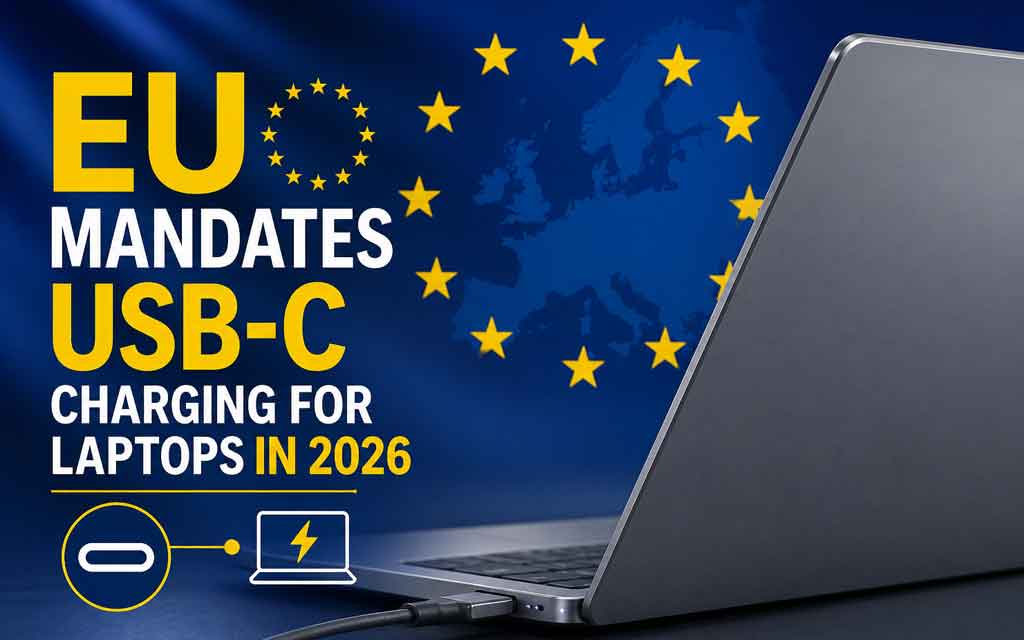
The European Union has officially ushered in the final major phase of its ambitious Common Charger Directive, requiring all new laptops sold in the bloc to support USB-C charging as of April 28, 2026. This landmark regulation builds on the successful 2024 rollout for smartphones, tablets, and other portable devices, aiming to slash electronic waste, simplify consumer life, and push the industry toward true interoperability.
Background: From Phones to Laptops — The Long Road to One Charger
The EU’s push for a common charging standard dates back to the early 2010s, when a voluntary agreement with manufacturers failed to deliver meaningful change. In 2022, the European Parliament and Council amended the Radio Equipment Directive (2014/53/EU) to make USB-C mandatory. Phones, tablets, headphones, and similar devices fell under the rules from December 28, 2024. Laptop manufacturers received an extended 16-month transition period due to the technical challenges of higher power delivery.
That grace period ended on April 28, 2026. Now, all new laptops marketed in the EU’s 27 member states must include at least one USB-C port capable of charging.
Key Details of the Laptop Mandate
- Scope: Applies to portable computers with a power delivery rating of up to 100W. This covers the vast majority of ultrabooks, productivity laptops, and mainstream models from brands like Dell, HP, Lenovo, Apple (MacBooks already use USB-C/Thunderbolt), ASUS, and Acer.
- Exceptions: High-performance gaming laptops and workstations requiring more than 100W can continue using proprietary barrel-plug connectors in addition to the mandatory USB-C port. They are not fully exempt but have flexibility for their higher-power needs.
- Unbundled Sales: Manufacturers must offer an “unbundled” option — laptops sold without a charger in the box. This encourages reuse of existing chargers and further reduces waste. Bundled chargers are still allowed, but the no-charger choice is now mandatory to offer.
- Fast Charging Standards: The directive promotes harmonized fast charging via USB Power Delivery (PD) where applicable, ensuring consistent performance without reliance on proprietary protocols.
Existing laptops already on sale, refurbished units, and second-hand devices are unaffected.
Environmental and Economic Impact
The EU Commission estimates the broader common charger rules will:
- Prevent up to 11,000 tonnes of e-waste annually across all covered devices.
- Save consumers around €250 million per year by reducing the need for multiple proprietary chargers and adapters.
For laptops specifically, the shift promises to end the era of carrying brand-specific bricks and cables. Many consumers already own USB-C PD chargers capable of powering modern laptops, making the transition seamless for most.
Industry Response and Challenges
Major manufacturers were largely prepared. Apple transitioned MacBooks years ago, and most Windows OEMs have increasingly adopted USB-C/Thunderbolt ports. However, the mandate accelerates full compliance and could influence global designs, as companies often standardize products for major markets like the EU.
Challenges remain:
- Not all USB-C cables or chargers deliver the same power — consumers must still check wattage ratings for optimal performance.
- High-end gaming rigs retain some proprietary flexibility, but even they now include USB-C.
- Global supply chains may see ripple effects, with non-EU markets potentially benefiting from standardized components over time.
Broader Implications for Tech and Sustainability
This regulation is part of the EU’s larger Green Deal and circular economy initiatives. By standardizing connectors, the EU is reducing fragmentation in consumer electronics and setting a de facto global precedent — similar to how past EU rules influenced mobile charger designs worldwide.
Critics argue it slightly stifles innovation in charging tech, but supporters highlight the massive reduction in redundant accessories and e-waste. As USB-C (and future USB standards) evolves with higher power delivery (USB PD 3.1 supports up to 240W), the foundation laid today positions the industry for even better universality.
For consumers in the EU: One charger truly can rule them all — from your phone to your laptop. For the planet: fewer discarded adapters piling up in landfills.
As the directive’s laptop phase rolls out, expect more “charger-free” bundle options in stores and clearer labeling on power compatibility. The era of proprietary laptop chargers is effectively over in Europe.
VFuture Media will continue tracking how this impacts global laptop launches, pricing, and sustainability metrics. What are your thoughts on mandatory standards like this — necessary regulation or overreach? Share below



Leave a Comment