
By VFuture Media Team | May 6, 2026
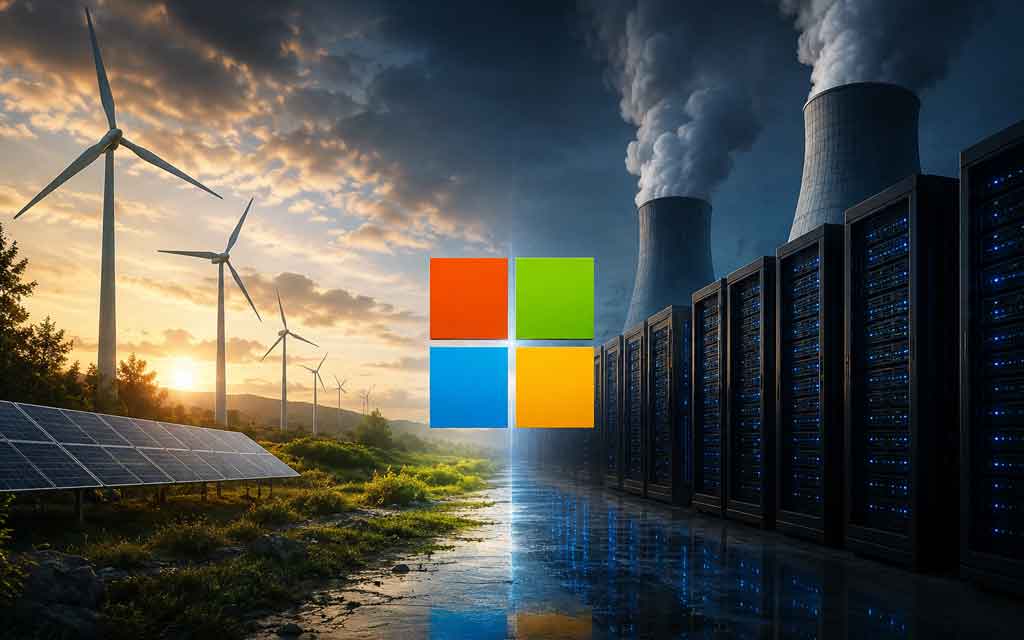
Microsoft is reportedly weighing whether to delay or abandon its 2030 target of matching 100% of hourly electricity use in data centers with renewable energy. As AI demand explodes, discover the challenges, implications for sustainability goals, and the future of clean power for hyperscale AI infrastructure.
In a major development shaking the intersection of AI innovation and climate tech, Microsoft is reportedly considering scaling back or even dropping its ambitious 2030 goal to power its data centers with 100% clean energy on an hourly basis. According to a Bloomberg report published today, the tech giant is evaluating whether to delay or abandon its target of matching 100% of its hourly electricity consumption with renewable energy purchases.
This potential pivot comes as the AI boom drives unprecedented power demands on data centers worldwide. For a forward-thinking site like VFuture Media, focused on AI, green innovation, EVs, quantum computing, and climate tech, this story highlights a critical tension: Can the explosive growth of artificial intelligence coexist with aggressive sustainability targets?
Microsoft’s Original Clean Energy Commitments: From Bold Pledges to Reality Check
Back in 2020, Microsoft set some of the most ambitious corporate sustainability goals in the tech industry. These included becoming carbon negative by 2030, achieving water positive status, and matching 100% of its electricity use with renewable energy purchases.
- In February 2026, the company proudly announced it had met its 2025 goal early by contracting 40 gigawatts (GW) of new renewable energy supply — with 19 GW already online — primarily through long-term power purchase agreements (PPAs).
- The company committed to continuing this annual matching approach while expanding into more carbon-free sources like nuclear restarts (e.g., the Three Mile Island deal).
However, the finer-grained 2030 target — often called 24/7 carbon-free energy (CFE) or hourly matching — has proven far more challenging. This goal aimed to ensure that every kilowatt-hour consumed by Microsoft’s data centers and operations was matched with clean energy in real time, not just annually through RECs (renewable energy certificates).
Recent reports show Microsoft has already adjusted some ambitions:
- It stepped back from being fully climate-negative by 2030 and delivering around-the-clock clean electricity in favor of a broader “carbon removal” strategy.
- New data center plans have drawn fire from environmental groups for limited mentions of renewables and reliance on natural gas in certain regions (e.g., Wisconsin projects).
Why Now? The AI Data Center Power Hunger Driving the Shift
The core driver is no secret: AI is power-hungry.
Hyperscale AI training and inference require massive computational resources. Microsoft’s Azure cloud and OpenAI partnership have accelerated data center expansion at a breakneck pace. Industry forecasts suggest U.S. data centers could consume up to 8-12% of national electricity by 2030 — double current levels in some estimates.
Anonymous sources cited in the Bloomberg report indicate Microsoft is prioritizing speed and scale in the global AI race over rigid hourly renewable matching, which faces practical hurdles like:
- Intermittency of solar and wind.
- Grid infrastructure bottlenecks.
- Slower-than-expected rollout of new clean energy projects.
This isn’t unique to Microsoft. Peers like Google have called similar 2030 goals a “moonshot,” and Amazon, Meta, and others face similar scrutiny as emissions rise despite renewable PPAs.
Implications for Sustainability, Tech, and the Planet
Environmental Impact: Critics, including groups like Stand.Earth, argue that relaxing targets could undermine global decarbonization efforts. Microsoft’s Scope 1 and 2 emissions have already risen significantly since 2020 due to data center growth. Off-grid gas-powered projects and new fossil fuel infrastructure in some regions could add tens of millions of tons of CO₂ equivalent.
For the AI Industry: A more pragmatic approach might accelerate AI deployment, potentially unlocking breakthroughs in climate modeling, energy optimization, and green tech R&D. However, it risks greenwashing accusations and regulatory backlash.
Economic and Community Angle: Microsoft’s January 2026 “Community-First AI Infrastructure” plan promises data centers won’t raise local electricity prices or strain water supplies — but omits strong renewable commitments. This has sparked community pushback in places like Wisconsin and Ireland.
Positive Outlook for Green Innovation: At VFuture Media, we see opportunity. This pivot could spur investment in:
- Small Modular Reactors (SMRs) and advanced nuclear.
- Next-gen geothermal and long-duration energy storage.
- AI-driven efficiency tools for data centers (e.g., liquid cooling, chip-level optimization).
- Carbon removal technologies (Microsoft remains a major buyer despite some program adjustments).
What Microsoft Is Still Doing Right (And What Comes Next)
Despite the reported reconsideration, Microsoft continues heavy renewable contracting and nuclear deals. Chief Sustainability Officer Melanie Nakagawa and Cloud Operations President Noelle Walsh have emphasized that carbon-free electricity (including nuclear) will play a bigger role going forward.
The company’s 2025 Environmental Sustainability Report highlights progress in mass timber data centers (up to 65% lower embodied carbon), liquid cooling transitions, and supplier renewable mandates.
Key Question for the Future of Tech: Will Microsoft (and the industry) double down on innovation to make 24/7 clean power feasible, or will annual matching + carbon removal become the new normal?
The Road Ahead: Sustainable AI Is Still Possible
This reported shift doesn’t mean Microsoft is abandoning clean energy entirely — far from it. It reflects the real-world friction between today’s AI surge and tomorrow’s climate goals. For the green innovation community, it’s a call to action.
At VFuture Media, we’ll continue tracking how AI and climate tech converge. Could breakthroughs in fusion, advanced batteries, or AI-optimized grids make hourly clean matching routine by 2030? Or will hybrid approaches (renewables + nuclear + removal) define the next decade?
What do you think? Should Big Tech prioritize AI speed or strict hourly renewables? Drop your thoughts in the comments below.
Stay ahead of the curve with VFuture Media — your source for AI, EVs, quantum computing, robotics, space tech, and climate innovation. Follow us for more in-depth analysis on the future of sustainable technology.


Leave a Comment