
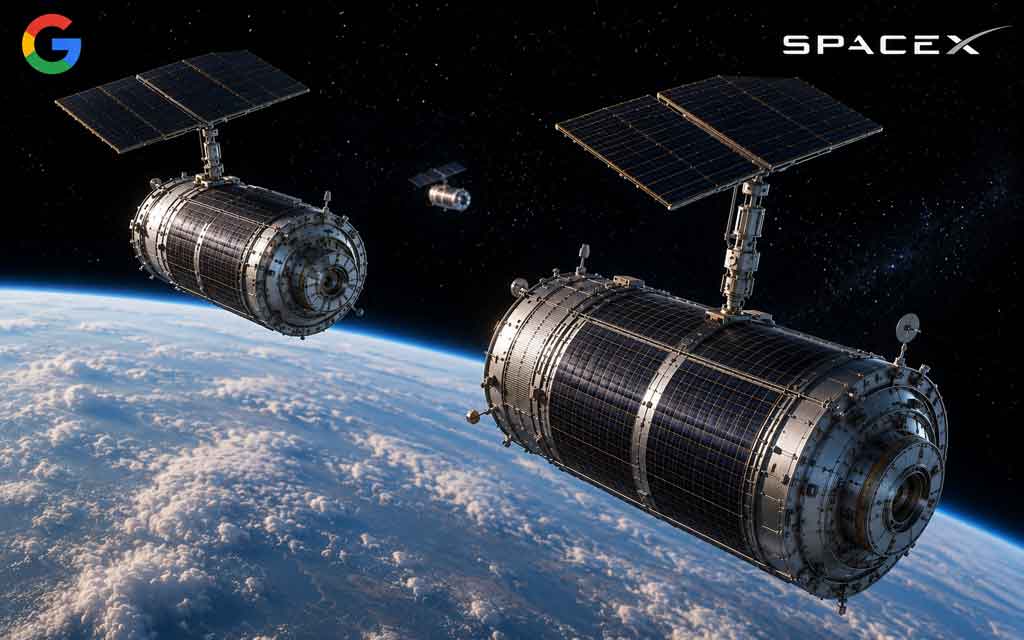
Google and SpaceX Rocket Launch Deal: The Dawn of Orbital AI Data Centers
In a groundbreaking development reported on May 12, 2026, Alphabet’s Google is in advanced discussions with SpaceX for a major rocket launch agreement. The purpose: to send experimental orbital data centers into low Earth orbit as part of Google’s ambitious Project Suncatcher.
According to The Wall Street Journal, Reuters, and multiple sources, the partnership aims to launch solar-powered satellites equipped with Google’s Tensor Processing Units (TPUs) for high-performance AI workloads. Google is also exploring deals with other launch providers, but a SpaceX collaboration stands out given Google’s existing stake in the company and SpaceX’s reusable rocket expertise.
This move signals a serious push toward space-based computing, where unlimited solar energy, natural vacuum cooling, and massive scalability could address the exploding power demands of artificial intelligence.
What is Google’s Project Suncatcher?
Announced in November 2025, Project Suncatcher is Google’s research moonshot to build a scalable, space-based AI infrastructure system. The vision involves compact constellations of solar-powered satellites carrying TPUs, interconnected via high-speed free-space optical (laser) links.
Key Highlights of Project Suncatcher:
- Satellites in sun-synchronous low Earth orbit for near-constant sunlight exposure.
- Modular clusters of smaller satellites for easy scaling.
- Radiation-hardened TPUs tested for long-duration missions.
- Laser communication links targeting multi-terabit speeds.
- First prototypes: Two test satellites planned for launch by early 2027 in partnership with Planet Labs.
Google researchers state that “in the future, space may be the best place to scale AI compute” due to abundant clean energy and minimal terrestrial resource use.
Why Build Data Centers in Space? Addressing AI’s Energy Bottleneck
AI training and inference are driving unprecedented demand for electricity, cooling, and land. Traditional data centers face grid constraints, high costs, and environmental pushback. Orbital data centers offer compelling solutions:
| Aspect | Earth-Based Data Centers | Orbital Data Centers (Suncatcher) |
|---|---|---|
| Power Availability | Grid-dependent, intermittent renewables | Near-constant solar (up to 8x more productive) |
| Cooling Requirements | Massive water and energy use | Passive radiative cooling in vacuum |
| Land & Environmental Impact | High consumption | Zero terrestrial footprint |
| Scalability | Limited by regulations and power | Highly scalable satellite constellations |
| Operational Uptime | Affected by weather and outages | Optimized orbits for continuous operation |
Core Advantages:
- Unlimited Solar Power: In the right orbit, panels receive sunlight almost continuously without atmospheric filtering.
- Sustainability: Reduces strain on Earth’s power grids and water resources.
- Performance Boost: Enables larger-scale AI training with fewer constraints.
- Cost Trajectory: Falling launch prices (thanks to Starship) could make orbital compute competitive by the mid-2030s.
The Google-SpaceX Partnership: Strategic Implications
Google already holds a stake in SpaceX, making this collaboration strategically aligned. For SpaceX, winning Google’s launch business strengthens its position ahead of a potential IPO and validates the market for orbital infrastructure.
Elon Musk has long discussed space-based data centers, positioning them as a natural extension of Starlink and future Starship capabilities. A successful deal could accelerate timelines for both companies while intensifying competition in the emerging space economy.
Google continues evaluating multiple launch partners to ensure reliability and cost-effectiveness for its 2027 prototype mission.
Challenges and Timeline for Orbital Data Centers
While promising, space-based compute faces hurdles:
- Radiation hardening of hardware.
- Reliable high-bandwidth laser links between satellites and ground stations.
- Orbital dynamics and maintenance.
- Initial launch and deployment costs.
Google’s approach starts small with 2027 prototypes to validate the concept before scaling. Early results from radiation testing and lab optical links are encouraging.
The Bigger Picture: Space as the Next Frontier for AI Infrastructure
As AI models grow exponentially, energy and resource limitations on Earth become critical bottlenecks. Projects like Suncatcher, alongside similar efforts from other tech giants, point toward a hybrid future where compute is distributed between ground, cloud, and orbit.
This development could transform industries reliant on AI — from scientific research to autonomous systems — by providing cleaner, more abundant processing power.
What’s Next? Watch for updates on the Google-SpaceX launch agreement and the 2027 prototype deployment. The race to orbit is on.
Conclusion: A Giant Leap for AI Compute
The reported talks between Google and SpaceX mark a pivotal moment in the evolution of digital infrastructure. Project Suncatcher could unlock unprecedented scale for AI while easing pressure on Earth’s resources.
At VU Future Media, we’ll continue tracking this story as it unfolds. The convergence of AI and space technology is no longer science fiction — it’s becoming strategic reality.
Share your thoughts in the comments: Do you believe orbital data centers will become mainstream by 2035?
Google is reportedly partnering with SpaceX to launch orbital AI data centers powered by solar energy as part of Project Suncatcher.




Leave a Comment