
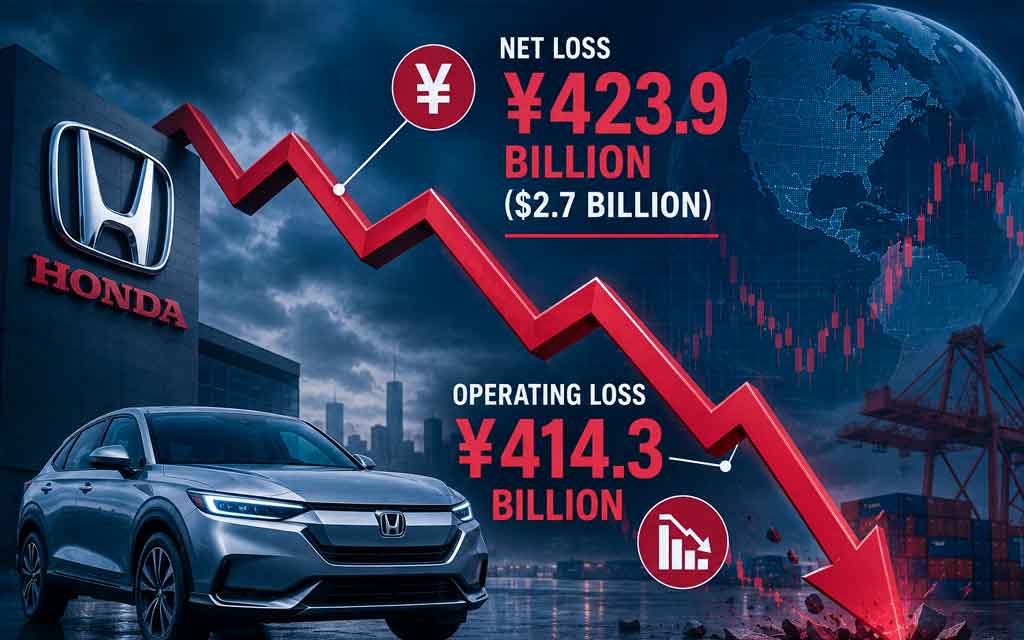
Honda Motor Co. has posted its first full-year loss since going public in 1957, marking a historic shift for the Japanese automaker. For the fiscal year ended March 31, 2026, Honda reported a net loss of approximately ¥423.9 billion ($2.7 billion) and an operating loss of ¥414.3 billion, driven largely by massive restructuring charges related to its electric vehicle (EV) strategy.
If you’re searching for Honda first annual loss 2026, Honda EV losses recession signal, or auto industry outlook 2026, this in-depth analysis explains what happened, why it happened, and whether it points to a broader U.S. or global recession.
What Exactly Happened with Honda’s 2026 Financial Results?
- Historic Loss: First annual loss as a listed company in nearly 70 years.
- Scale of Impact: Up to $15.7 billion (¥2.5 trillion) in EV-related restructuring charges and write-downs.
- Revised Guidance: The company swung from a previously expected ¥550 billion profit to a loss of ¥270–570 billion.
- Key Actions: Cancelled development of three planned EV models (including some for U.S. production), suspended ambitious EV targets (e.g., 20% EV sales by 2030), and paused a major EV/battery plant in Canada.
Honda’s motorcycle division remained strong with record profits, but the automotive segment was hit hard.
Main Reasons Behind Honda’s Big Loss
- Weaker-than-Expected EV Demand — Slow adoption in the U.S. and China, intensified competition from low-cost Chinese EVs.
- Policy Shifts — Changes in U.S. EV incentives and tariffs under the current administration reduced profitability.
- High Development Costs — Significant investments in EVs that no longer align with market realities.
- Hybrid Strength vs. EV Pivot — Honda is now doubling down on profitable hybrids while scaling back pure EVs.
CEO Toshihiro Mibe acknowledged that EV demand “fell sharply,” making profitability difficult in the current environment.
Does Honda’s Loss Indicate a Recession in 2026?
Short Answer: No — this is primarily a company-specific strategic reset, not a broad recession signal.
Why it’s NOT a recession indicator:
- Honda’s loss stems from one-time EV restructuring charges, not collapsing overall sales or economic demand.
- The company is forecasting a strong rebound with ¥500 billion ($3.2 billion) operating profit for FY2027, beating analyst estimates. Shares rose on this news.
- Broader auto industry context: Hybrids are booming, and many automakers (Ford, GM, Stellantis) have also slowed EV plans due to similar demand and cost issues.
- U.S. economy indicators (as of May 2026) remain relatively stable — no widespread job losses, consumer spending is holding, and other sectors like tech and AI continue growing.
Why some see it as a warning:
- It highlights challenges in the EV transition amid high interest rates, tariff impacts, and shifting consumer preferences.
- Auto sector weakness can ripple into manufacturing jobs, supply chains, and related industries.
- If multiple major automakers report similar struggles, it could signal slower growth in a key global industry.
This event reflects sector transformation pain rather than economy-wide recession. Recessions typically involve broad declines in GDP, rising unemployment, and falling consumer confidence across sectors — none of which are clearly evident here.
What This Means for the Auto Industry and American Consumers in 2026
- More Focus on Hybrids: Expect Honda (and competitors) to push reliable, profitable hybrid models like the Civic and CR-V.
- Slower EV Rollout: Fewer new pure EV models in the near term, potentially stabilizing prices and charging infrastructure growth.
- Investment Opportunities: Honda’s pivot could strengthen its long-term position if hybrids remain popular.
- Job Impacts: Some EV-related projects delayed (e.g., Canada plant), but core manufacturing operations continue.
Honda Stock Reaction and Outlook
Honda shares initially dropped on the loss announcement but recovered on the positive 2027 profit forecast. The company remains financially solid with strong cash flow from motorcycles and core operations.
Lessons for Investors and Businesses
Honda’s situation underscores the risks of aggressive bets on emerging technologies without flexible strategies. In 2026, adaptability — balancing EVs, hybrids, and traditional strengths — is key.
At VFutureMedia, we analyze how major corporate moves like Honda’s historic loss affect the U.S. economy, job market, and investment landscape. This is a story of strategic adjustment in a changing auto world, not the start of a recession.
Have you noticed changes in car buying trends or EV interest? Share your thoughts in the comments below.
Last Updated: May 14, 2026
Keywords: Honda first annual loss since 1957, Honda 2026 financial results, Honda EV restructuring, auto industry recession signal 2026, Honda loss analysis



Leave a Comment