
By Ethan Brooks, Senior EV Analyst at VFutureMedia Published: May 17, 2026
Global electric vehicle (EV) demand continues its cautious rebound, with April 2026 marking the second consecutive month of year-on-year growth. According to Benchmark Mineral Intelligence, the world registered 1.60 million EVs (battery electric and plug-in hybrids) in April — up 6% from April 2025 but down 9% from the strong March surge.
Year-to-date (YTD) sales through April stand at 5.6 million units, slightly behind 2025 levels but showing resilience amid regional divergences, high fuel prices, and evolving policy landscapes. This data signals a stabilizing yet uneven EV market rebound for 2026.
Regional Breakdown: Europe Leads, China Exports Surge, North America Lags
The global EV story in April 2026 is one of stark regional contrasts:
- Europe: Over 400,000 EVs registered (+27% YoY). Strong growth in key markets like Germany (+33%), France (+36%), and Italy (nearly doubled) driven by incentives, high petrol prices, and Chinese brand penetration.
- China: Domestic sales remain soft (down significantly YTD due to subsidy adjustments), but exports hit record highs — over 400,000 units in April alone. Chinese brands now capture growing shares in Europe and emerging markets.
- North America: Sales down ~25% YTD. High interest rates, policy uncertainty, and slower infrastructure rollout continue to weigh on adoption.
Global EV Sales Snapshot (Benchmark Mineral Intelligence)
Global
- 1.60 million EVs sold in April 2026
- +6% YoY growth
- 5.6 million YTD sales
- Second consecutive month of growth
Europe
- Around 400,000 EVs sold
- +27% YoY growth
- Strong market momentum
- Chinese EV brands gaining share rapidly
China (Domestic)
- Domestic market remained soft
- Negative YoY performance
- Down around 17–21% YTD
- EV exports continue booming globally
North America
- EV market lagging behind
- Around -25% decline
- Slower YTD performance
- Policy uncertainty and high interest rates impacting demand
Implications for Major Automakers
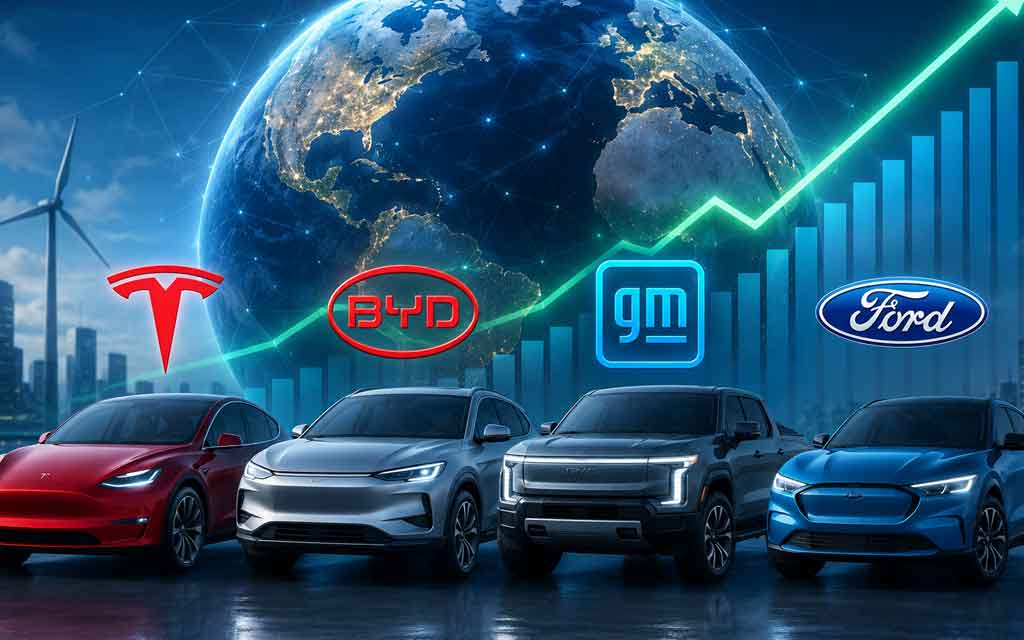
Tesla: Remains a global leader with strong brand loyalty, software advantages, and Supercharger network. Q1 2026 deliveries showed resilience, reclaiming the top spot in some periods. However, growth is now more regionally dependent, with competition intensifying from affordable Chinese models.
BYD: The clear winner in volume and exports. April NEV sales rebounded sequentially, with massive overseas shipments (135k+). BYD leads in cost efficiency, vertical integration (batteries to vehicles), and is topping charts in markets like the UK, Australia, and Brazil. It poses the biggest competitive threat to legacy players.
GM: Ultium platform vehicles are gaining traction, but overall EV sales remain challenged in North America. The company is balancing EV commitments with profitable hybrids while navigating slower U.S. demand.
Ford: Facing profitability pressures in the EV segment. Focus remains on scaling competitive models, but high costs and U.S. market softness have led to cautious investment. CEO commentary highlights the need to learn from Chinese efficiency.
Legacy automakers are accelerating affordable models and hybrid strategies to bridge the gap, while Chinese players like BYD, Geely, and Chery push aggressive pricing and exports.
Consumer Adoption Barriers: Price, Charging & More
Despite the rebound, barriers persist:
- Upfront Price: EVs still carry a premium in many markets (though battery costs are falling). High interest rates amplify this.
- Charging Infrastructure: Range anxiety remains real. Public charging reliability, availability (especially in rural areas), and time (45% of consumers cite charging issues) are top concerns. Home charging access is limited for apartment dwellers.
- Other Factors: Model availability in desired segments (e.g., affordable family SUVs), resale value uncertainty, and policy shifts.
Pros of the Current Rebound:
- High petrol prices accelerating shifts in Europe.
- Falling battery prices and new affordable models entering in late 2026–2027.
- Technological improvements in range, charging speed, and software.
Cons & Risks:
- Uneven regional growth could slow overall investment.
- Potential policy reversals or incentive cuts.
- Supply chain and grid strain from rapid scaling.
Future Outlook Through 2027: Optimistic Yet Realistic
Analysts forecast global EV sales to reach 22–25 million in 2026 (24–27% market share), climbing toward 30 million by 2027 as affordability improves and infrastructure catches up. Europe and China will likely lead, with North America accelerating post-2027 if incentives stabilize and more competitive models launch.
Longer-term, EVs are on track for 30–40%+ global share by 2030, driven by cost parity, regulatory pressure, and energy independence.
Actionable Advice for Buyers and Investors in 2026–2027
For Buyers:
- Research total cost of ownership (fuel + maintenance savings often offset higher upfront costs within 3–5 years).
- Prioritize models with strong warranties, access to reliable charging (home/work preferred), and federal/state incentives where available.
- Consider 2026 launches: More affordable options from BYD, Tesla refreshes, GM/Ford entries, and European/Asian crossovers.
- Test drive and simulate charging scenarios for your lifestyle.
For Investors:
- Watch companies with strong vertical integration (BYD, Tesla) and those scaling profitably.
- Monitor battery tech, charging infrastructure plays, and policy developments.
- Diversify: Hybrids as a bridge, pure EVs for long-term growth.
The April 2026 data confirms EV momentum is real but requires patience and targeted solutions to barriers. At VFutureMedia, we believe 2026–2027 will be a pivotal consolidation year — rewarding efficient innovators and forward-thinking adopters.
What are your thoughts on the EV rebound? Share in the comments or explore our related guides on best EVs 2026 and charging infrastructure trends.
Ethan Brooks is a Senior EV Analyst at VFutureMedia with over 8 years covering automotive electrification, battery supply chains, and sustainable mobility. He holds credentials in environmental policy and data analytics. Sources include Benchmark Mineral Intelligence, Reuters, Electrek, and industry reports. All data as of mid-May 2026.



Leave a Comment