
By Ethan Brooks, USA-based tech analyst focused on innovation and opportunity for American workers May 18, 2026 – Published on www.vfuturemedia.com
Introduction: The Painful but Necessary Shift in American Tech
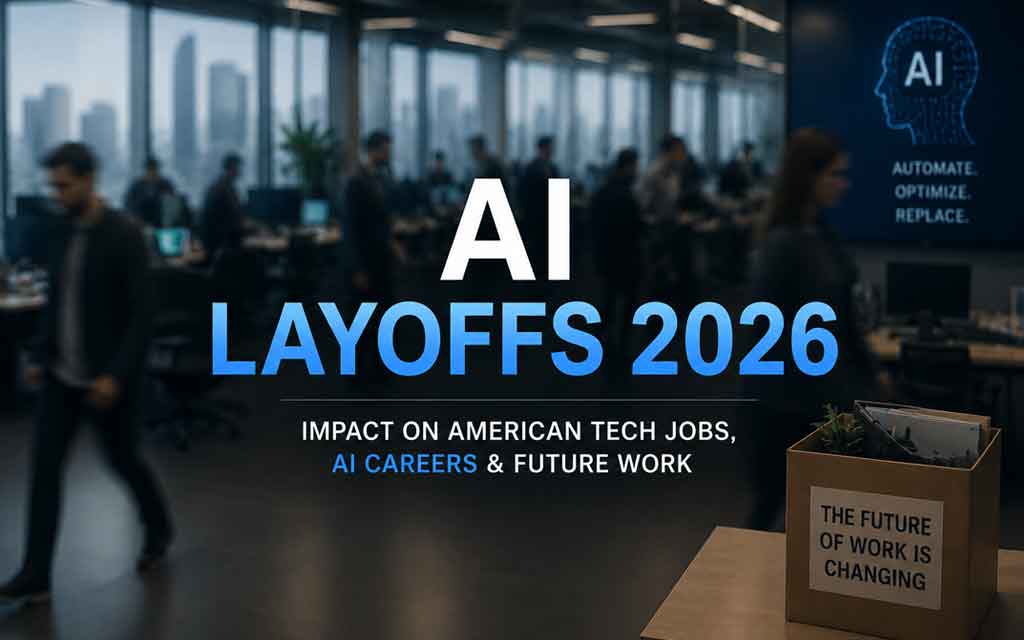
America’s tech industry has always been a powerhouse of innovation, creating millions of high-paying jobs and driving economic growth. But in mid-May 2026, the conversation has turned serious: AI-driven layoffs are accelerating. According to Challenger, Gray & Christmas, AI accounted for 26% of all job cuts in April 2026 — 21,490 positions — marking the second straight month it led all reasons for layoffs.
For American engineers, developers, and tech professionals in hubs like Austin, Seattle, San Francisco, and emerging centers in Texas and Florida, this feels personal. Yet this isn’t the end of tech jobs — it’s a painful transition toward higher-value work, greater productivity, and stronger U.S. competitiveness against global rivals like China.
This post delivers straight talk: the real numbers, who is affected, why it’s happening, and — most importantly — how American workers can adapt, thrive, and seize new opportunities in the AI era.
This Week’s Layoff Reality: Numbers Don’t Lie
April 2026 saw U.S. employers announce 83,387 job cuts, up 38% from March but still down 21% year-over-year. AI was explicitly cited in over 49,000 cuts year-to-date.
Major companies making moves in April–May 2026:
- Meta: Planning ~8,000 cuts (10% of workforce) on May 20 to fund aggressive AI investments.
- Cisco: Cutting ~4,000 jobs (under 5% of workforce) to pivot toward AI and emerging tech.
- Coinbase: Laying off 700 employees (14% of staff) as CEO Brian Armstrong pushes to become “AI-native.”
- Cloudflare: Over 1,000 cuts, explicitly tied to AI restructuring.
- Others: LinkedIn, Upwork, Block, and more joining the wave.
Tech has seen over 135,000 cuts in 2026 so far, with AI as a top driver. This isn’t hidden — companies are openly saying they’re replacing repeatable tasks with AI agents to boost efficiency and redirect capital toward frontier AI development.
Why AI Layoffs Are Happening Now: Efficiency Over Headcount
Companies aren’t cutting just to cut. They’re restructuring for the agentic AI era:
- AI tools like Claude Code and multi-agent systems now handle routine coding, data analysis, customer support scripting, and middle-management coordination.
- One AI “player-coach” team can replace what used to take multiple people.
- Capital is flowing to AI R&D instead of large payrolls. Meta, for example, is trading headcount for massive GPU investments.
This mirrors past technological shifts — tractors replaced farmhands, computers replaced typists — but the speed is unprecedented. The good news? Productivity gains are real, and they create new economic value that historically leads to net job growth.
Who Is Most Affected? The Hard Truth
Hardest hit:
- Entry-level and junior roles doing well-defined, repetitive coding or support tasks.
- Mid-level “pure implementers” focused on routine features.
- Certain middle-management and coordination roles now handled by AI agents.
Thriving or stable:
- Senior architects who design systems and make high-judgment calls.
- AI orchestrators, prompt engineers (evolving into “vibe coders”), and integration specialists.
- Roles close to the business — understanding customers, revenue, and strategy.
- Engineers working on AI infrastructure, safety, and deployment.
Data shows software engineering job postings remain strong — over 67,000 open roles globally, with strong U.S. demand for experienced talent. IBM is even tripling entry-level hiring in some areas.
The Flip Side: New Jobs and Rising Demand
AI isn’t just destroying jobs — it’s creating and transforming them:
- AI orchestration and agent management roles are exploding.
- Demand for software engineers who can steer AI tools is up significantly.
- Entire new categories: AI safety, ethics governance, synthetic data creation, and human-AI collaboration design.
- Broader economy gains: Every industry using AI (healthcare, manufacturing, finance) needs tech talent to implement it.
Studies and real-world data show software developer employment is projected to grow 15%+ by 2034. Companies building more software thanks to AI need humans to guide, review, and innovate at the system level.
Vibe Coding & Claude: Your Adaptation Superpower
One of the brightest tools for American workers right now is vibe coding — describing what you want in natural language and letting AI (especially Claude Code) build it.
- Non-coders and displaced developers are launching apps and automations in days instead of months.
- Claude from Anthropic leads enterprise adoption in 2026, with strong agentic capabilities for real coding tasks.
- Success stories: Solo builders creating $100K+/month tools by “vibing” ideas into production code.
Practical reskilling path for laid-off tech workers:
- Master Claude Code / Cursor / agentic workflows.
- Learn system design and product thinking.
- Build personal projects that solve real problems.
- Focus on domains where human judgment matters — compliance, customer empathy, complex architecture.
This isn’t “learn to code” 2.0 — it’s “learn to direct AI” — a skill that democratizes entrepreneurship and creates new American startups.
Benefits for the American Economy & Workers Who Adapt
- Higher Productivity: Companies become more competitive globally, leading to growth and hiring in winning areas.
- Energy Independence & Manufacturing: AI efficiencies free capital for domestic investment in chips, energy, and robotics.
- New Opportunities: Displaced workers who upskill often land better-paying roles. The U.S. maintains leadership in AI innovation.
- Broader Prosperity: Cheaper, faster software and services benefit all Americans — from small businesses to families.
This transition rewards resilience, a classic American trait.
Challenges & Policy Ideas for American Leadership
Real pain exists — especially for juniors and mid-career professionals in oversupplied routine roles. Entry-level tech unemployment is elevated.
What we need:
- Expanded workforce training programs focused on AI collaboration.
- Tax incentives for companies that reskill rather than just cut.
- Support for American AI infrastructure so the jobs stay here.
- Community colleges and bootcamps teaching vibe coding + business skills.
Regulation should encourage innovation while protecting workers during transition — not slow down U.S. progress.
Future Outlook: 2026–2028 and Beyond
By late 2026 and into 2027–2028:
- AI agents will handle more routine work, but human oversight and creativity will be in higher demand.
- Net tech employment should stabilize and grow as AI unlocks new industries and products.
- The winners will be “AI-native” American companies and workers who embrace the tools.
History shows technology shifts ultimately raise living standards. The AI wave can do the same if we adapt boldly.
Conclusion: American Resilience Will Win Again
AI layoffs in 2026 are real and disruptive — but they reflect a powerful transformation that strengthens America’s global edge. For workers facing uncertainty: this is your moment to pivot toward higher-value skills like vibe coding, system orchestration, and AI-augmented creativity.
The United States has the talent, capital, and entrepreneurial spirit to lead this revolution. Companies that execute well will create more prosperity. Workers who learn to ride the wave — not fight it — will thrive.
Stay informed, build relentlessly, and bet on American innovation. The future of tech isn’t fewer jobs — it’s better ones for those who adapt.
What’s your experience with AI tools or recent job market changes? Share in the comments and subscribe to vfuturemedia.com for more on AI careers, tech adaptation, and U.S. innovation.
Author Bio: Ethan Brooks is a USA-based tech analyst with over 15 years covering AI, jobs, and innovation. Passionate about practical strategies that help American workers and families succeed in the future economy.

Leave a Comment