
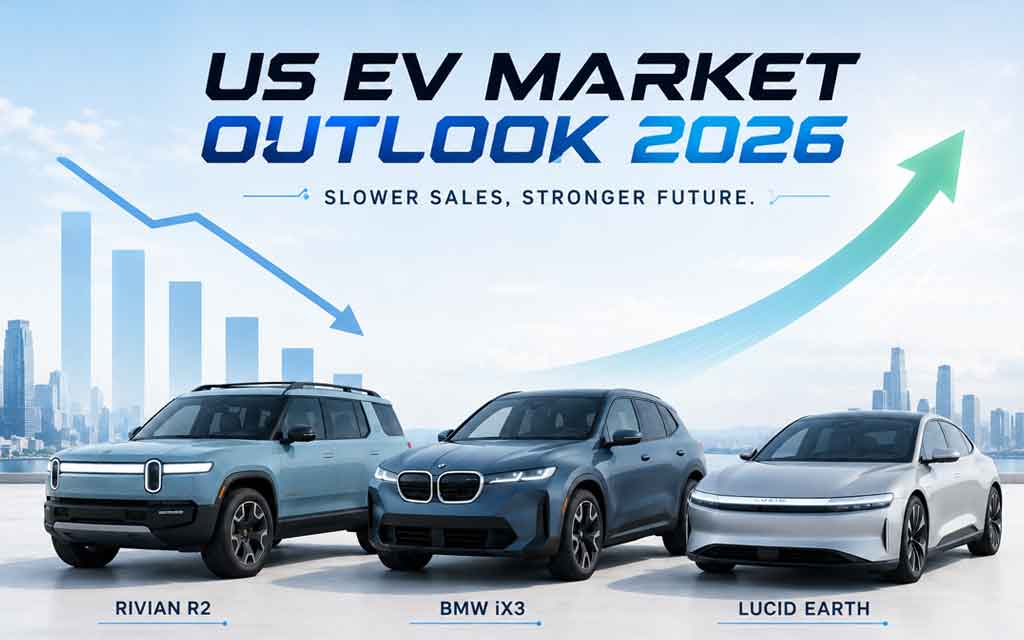
The US electric vehicle market is navigating a challenging phase in June 2026 following the expiration of federal EV tax credits in late 2025. While global EV sales are projected to hit nearly 23 million units (almost 30% of new car sales), the American market has cooled significantly, with Q1 2026 sales dropping around 27% year-over-year to approximately 216,000 units.
Despite the slowdown, major automakers are flooding the market with exciting new models, aiming to revive demand through better affordability, longer range, and superior technology.
Key EV Launches Dominating the US Market
- Rivian R2: Deliveries began in June 2026 for this more affordable midsize electric SUV. Priced to compete in the mass market, it offers over 300 miles of range and quick DC fast charging. The R2 is seen as critical for Rivian’s growth in the competitive US market.
- BMW iX3 and i3: BMW’s Neue Klasse platform models launched in summer 2026. The iX3 SUV and i3 sedan deliver up to 440 miles of range, 800V architecture for ultra-fast charging, and premium interiors with innovative displays. These are targeting luxury buyers in coastal and urban markets.
- Lucid Earth: Lucid’s more accessible midsize SUV is gaining traction, starting around $48,000. It brings the company’s efficient powertrain technology to a broader audience.
Other notable 2026 entries include refreshed Tesla Model Y variants, Hyundai Ioniq lineup updates, Mercedes and Porsche electric models, and the return of more affordable options like a new Chevrolet Bolt.
USA Market Impact Analysis
The end of the $7,500 federal tax credit has made price sensitivity a top concern for American buyers. Many consumers are shifting toward used EVs, which saw strong growth in early 2026 with average prices dropping near gasoline vehicle levels.
Key Trends in the US:
- Tesla continues to dominate with roughly 45-60% market share, though non-Tesla brands like Toyota bZ, Hyundai, and Rivian are gaining ground.
- Enterprise and fleet adoption remains strong in states like California, New York, and Texas, where additional state-level incentives and high fuel prices support EVs.
- Vehicle-to-Grid (V2G) technology and home charging solutions are becoming major selling points as Americans focus on long-term ownership costs.
Challenges & Opportunities: Higher interest rates and reduced incentives have slowed mass adoption, but improving battery tech and new affordable models under $40,000–$50,000 are expected to help recovery in H2 2026. States with strong EV infrastructure and rebates (California, Colorado, Washington) continue to outperform the national average.
This shift toward smarter, more efficient EVs without heavy subsidies could ultimately create a healthier, more sustainable US market. Early reviews suggest the 2026 wave of vehicles offers the best performance-value balance yet seen in America.
Leave a Comment