
Published: June 2, 2026 By VFuture Media Editorial Team
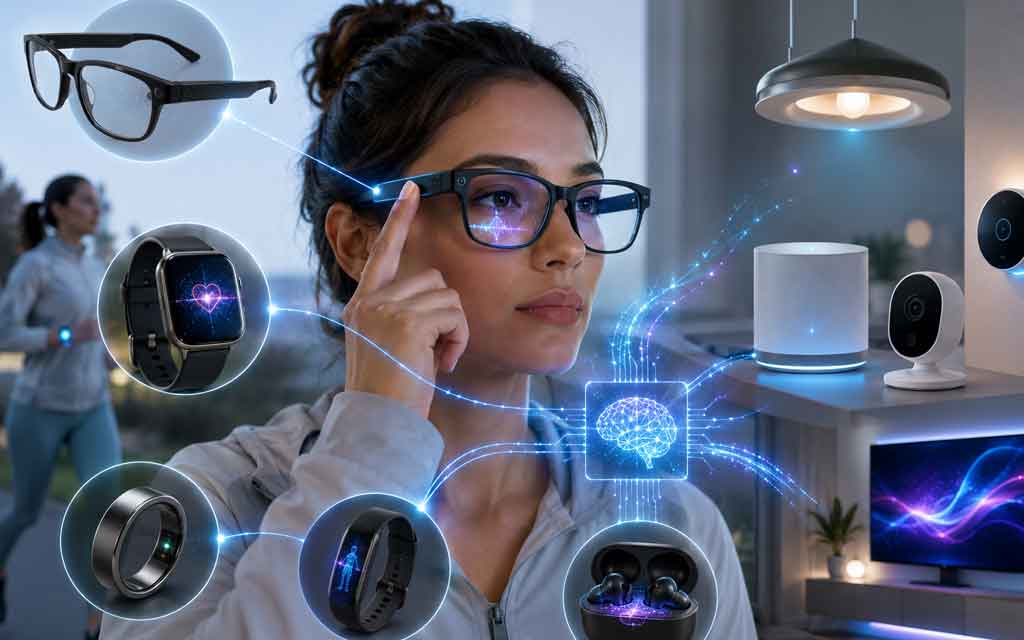
On-device AI — processing intelligence directly on the gadget instead of sending data to the cloud — has emerged as the biggest shift in consumer technology this year. It delivers faster responses, stronger privacy, offline functionality, and lower latency. In 2026, this technology is transforming wearables and smart homes, moving us from reactive devices to proactive, intelligent companions.
What is On-Device AI and Why Does It Matter in 2026?
On-device AI uses specialized neural processing units (NPUs) in chips like Qualcomm’s Snapdragon Wear Elite or mobile platforms to run AI models locally. This contrasts with cloud-dependent systems that require constant internet and raise privacy concerns.
Key Benefits:
- Near-zero latency — Instant responses for voice, health insights, or automation.
- Enhanced privacy — Sensitive data (health metrics, conversations, home footage) stays on your device.
- Offline reliability — Works without Wi-Fi.
- Better battery life — Optimized local processing reduces power-hungry cloud uploads.
- Lower long-term costs — No recurring cloud inference fees.
On-Device AI in Wearables: From Accessories to Autonomous Companions
2026 marks the year wearables truly became intelligent. Thanks to platforms like Qualcomm Snapdragon Wear Elite (with dedicated NPUs supporting up to 2-billion-parameter models), devices now handle complex tasks locally.
Major Transformations:
- Real-time Health & Wellness Coaching — Oura Ring Gen 4 and similar devices analyze sleep, stress, and vitals on-device for instant personalized insights without sharing raw data.
- Voice & Multimodal Assistants — Ray-Ban Meta Smart Glasses and Plaud NotePin use on-device models for transcription, summarization, translation, and visual search — even offline.
- Proactive Agentic Features — Wearables now anticipate needs: suggesting breaks, adjusting music based on heart rate, or creating action items from conversations automatically.
- Improved Battery & Privacy — Snapdragon Wear Elite delivers up to 30% better battery life while keeping processing local.
Devices like the Plaud NotePin S excel here, offering hours of recording with local AI summarization, making them ideal for professionals.
On-Device AI in Smart Homes: Faster, Smarter, More Private Automation
Smart homes in 2026 are shifting toward local intelligence via Matter standard, edge AI cameras, and hubs with on-device processing.
Key Changes:
- Instant Responsive Automation — Lights, thermostats, and security adjust immediately based on presence, voice, or patterns — no cloud delay.
- Advanced Security & Privacy — Cameras from brands like Aqara use on-device AI for object/person detection, reducing false alerts and keeping footage local.
- Energy Efficiency — Smart thermostats and appliances optimize usage in real-time without constant server pings.
- Agentic Home Intelligence — Systems learn habits and act proactively (e.g., preheating the oven or adjusting lighting based on your schedule).
Apple HomeKit stands out for strong local processing, while hybrid setups (local + selective cloud) are becoming the norm for complex analytics.
Head-to-Head: On-Device AI vs Cloud AI in Everyday Use
On-Device AI vs Cloud AI
Speed
- On-Device AI: Instant response with very low latency.
- Cloud AI: Depends on internet connectivity and server response times.
Privacy
- On-Device AI: High privacy since data remains on the device.
- Cloud AI: Lower privacy because data is transmitted to remote servers.
Offline Use
- On-Device AI: Excellent; works without an internet connection.
- Cloud AI: Limited or unavailable when offline.
Power Efficiency
- On-Device AI: More efficient for frequent, lightweight tasks.
- Cloud AI: Better suited for running large, complex AI models.
Best For
- On-Device AI: Wearables, smart home automation, real-time assistants, and edge computing.
- Cloud AI: Long-term pattern analysis, large-scale data processing, and advanced generative AI applications.
Most advanced setups in 2026 use a hybrid approach: on-device for speed/privacy and cloud for deeper insights.
Future Outlook for 2026 and Beyond
As NPUs become more powerful and models more efficient, expect:
- Fully standalone AI wearables that reduce smartphone dependency.
- Truly intelligent homes that anticipate needs with minimal user input.
- Greater adoption in health, security, and productivity.
Qualcomm, Apple, and others are heavily investing here, signaling that on-device AI is the foundation for the next decade of personal technology.
Stay Ahead with VFuture Media
At VFuture Media, we deliver in-depth coverage of AI gadgets, emerging tech trends, smart homes, and wearables shaping 2026.
Keywords: on-device AI 2026, on-device AI wearables, on-device AI smart homes, Snapdragon Wear Elite, AI privacy wearables, Matter standard local AI, best AI gadgets 2026, Ray-Ban Meta on-device AI


Leave a Comment