
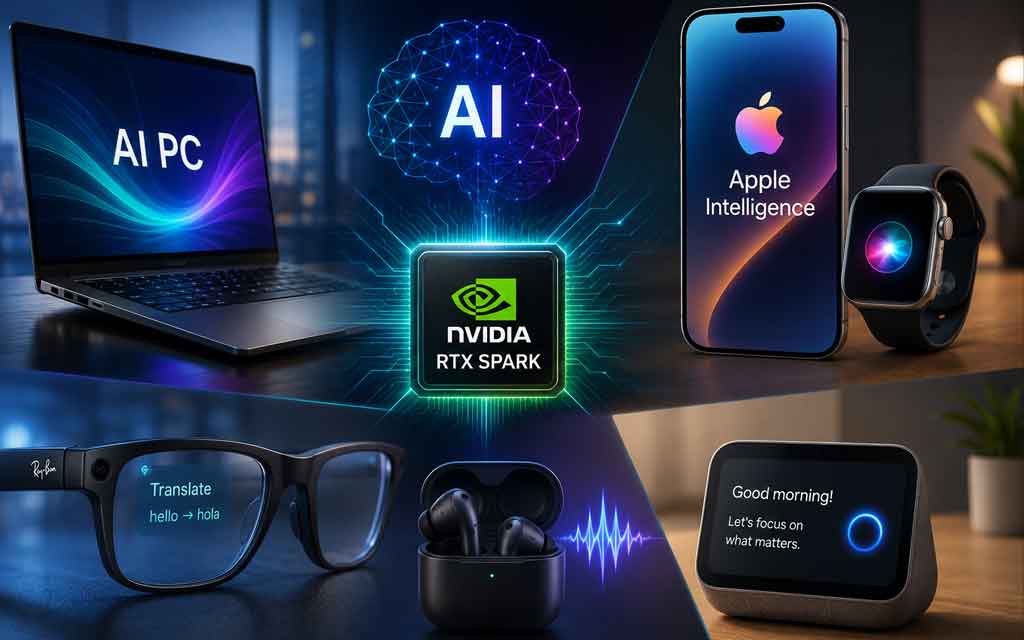
While Apple’s WWDC and Rivian’s R2 launch are grabbing major headlines, June 2026 is quietly delivering something even more foundational: the AI models and hardware that will power the next generation of everyday gadgets Americans will actually buy and use.
The biggest shift happening right now is not just new phones or cars — it’s the rapid movement of powerful frontier AI models into consumer devices through better on-device chips, hybrid cloud architectures, and specialized hardware. This month’s developments from Nvidia, Apple, and the leading AI labs signal that the “AI PC,” AI wearables, and truly useful personal agents are moving from concept to reality faster than most people expected.
The Current State of Frontier AI Models (Early June 2026)
The model race has never been this fast or specialized. We’ve moved past the question of “which model is smartest overall” to a more practical reality: different models now excel at different tasks, and hardware makers are choosing the best ones for specific devices and use cases.
Here’s where the top frontier models stand as of early June 2026:
Top Frontier AI Models (June 2026)
- Claude Opus 4.8 — Anthropic (May 28, 2026)
- Standout Strength: Agentic workflows, coding, and long-form writing
- Best For: Power users and developers
- Intelligence Index: 61.4 (Current #1)
- GPT-5.5 — OpenAI (April 23, 2026)
- Standout Strength: All-around performance, tool use, creativity, and ecosystem integration
- Best For: Everyday work, content creation, and professional tasks
- Intelligence Index: ~60.2
- Gemini 3.5 — Google (May 2026 updates)
- Standout Strength: Advanced reasoning and strong price-to-performance ratio
- Best For: Research, multimodal analysis, and enterprise applications
- Status: Strong contender among top-tier models
- Grok 4 / 4.3 — xAI (May 2026)
- Standout Strength: Real-time information access and coding assistance
- Best For: Live trends, technical research, and developer workflows
- Status: Top-tier frontier AI model
Key takeaway: Claude 4.8 currently leads in reliable agentic behavior (multi-step reasoning and tool use). GPT-5.5 remains the most versatile daily driver for most people. Gemini continues to win on value and multimodal strength. Grok stands out for real-time information and developer-friendly coding performance.
This specialization matters because the gadgets coming later this year will be optimized around specific models — or hybrid combinations of them.
Nvidia Just Entered the Consumer PC Market — And It Changes Everything
The biggest hardware story of early June came from Computex 2026 in Taipei. Nvidia announced the RTX Spark — its first serious consumer PC chip (a CPU + GPU superchip) designed specifically for AI PCs.
This is a major strategic move. Nvidia has long dominated AI training and data center GPUs. Now it is directly targeting the consumer and professional laptop/desktop market with silicon built from the ground up for running powerful AI agents locally.
Why RTX Spark Matters for American Buyers
- Brings high-performance local/on-device AI to Windows laptops and desktops from Dell, Lenovo, HP, Microsoft Surface, and others.
- Expected to launch in fall 2026.
- Focuses on running AI agents privately and instantly on your device instead of sending everything to the cloud.
- Nvidia CEO Jensen Huang called it “the new PC.”
For U.S. consumers and businesses, this means:
- Much faster local AI performance with no internet lag.
- Better privacy (sensitive data stays on your device).
- New laptop buying decisions coming later this year.
- Significantly more powerful AI features in everyday tools — file search, email drafting, coding assistants, photo/video editing, and personal agents — all running locally.
This directly challenges Intel, AMD, Qualcomm, and even Apple’s current dominance in the AI PC space. The era of “AI PCs” is no longer just marketing — it’s becoming a real hardware battleground.
Apple’s On-Device AI Strategy at WWDC 2026
At WWDC (June 8), Apple isn’t just upgrading Siri — it’s doubling down on efficient on-device AI while using powerful cloud models when needed.
The new Siri and broader Apple Intelligence features are expected to combine:
- Advanced cloud models (reportedly a custom version of Google’s Gemini for heavy reasoning).
- Highly optimized on-device inference on the A18 and upcoming A19 chips (iPhone 16 and 17 series).
This hybrid approach is Apple’s signature strategy: deliver powerful reasoning when you need it, while keeping fast, private, and always-available AI running directly on your device. Many existing iPhones will receive meaningful AI upgrades without requiring new hardware.
The result for users should be a much smarter Siri that can see what’s on your screen, maintain personal context, and handle multi-step tasks — all while respecting Apple’s strong privacy positioning.
The Bigger Gadget Trend: AI Is Moving to Your Face and Desk
Beyond phones and laptops, June 2026 highlights the accelerating shift toward AI-native wearables and personal devices:
- AI smart glasses — Meta’s Ray-Ban updates and multiple third-party options now offer real-time translation, visual intelligence, and contextual assistance.
- Next-gen AI earbuds — Devices with contextual awareness that understand what you’re doing and can respond intelligently without you pulling out your phone.
- Ambient desktop AI companions — Early signs of always-on AI assistants that live on your desk or in your workspace and proactively help with tasks.
The common thread across all these devices is that they only become truly useful when backed by the latest frontier models (Claude 4.8, GPT-5.5, Gemini 3.5) running efficiently — either locally on powerful new chips like Nvidia’s RTX Spark or through smart hybrid cloud + on-device architectures.
Why This Matters for U.S. Readers Right Now
June 2026 is shaping up as a pivotal month for anyone thinking about their next tech purchase or how they’ll work and live with AI in the second half of the year.
For laptop buyers If you want maximum local AI performance and privacy, it may be worth waiting for fall 2026 RTX Spark-powered AI PCs rather than buying now.
For iPhone users WWDC will demonstrate how much smarter your current device can become through software updates. Many people won’t need to upgrade hardware immediately.
For professionals and creators The gap between “good enough” AI and truly transformative AI is closing quickly — especially for coding, research, writing, and complex agentic workflows.
For privacy-conscious users The big battle right now is on-device vs. cloud. June’s announcements from both Nvidia and Apple show that both paths are advancing rapidly. You’ll increasingly have real choices about where your data is processed.
The Bottom Line
June 2026 isn’t just about flashy new phones or electric vehicles. It’s the month when the best frontier AI models started seriously shipping inside the actual gadgets Americans will buy and use daily in the second half of the year.
Nvidia’s entry into consumer AI PCs, Apple’s hybrid on-device strategy, and the rapid specialization of models like Claude 4.8 and GPT-5.5 are creating the foundation for a new generation of intelligent, private, and useful devices — from laptops and phones to glasses and earbuds.
The AI revolution is moving from the cloud into your pocket, your desk, and eventually onto your face. The gadgets that win will be the ones that combine the smartest models with efficient hardware and thoughtful user experiences.
For American consumers and professionals, the decisions you make about your next laptop, phone, or wearable in the coming months will increasingly be decisions about which AI ecosystem you want to live inside.
FAQs
What is Nvidia RTX Spark? Nvidia’s new consumer PC chip (CPU + GPU superchip) designed specifically for running powerful AI agents locally on Windows laptops and desktops. It is expected to launch in fall 2026.
How does Apple’s AI strategy differ from Nvidia’s? Apple is using a hybrid approach — powerful cloud models (reportedly custom Gemini) combined with highly optimized on-device processing on its A-series chips. Nvidia is pushing for more powerful fully local AI on Windows PCs.
Which frontier AI model is currently the best? It depends on the task. Claude Opus 4.8 leads in agentic workflows and coding. GPT-5.5 is the strongest all-rounder for most people. Gemini excels at value and multimodal tasks.
Should I wait to buy a new laptop? If you care about strong local AI performance and privacy, waiting for RTX Spark-powered machines in fall 2026 could be worthwhile. Otherwise, current AI PCs are already quite capable.
What are AI smart glasses and why do they matter? These are wearable glasses (like updated Meta Ray-Bans) with cameras and AI that can provide real-time visual intelligence, translation, navigation help, and contextual information hands-free.
Will these new AI features require new hardware? Many Apple Intelligence features will work on existing iPhones. However, the most advanced on-device AI experiences (and full RTX Spark capabilities) will benefit significantly from newer hardware.
How will this affect everyday users? Expect much smarter personal assistants, better local search and organization, more helpful creative tools, and AI that can actually complete multi-step tasks for you — all while giving you more control over privacy.

Leave a Comment