
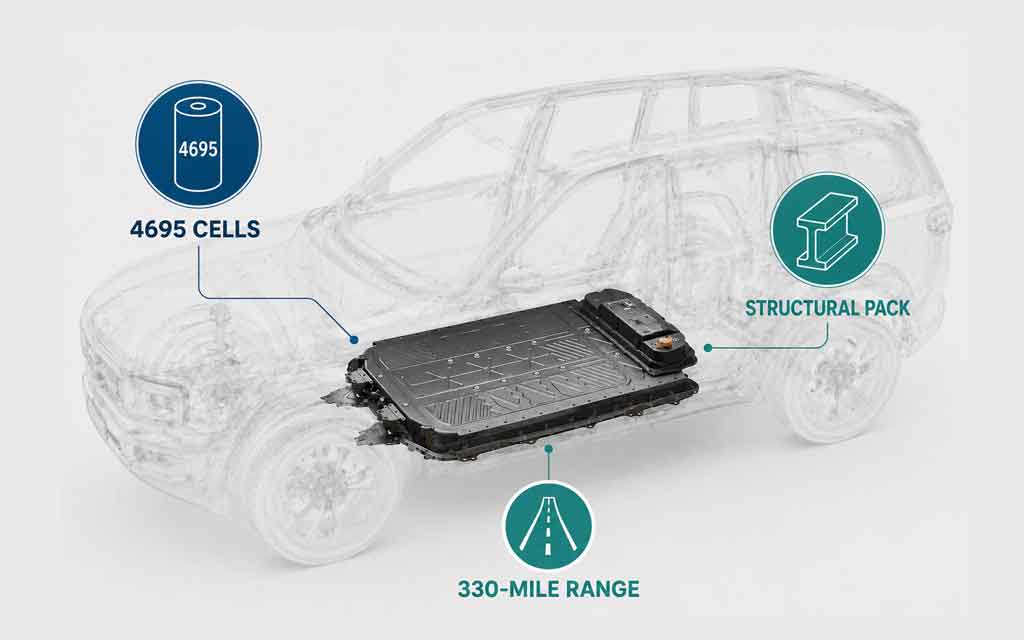
The Rivian R2 introduces a completely new battery architecture compared to the R1 platform. It focuses on simplification, cost reduction, and structural integration while maintaining strong range and performance for a midsize adventure SUV.
1. Battery Cell Technology
- Cell Format: 4695 cylindrical cells (46 mm diameter × 95 mm height)
- Supplier: LG Energy Solutions
- Chemistry: NCA (Nickel Cobalt Aluminum)
The 4695 cell is slightly larger (taller) than Tesla’s 4680 cells. Rivian chose this format to increase energy per cell, reduce the total number of cells, and lower manufacturing complexity and cost.
Key Advantages of 4695 Cells in R2:
- Higher energy density per cell
- Fewer cells overall → simpler pack design and assembly
- Better cost efficiency than the multi-module approach used in the R1
2. Battery Pack Design & Architecture
The R2 uses a structural battery pack — the battery itself contributes to the vehicle’s rigidity (similar in concept to Tesla’s structural packs but executed differently).
Pack Specifications:
- Number of modules: Only 3 large modules (major simplification vs. R1)
- Total cells: 768 cells (256 cells per module)
- Architecture: 400V system (not 800V)
- Pack weight: Approximately 541 kg
- Pack volume: 394 liters
- Pack-level energy density: 167 Wh/kg (excellent for a structural pack)
This design dramatically reduces complexity — nearly 10× fewer cells than the R1 platform — which helps lower cost and improve manufacturability.
3. Battery Capacity
Large / Long Range Battery Pack
- Nominal Capacity: ~86.8–95 kWh
- Usable Capacity (EPA): 87.9–88.67 kWh
- Expected EPA Range: Up to 330–335 miles
- Availability: Performance and Premium trims (2026)
Standard Battery Pack
- Nominal Capacity: ~65–75 kWh
- Usable Capacity (EPA): Not fully confirmed
- Expected EPA Range: Lower than Long Range pack
- Availability: Expected in 2027
- The Large pack is the one currently in production for early R2 deliveries.
- The smaller Standard pack will arrive later with more affordable trims.
4. Charging Performance
- DC Fast Charging: 10–80% in approximately 29–30 minutes
- Peak charging power: Around 210 kW
- AC Charging: Up to 48A (11.5 kW) onboard
Even though Rivian stayed with a 400V architecture (instead of moving to 800V), they achieved competitive charging times through improved cell chemistry, better thermal management, and pack design optimizations. CEO RJ Scaringe has stated that 800V is “not as critical” for the R2’s size and price positioning.
5. Thermal Management
- Liquid-cooled system with a refrigerant-cooled chiller
- In-line heating element for cold-weather performance
- Improved thermal capabilities compared to the R1 in early feedback
6. Battery Warranty & Longevity
- Warranty: 8 years or 150,000 miles (whichever comes first)
- Self-discharge rate: Less than 4% per month (estimated)
- Rivian plans second-life applications and recycling programs for end-of-life batteries
7. Comparison: R2 vs R1 Battery Approach
| Aspect | Rivian R1 | Rivian R2 | Improvement |
|---|---|---|---|
| Cell Format | Smaller cylindrical/pouch | 4695 cylindrical | Larger cells, fewer total |
| Number of Cells | Several thousand | 768 | ~10× reduction |
| Modules | Many small modules | 3 large structural modules | Much simpler |
| Architecture | 400V | 400V | Same (cost-focused) |
| Structural Integration | Limited | Full structural pack | Better rigidity & efficiency |
| Manufacturing Complexity | High | Significantly lower | Major cost advantage |
Summary: Why Rivian Chose This Battery Tech for the R2
Rivian’s strategy with the R2 battery is clear:
- Prioritize cost reduction and simpler manufacturing to hit a lower price point (~$45K–$60K range)
- Use larger 4695 NCA cells from LG for better energy density and fewer parts
- Keep a 400V architecture to control costs while still delivering competitive charging
- Leverage a structural pack for vehicle rigidity and weight savings
- Focus on real-world usability (range + charging speed) rather than chasing the highest voltage architecture
This approach makes the R2 more scalable and profitable while still offering up to ~330+ miles of range in top trims.

Leave a Comment