
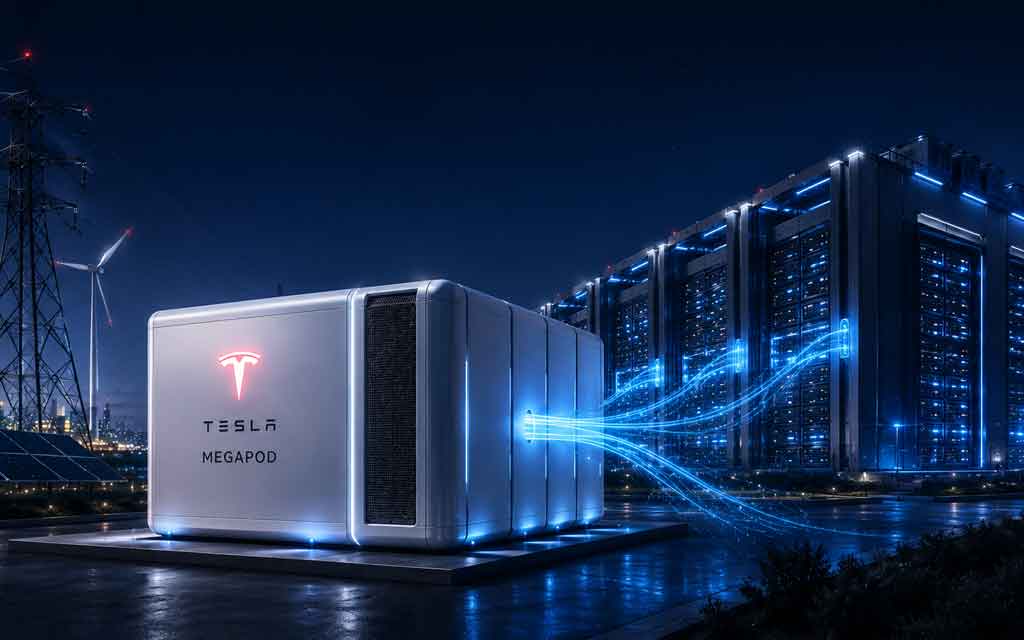
Tesla has filed a U.S. trademark application for “MEGAPOD” — described as modular data center hardware systems for artificial intelligence computing. The filing covers self-contained units that include AI servers, specialized hardware for AI data processing, networking equipment, power distribution, and cooling systems.
This is not just another trademark. It points to a deliberate strategy from Elon Musk and Tesla to address one of the biggest bottlenecks in the current AI boom: electricity and infrastructure.
The Core Problem Musk Is Solving
Musk has repeatedly stated that the primary constraint on scaling AI is no longer chips or algorithms — it is power. Building massive centralized AI data centers requires enormous amounts of electricity, long permitting timelines, and huge capital investment. Many projects are delayed or scaled back because of grid limitations.
Tesla’s Megapod concept aims to bypass much of this friction by creating modular, deployable AI compute units that can be placed where power infrastructure already exists.
What Is Megapod?
From the trademark description, a Megapod is essentially a containerized or modular AI data center in a box (or series of boxes). It integrates:
- High-performance AI servers and accelerators
- Networking equipment
- Power distribution systems
- Cooling infrastructure
The goal is to offer a turnkey, scalable unit that companies (or Tesla itself) can deploy much faster than traditional data center construction.
This approach mirrors what Tesla already does successfully with Megapack — large-scale, modular energy storage that can be deployed in months rather than years.
Elon Musk’s Megapod Strategy Explained
Musk’s thinking appears to combine several of Tesla’s existing strengths:
1. Leverage the Supercharger Network as Distributed Compute Infrastructure Tesla already has thousands of Supercharger sites worldwide with significant grid connections and power capacity. Many of these sites have spare capacity outside peak charging hours. Instead of building brand-new data centers from scratch, Tesla can place Megapods at existing locations that already have grid access. This dramatically reduces deployment time and cost.
2. Solve the Power Bottleneck with Tesla Energy Products AI workloads create massive, spiky power demands. Megapods would likely be paired with Megapack battery systems to:
- Smooth out power spikes
- Provide backup during outages
- Enable peak shaving and grid services
- Potentially store cheap off-peak electricity for AI compute
This creates a tightly integrated energy + compute solution.
3. Shift from Centralized to Distributed / Edge AI Compute Traditional hyperscale data centers are centralized and often located far from users. Megapods enable edge computing — placing AI processing power closer to where data is generated or needed (factories, cities, research facilities, or even vehicle fleets). This reduces latency and transmission costs for certain workloads.
4. Create a New Hardware + Services Business Tesla could sell or lease Megapods as physical products (similar to how it sells Megapacks and Solar). It could also offer software for monitoring and optimizing these AI systems, and potentially provide compute capacity as a service. This opens an entirely new revenue stream beyond cars and energy.
5. Support Tesla’s Own AI Ambitions Tesla needs enormous compute for:
- Training and improving Full Self-Driving (FSD)
- Developing Optimus humanoid robots
- Running inference at scale
Megapods could give Tesla more flexible, faster-to-deploy compute capacity while also generating external revenue.
Strategic Advantages Musk Is Betting On
- Speed: Modular units can be manufactured and deployed much faster than traditional data centers.
- Scalability: Start small and expand by adding more Megapods as demand grows.
- Capital Efficiency: Use existing Supercharger grid connections instead of fighting for new high-power grid interconnections.
- Synergy: Combines Tesla’s strengths in vehicles, energy storage, AI hardware (Dojo/AI5 chips), and software.
- Defensibility: Hard for competitors to replicate the combination of widespread physical infrastructure + energy expertise + AI chips.
Potential Challenges
While the strategy is ambitious, it faces hurdles:
- Technical complexity of integrating high-density AI servers with mobile or semi-mobile power and cooling
- Regulatory and grid operator approval for using charging sites for compute
- Competition from established players already building massive AI data centers
- Whether demand exists for modular AI hardware versus traditional centralized facilities
Bottom Line: Musk’s Bigger Vision
The Megapod trademark is another signal that Tesla is positioning itself as a full-stack AI infrastructure company — not just a car or energy company. Musk’s strategy appears to be:
Use Tesla’s existing physical footprint and energy expertise to solve the power problem that is currently limiting AI growth, while creating a new, high-margin hardware and services business in the process.
By turning underutilized Supercharger sites into distributed AI compute nodes and packaging everything into modular, rapidly deployable units, Tesla aims to move faster and more flexibly than traditional data center builders.
This fits Musk’s long-term pattern: take an existing constraint (in this case, power and infrastructure for AI), leverage Tesla’s unique assets (Superchargers + Megapacks + AI chips), and turn it into both a solution for the industry and a new business opportunity.




Leave a Comment