
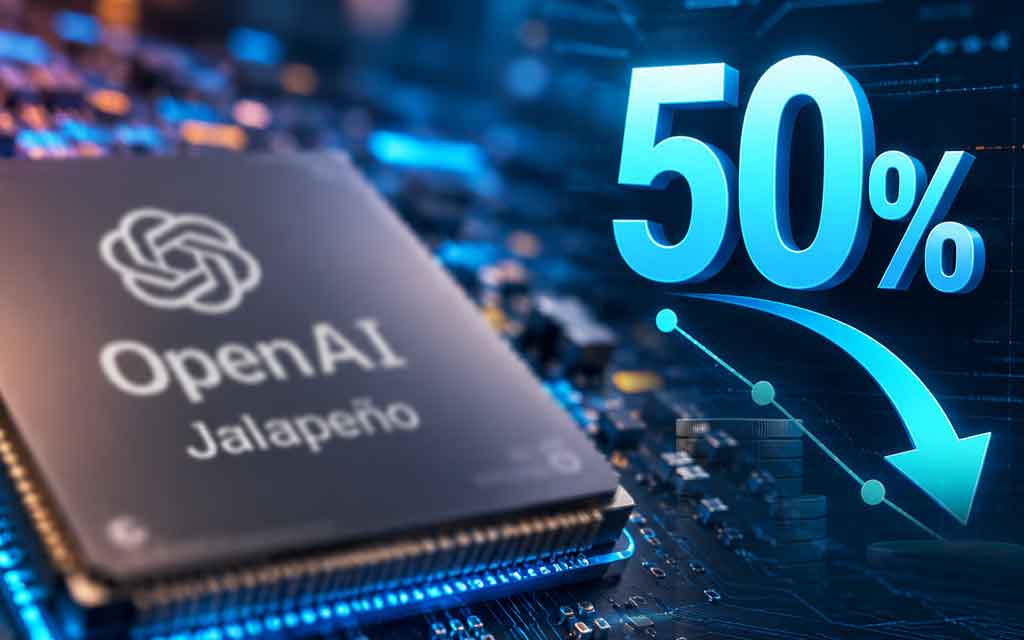
In the heart of America’s tech renaissance, OpenAI has just dropped a bombshell that could reshape the entire artificial intelligence landscape: its first custom-designed AI chip, codenamed Jalapeño. Developed in close partnership with semiconductor giant Broadcom, this inference-focused processor promises dramatically lower costs, faster performance, and greater efficiency for powering the next generation of AI applications that millions of Americans rely on daily — from smarter ChatGPT responses to enterprise tools driving productivity across industries.
As an international technology journalist tracking US innovation, I’ve followed the AI arms race closely. This move isn’t just another hardware upgrade — it’s a strategic masterstroke reinforcing American leadership in AI at a time when compute costs and energy demands threaten to slow progress. Jalapeño signals a new era where US companies control not only the software models but also the specialized silicon running them, reducing reliance on foreign supply chains and accelerating the AI-powered future for everyday Americans.
The Birth of Jalapeño: American Ingenuity Meets Cutting-Edge Collaboration
OpenAI unveiled Jalapeño on June 24, 2026, marking the company’s first foray into custom AI hardware. Engineers at OpenAI designed the chip specifically for inference — the critical phase where trained AI models process new data to generate responses, predictions, or actions. Unlike training (which builds the model), inference powers real-world usage like answering your queries, generating code, or analyzing images in real time.
Working hand-in-hand with Broadcom, OpenAI leveraged its own AI models to optimize the chip’s architecture. Early samples are already in testing, with full deployment ramps planned as part of a massive 10-gigawatt custom AI accelerator initiative targeting completion by the end of 2029. Reports indicate Jalapeño delivers up to 50% lower costs compared to traditional off-the-shelf solutions while maintaining or exceeding performance for OpenAI’s workloads.
This collaboration builds on Broadcom’s expertise in custom ASICs (Application-Specific Integrated Circuits) for hyperscalers. OpenAI joins the likes of Google, Meta, and others in designing tailored silicon, but with a laser focus on making advanced AI more affordable and scalable for the US market and beyond.
Key Technical Highlights (Projected/Announced):
- Optimized for large language model inference
- Significant power efficiency gains, crucial for data center sustainability
- Integration with existing OpenAI infrastructure for seamless scaling
- Potential for broader ecosystem availability through Broadcom partnerships
Why Inference Matters: The Hidden Engine of Everyday AI
Most public discussion around AI focuses on flashy training runs and massive GPU clusters from NVIDIA. But inference is where the rubber meets the road for consumers and businesses. Every ChatGPT conversation, every AI-assisted email draft, every recommendation engine — these run on inference hardware.
Jalapeño addresses the skyrocketing demand for inference compute. As AI adoption explodes in the US — in healthcare diagnostics, personalized education, autonomous driving assistance, and creative tools — the cost of running these models has become a bottleneck. By bringing custom silicon in-house, OpenAI aims to slash operational expenses, pass savings to users (potentially through lower API pricing), and maintain its competitive edge.
Analysts project this could accelerate AI deployment across American industries. Smaller businesses, startups, and even individual developers gain access to more powerful tools without prohibitive cloud bills. For the average American worker, this translates to AI assistants that are faster, more reliable, and more capable of handling complex tasks — boosting productivity in offices, factories, and homes nationwide.
Economic and Strategic Impact: Strengthening US AI Dominance
In the broader context of US technology policy, Jalapeño arrives at a pivotal moment. The Trump administration’s recent Executive Order on Promoting Advanced Artificial Intelligence Innovation and Security emphasizes light-touch regulation and innovation acceleration while addressing security needs. OpenAI’s hardware push aligns perfectly — demonstrating private-sector leadership that complements national goals of maintaining America’s edge over global competitors.
Cost and Efficiency Advantages:
- Up to 50% reduction in inference costs
- Better energy efficiency → lower electricity demands for data centers
- Reduced dependency on imported components
This has ripple effects across the US economy. Data centers, already booming in states like Texas, Virginia, and Arizona, become more viable and sustainable. Jobs in semiconductor design, manufacturing, and AI engineering get a boost. Investors are watching closely: Broadcom shares reacted positively to the announcement, and the news reinforces confidence in the AI infrastructure buildout.
Comparison with Existing Solutions
| Aspect | Traditional GPUs (e.g., NVIDIA) | OpenAI Jalapeño (Projected) |
|---|---|---|
| Primary Focus | Training + Inference | Optimized Inference |
| Cost Efficiency | Higher for high-volume inference | Up to 50% lower |
| Power Consumption | Higher | Significantly improved |
| Customization | General-purpose | Tailored for OpenAI models |
| Scalability | Excellent | Designed for massive deployment |
While NVIDIA remains the king of versatile AI accelerators, specialized chips like Jalapeño excel in targeted workloads. This “best tool for the job” approach is classic American innovation — pragmatic, efficient, and results-driven.
Challenges and the Road Ahead
No breakthrough is without hurdles. Custom chip development is expensive and time-intensive. Integration, yield rates, and ensuring security against potential vulnerabilities will require ongoing vigilance. OpenAI must also navigate the complex global supply chain, though US-focused partnerships help mitigate risks.
Energy consumption remains a key concern for the entire industry. Jalapeño’s efficiency gains are promising, but the sheer scale of AI deployment will demand continued advances in renewable energy and grid modernization — areas where US green tech innovation is also surging.
Looking forward, expect more custom silicon announcements from US players. This hardware-software co-design trend (pioneered effectively by companies like Apple) is now fully embraced in the AI sector, positioning America to lead for years to come.
What This Means for American Innovators and Consumers
For tech enthusiasts and professionals in the US:
- Developers: Cheaper, faster API access means more ambitious projects.
- Businesses: AI integration becomes more cost-effective, leveling the playing field.
- Everyday Users: Smarter, more responsive AI tools in apps, search, productivity software, and entertainment.
- Investors: Strong validation for the AI infrastructure thesis.
Jalapeño embodies the spirit of American ingenuity — bold collaboration between trailblazing startups and established tech leaders to solve real problems and create new opportunities.
FAQs About OpenAI’s Jalapeño Chip
Q: When will Jalapeño power public OpenAI services? A: Testing is underway; broader rollout is expected as part of the multi-year deployment plan, with initial benefits possibly appearing in late 2026 or 2027.
Q: Will this make ChatGPT cheaper or faster? A: Likely yes on both fronts over time, as inference costs drop significantly.
Q: How does this affect competition with other AI companies? A: It gives OpenAI a hardware advantage in efficiency, pressuring rivals to innovate similarly.
Q: Is this good news for US jobs? A: Yes — in design, manufacturing partnerships, data centers, and AI application development.
The Future Is Silicon-Powered American Innovation
OpenAI’s Jalapeño chip isn’t just hardware — it’s a statement. In 2026, the United States continues to lead the world not by restricting technology, but by unleashing it through smart engineering and strategic partnerships. As AI becomes as fundamental as electricity to modern life, innovations like this ensure that American ingenuity remains at the forefront, delivering tools that empower people, grow the economy, and secure the nation’s technological future.
The Jalapeño is spicy indeed — and America’s AI kitchen is cooking up something revolutionary. Stay tuned as this story unfolds; the best is yet to come.




Leave a Comment